







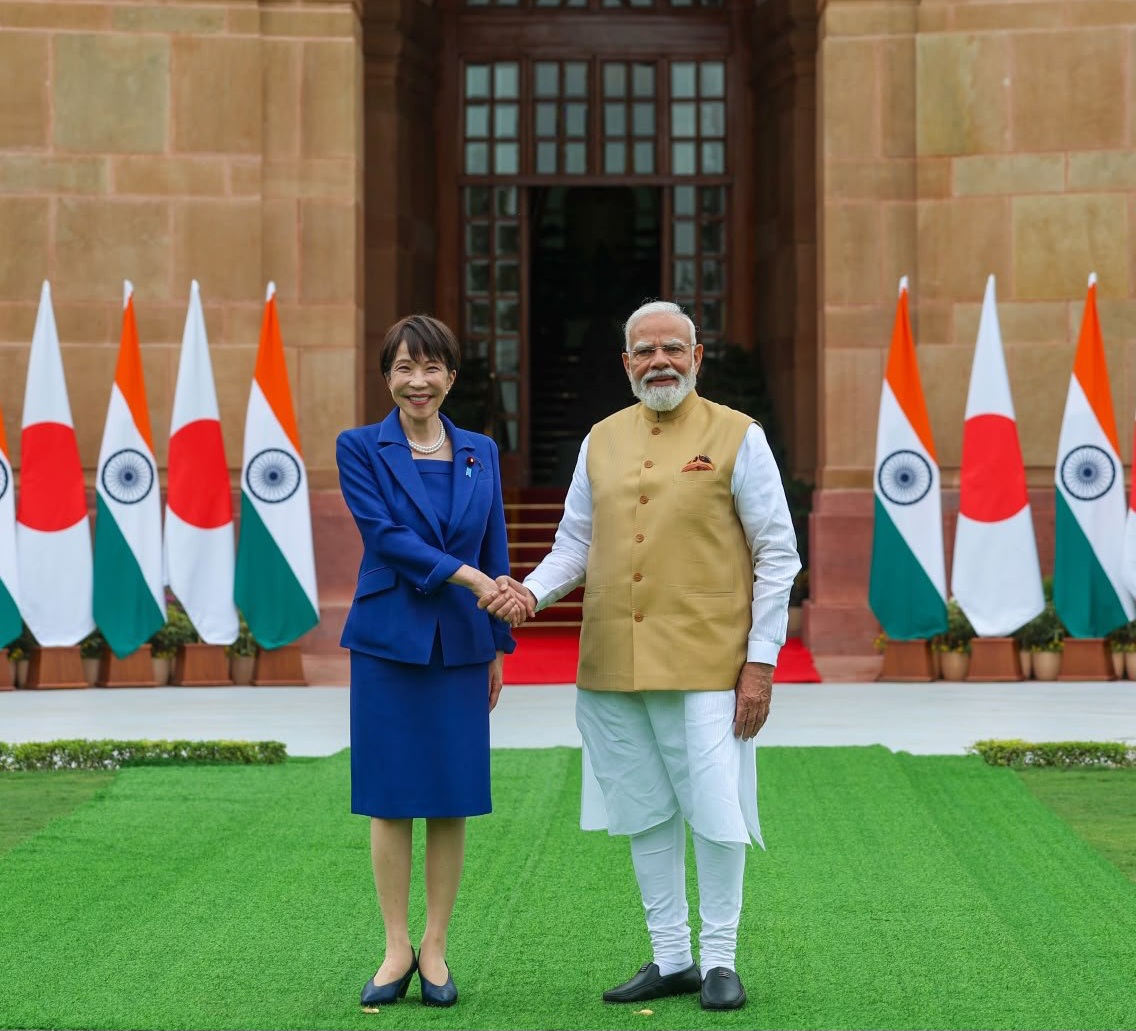
India and Japan on Thursday unveiled an ambitious roadmap to further strengthen their Special Strategic and Global Partnership, with Prime Minister Narendra Modi and Japanese Prime Minister Sanae Takaichi agreeing to deepen cooperation in defence, economic security, artificial intelligence (AI), clean energy, high-speed rail, resilient supply chains and people-to-people exchanges.
Following the 16th India-Japan Annual Summit in New Delhi, the two leaders reaffirmed their commitment to advancing bilateral ties based on three priority pillars — defence and security cooperation; economic partnership, including economic security, energy resilience, technology and innovation; and stronger people-to-people exchanges. They said a stronger India-Japan partnership would contribute to a free, open, resilient and prosperous Indo-Pacific amid an increasingly uncertain global geopolitical environment.
The two Prime Ministers welcomed the growing momentum in defence cooperation and directed their Ministers to hold the fourth India-Japan 2+2 Ministerial Meeting in Tokyo by the end of this year. They agreed to expand maritime security cooperation through enhanced military exercises, maritime domain awareness, naval maintenance, repair and overhaul (MRO), and collaboration in defence equipment and technology under the ‘Make in India’ framework. India also welcomed Japan’s review of its defence equipment transfer principles, while both sides expressed satisfaction over reaching an agreement in principle on the remaining technical aspects of the UNICORN communication antenna project.
Recognising emerging geopolitical and supply chain challenges, India and Japan adopted a Joint Declaration on Economic Security Cooperation, aimed at strengthening collaboration in semiconductors, critical minerals, information and communication technology, clean energy and pharmaceuticals. The two countries also pledged to promote resilient and diversified supply chains, oppose economic coercion and arbitrary export restrictions, and facilitate high-technology trade while easing export control challenges.
The leaders adopted a Joint Statement on AI Cooperation, reaffirming their commitment to develop trusted, resilient and inclusive artificial intelligence ecosystems. They agreed to enhance cooperation on AI research, digital infrastructure and innovation while ensuring trustworthy AI development in line with the Hiroshima AI Process and the New Delhi Declaration on AI Impact. The inaugural India-Japan AI Strategic Dialogue was also welcomed as a key step in advancing bilateral cooperation.
On energy, both countries adopted a Joint Statement on Energy Resilience and agreed to expand cooperation across the energy value chain, including strategic petroleum reserves, clean ammonia, green hydrogen, solar technologies and nuclear energy. Japan also reaffirmed its support for India’s membership of the International Energy Agency (IEA). The two sides launched the India-Japan Cooperative Biogas for Growth Initiative to support India’s target of establishing 1,000 biogas and organic fertiliser plants across the country.
The leaders welcomed growing Japanese investments in India and reiterated their commitment to achieving the 10 trillion yen investment target. They agreed to accelerate the review of the India-Japan Comprehensive Economic Partnership Agreement (CEPA), strengthen financial cooperation, promote local currency transactions, and enhance collaboration in logistics, textiles, food processing, agriculture, healthcare, automobiles and industrial capital goods. They also welcomed the launch of the India-Japan SME Forum and pledged greater support for startups, MSMEs and industrial partnerships.
Prime Minister Modi and Prime Minister Takaichi reaffirmed their commitment to the Mumbai-Ahmedabad High-Speed Rail project, with Japan expressing full support for India’s target of commencing commercial operations on priority sections in 2027. The two leaders also agreed to explore cooperation on future high-speed rail corridors and signed a Memorandum of Cooperation on the Next-Generation Mobility Partnership.
Science and technology cooperation also featured prominently, with both leaders welcoming progress on the joint Lunar Polar Exploration (LUPEX) mission, expanding collaboration in quantum technologies, academic research and student exchanges. They also agreed to promote Japanese language education in India and expand cultural exchanges, tourism and cooperation in creative industries such as anime, manga, gaming and films.
On regional and global issues, the two leaders reaffirmed their commitment to a free and open Indo-Pacific, stronger cooperation under the Quad, support for ASEAN centrality, and collaboration in India’s Northeast. They expressed serious concern over developments in the East and South China Seas, called for peaceful resolution of maritime disputes in accordance with international law, and reiterated support for freedom of navigation.
The joint statement also expressed concern over North Korea’s nuclear and missile programmes, the situation in Myanmar, the Middle East and Ukraine, while reaffirming support for reform of the UN Security Council, including India’s and Japan’s aspirations for permanent membership.
Condemning terrorism in all its forms, the two Prime Ministers strongly denounced cross-border terrorism from Pakistan. They condemned the April 22, 2025 terror attack in Pahalgam and the November 10, 2025 terror incident in Delhi, called for the perpetrators to be brought to justice, and urged concerted global action against UN-designated terrorist organisations, including Al Qaeda, ISIS/Daesh, Lashkar-e-Tayyiba and Jaish-e-Mohammed, along with their proxies.
Prime Minister Takaichi invited Prime Minister Modi to visit Japan next year for the 17th India-Japan Annual Summit, an invitation that the Indian Prime Minister accepted. The two leaders also renewed their commitment to strengthening bilateral ties as both countries celebrate 75 years of diplomatic relations under the India-Japan Year of Shared Horizons.


