







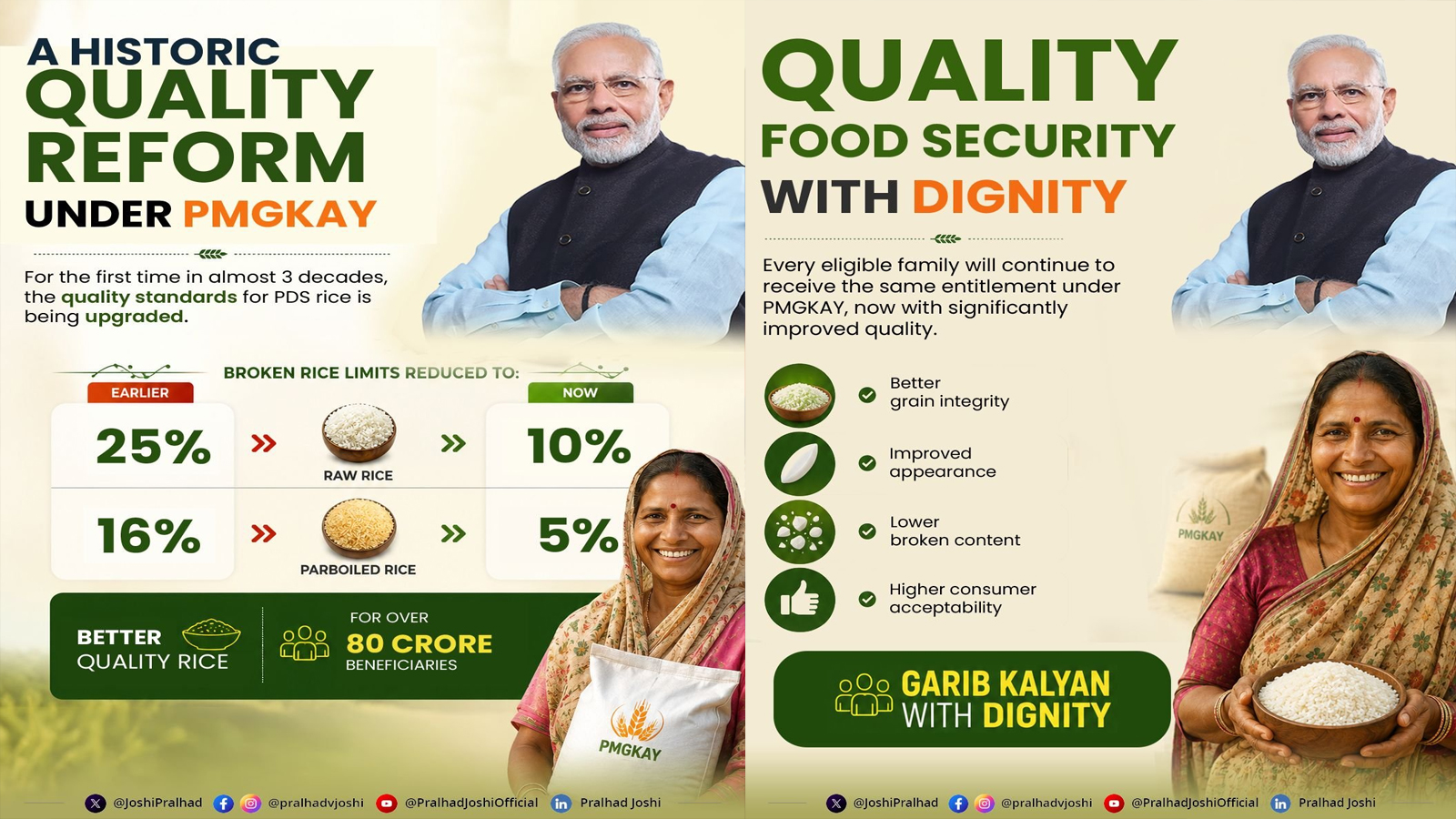
The Cabinet Committee on Economic Affairs (CCEA) has approved a major reform to improve the quality of rice distributed under the Pradhan Mantri Garib Kalyan Anna Yojana (PMGKAY) and other welfare schemes, paving the way for over 80 crore beneficiaries to receive rice with significantly lower broken grain content.
The decision marks the first revision in nearly three decades to the quality specifications of rice supplied through the Public Distribution System (PDS). Under the new policy, the permissible broken grain content in raw rice has been reduced from the existing 25 per cent to 10 per cent, while the limit for parboiled rice has been lowered from 16 per cent to 5 per cent.
The Ministry of Consumer Affairs, Food & Public Distribution said procurement of improved-quality rice will begin immediately and will be implemented across all procuring states in a phased manner by the Kharif Marketing Season (KMS) 2027-28. Distribution under PMGKAY and other welfare schemes will also be rolled out gradually to ensure a smooth transition across the country.
The Ministry said the move is aimed at improving the quality of food grains supplied under the food security programme without altering the quantity of rice beneficiaries receive. The improved specifications are expected to enhance grain integrity, appearance and overall consumer acceptability.
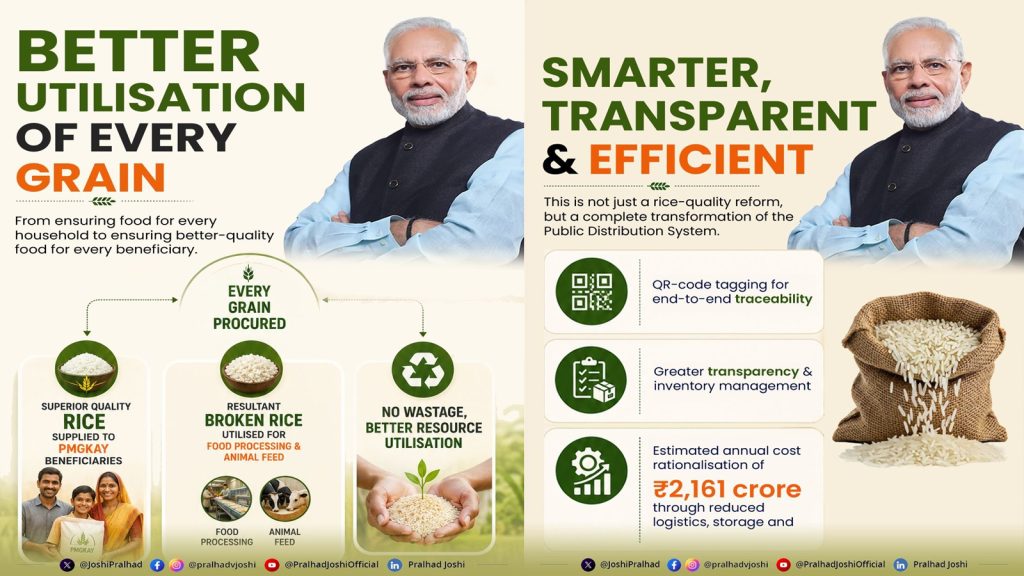
The revised policy also provides for the productive utilisation of broken rice generated during milling. Instead of being mixed with edible rice, the separated broken rice will be diverted for industrial and other permitted uses, ensuring that higher-quality rice reaches beneficiaries.
The reform is also expected to improve operational efficiency and reduce costs. The government estimates annual savings of around ₹2,161 crore through rationalisation of transportation, storage and packaging expenses. Broken rice will be auctioned directly from millers’ premises, while its storage in HDPE bags instead of jute sacks is expected to further reduce logistics costs. Revenue generated from the sale of broken rice will also help lower the overall food subsidy burden.
The proposal has already been tested through pilot projects in Haryana, Andhra Pradesh, Punjab, Odisha, Telangana and Chhattisgarh. The government said the pilot demonstrated the feasibility of producing improved-quality rice on a large scale, and the rice generated during the pilot phase will now also be supplied under PMGKAY and other welfare schemes.
To strengthen transparency and accountability in the Public Distribution System, the government will introduce QR code tagging of rice bags, enabling end-to-end traceability throughout the supply chain. The measure is expected to improve inventory management and help prevent leakages.
The Ministry said the reform represents the next step in strengthening India’s food security framework by ensuring that eligible households receive not only adequate food grains but also better-quality rice while improving efficiency, transparency and fiscal prudence in foodgrain management.


