







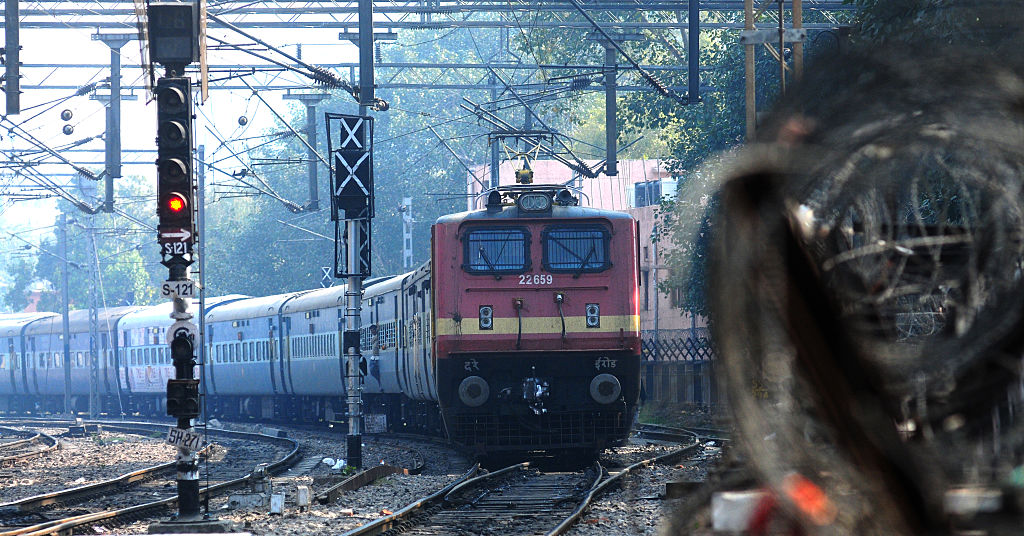
India has emerged as one of the world’s leading nations in railway electrification, with 99.6 per cent of its broad gauge network now electrified, making it the second most electrified major railway system globally after Switzerland. The milestone reflects one of the fastest railway electrification programmes undertaken anywhere in the world and marks a significant step towards cleaner, more energy-efficient rail transport.
According to information shared by Union Minister for Railways, Information and Broadcasting, and Electronics and Information Technology Ashwini Vaishnaw in a written reply in the Lok Sabha on Tuesday, Indian Railways has electrified nearly its entire broad gauge network, while work on the remaining routes is progressing.
The pace of electrification has accelerated sharply over the past decade. While 21,801 route kilometres were electrified over nearly six decades before 2014, an additional 48,072 route kilometres have been electrified between 2014 and 2026. The government has also made electrification an integral part of all new railway line and multi-tracking projects.
With 99.6 per cent electrification, India now ranks just behind Switzerland, which has achieved 100 per cent railway electrification. It is ahead of several major railway networks, including China (82 per cent), Spain (67 per cent), Japan (64 per cent), France (60 per cent) and the United Kingdom (39 per cent).
The government said railway electrification has significantly strengthened India’s transition towards sustainable transportation. According to a NITI Aayog report, rail transport emits about 11.5 grams of carbon dioxide per tonne-kilometre, nearly 89 per cent lower than road transport, which emits around 101 grams.
Electrification has also reduced Indian Railways’ dependence on imported fossil fuels. Diesel consumption for train operations has declined from 293 crore litres in 2015-16 to 108 crore litres in 2024-25, resulting in savings of nearly 185 crore litres. The reduction has helped lower carbon emissions while saving valuable foreign exchange that would otherwise have been spent on fuel imports.
Apart from environmental benefits, electric traction has improved operational efficiency by enabling higher hauling capacity, faster train speeds and reduced travel time. The transition also allows greater integration of renewable energy into railway operations.
As part of its clean energy strategy, Indian Railways is progressively meeting its traction power requirements through renewable sources. As of June 2026, it has commissioned around 1,161 MW of solar power capacity, including rooftop and ground-mounted installations, along with about 103 MW of wind power capacity, taking the total commissioned renewable energy capacity to over 1,260 MW.
The ministry said Mission 100% Electrification remains a technically challenging exercise, as electrification work is carried out on railway lines that continue to remain operational. To accelerate implementation, Indian Railways has introduced measures including a dedicated Project Monitoring Group portal for resolving execution bottlenecks, strengthened project monitoring systems, assured funding and enhanced financial powers for field units.
Across railway zones, 15 zones, including Central, Northern, Eastern, Western, South Central and East Coast Railways, along with Konkan Railway and Kolkata Metro, have already achieved 100 per cent electrification. North Western Railway has reached 99.8 per cent, while Northeast Frontier Railway and Southern Railway have achieved 98.7 per cent electrification.
At the state level, several states and Union Territories, including Andhra Pradesh, Bihar, Madhya Pradesh, Uttar Pradesh, Gujarat, Maharashtra, Odisha, Telangana, Punjab and Delhi, have achieved complete railway electrification. Rajasthan has reached 99.8 per cent, Tamil Nadu 98.3 per cent, Assam 97.9 per cent, Karnataka 96.8 per cent and Goa 91.4 per cent.


