







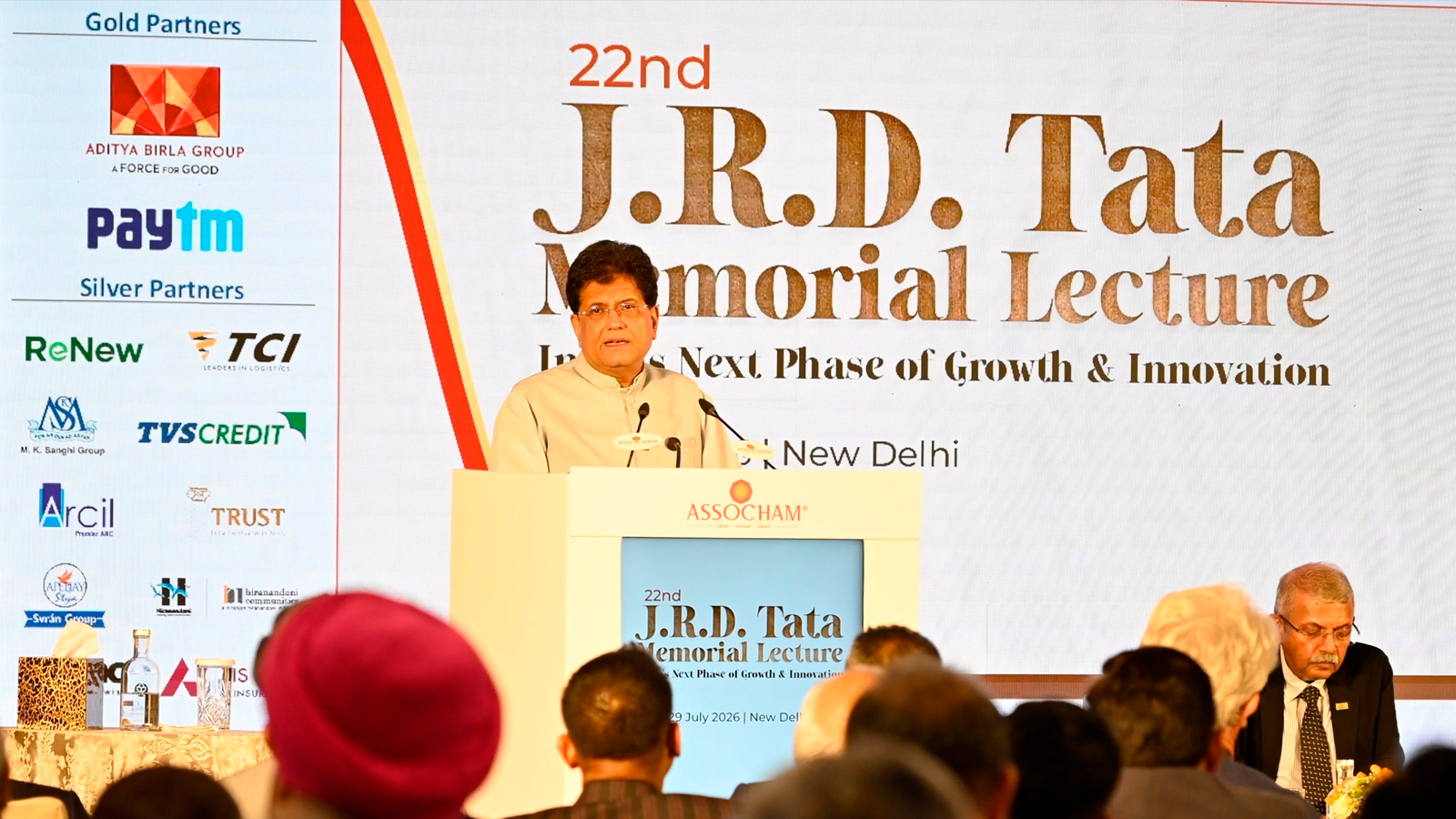
Union Commerce and Industry Minister Piyush Goyal on Wednesday said innovation, deep technologies, startups, MSMEs, skilled manpower and globally competitive manufacturing will be the key drivers of India’s economic growth as the country moves towards becoming a developed nation by 2047.
Delivering the 22nd J.R.D. Tata Memorial Lecture on the 122nd birth anniversary of Bharat Ratna J.R.D. Tata in New Delhi, Goyal said India’s development journey would be powered by research and development, entrepreneurship, technological advancement and a culture of excellence.
The minister said emerging technologies such as artificial intelligence, semiconductors, quantum computing, biotechnology, robotics and advanced materials will shape the next phase of industrial growth and strengthen India’s global competitiveness. He stressed that skill development must increasingly become an industry-led movement, with the government continuing to improve ease of doing business and create an enabling environment for enterprise and investment.
Highlighting the government’s push to promote innovation, Goyal said a ₹1 lakh crore Research, Development and Innovation (RDI) Fund has been launched to provide long-term, low-cost risk capital for emerging technologies. He added that under the IndiaAI Mission, nearly 38,000 GPUs have already been onboarded to provide affordable computing capacity to startups and researchers, with plans for further expansion.
The minister also announced that the government has launched the second Semiconductor Mission with an allocation of around US$12-13 billion, following the successful response to the first phase, and invited industry to participate through fresh investments and proposals.
Emphasising that innovation and manufacturing must progress together, Goyal said India’s manufacturing sector must focus on smarter production through automation, better product design, improved packaging, stronger branding and uncompromising quality standards. He added that India’s vast domestic market provides economies of scale, which businesses should leverage to expand into global markets, generate employment and benefit from the country’s expanding network of Free Trade Agreements (FTAs).
Referring to India’s trade strategy, Goyal said the country has concluded nine FTAs covering 38 developed economies with a combined GDP of nearly US$60 trillion, providing Indian businesses with unprecedented global market access. He contrasted these with agreements signed before 2014, which largely involved economies where India competed rather than complemented its trading partners.
The minister said India continued to remain the world’s fastest-growing major economy despite geopolitical uncertainties. He noted that the economy grew 7.7 per cent last year and 7.8 per cent in the last quarter, while merchandise exports have increased by 15 per cent during the current financial year since April 1. He added that institutions such as the OECD, World Bank and IMF continue to project India as the fastest-growing large economy.
Calling deep-tech startups the country’s next growth engine, Goyal urged industry and investors to back promising Indian innovations at an early stage instead of waiting for them to mature. He expressed concern that many innovative Indian startups are eventually acquired by foreign companies because domestic investors often hesitate to invest during the early stages.
Recalling the Bharat Innovates event held in Nice, France, alongside Prime Minister Narendra Modi and French President Emmanuel Macron, Goyal said 120 Indian deep-tech startups showcased their innovations before global investors and technology leaders, demonstrating the country’s growing innovation capabilities.
He urged industry to help startups move from prototype to commercialisation by adopting and testing indigenous technologies, saying global success would naturally follow once innovations prove commercially viable.
Goyal said India, currently a nearly US$4 trillion economy, is well positioned to achieve its target of becoming a US$13 trillion economy by 2047. He credited reforms such as reducing compliance burdens, decriminalising outdated laws through the Jan Vishwas Acts and simplifying regulations for creating a more business-friendly environment.
The minister also highlighted the importance of MSMEs in India’s growth story and called for greater adoption of technology to improve productivity, competitiveness and product quality.
Paying tribute to J.R.D. Tata, Goyal said the industrialist had built not just successful companies but also confidence, capability and a spirit of self-belief in India. Drawing a parallel with Guru Purnima, observed on July 29, he described J.R.D. Tata as a mentor who inspired generations of Indian entrepreneurs.
Concluding his address, Goyal urged industry to make the “Made in India” label synonymous with global quality and excellence by investing more in research and development, innovation, skill development and advanced technologies while leveraging India’s growing network of FTAs to expand internationally.


