







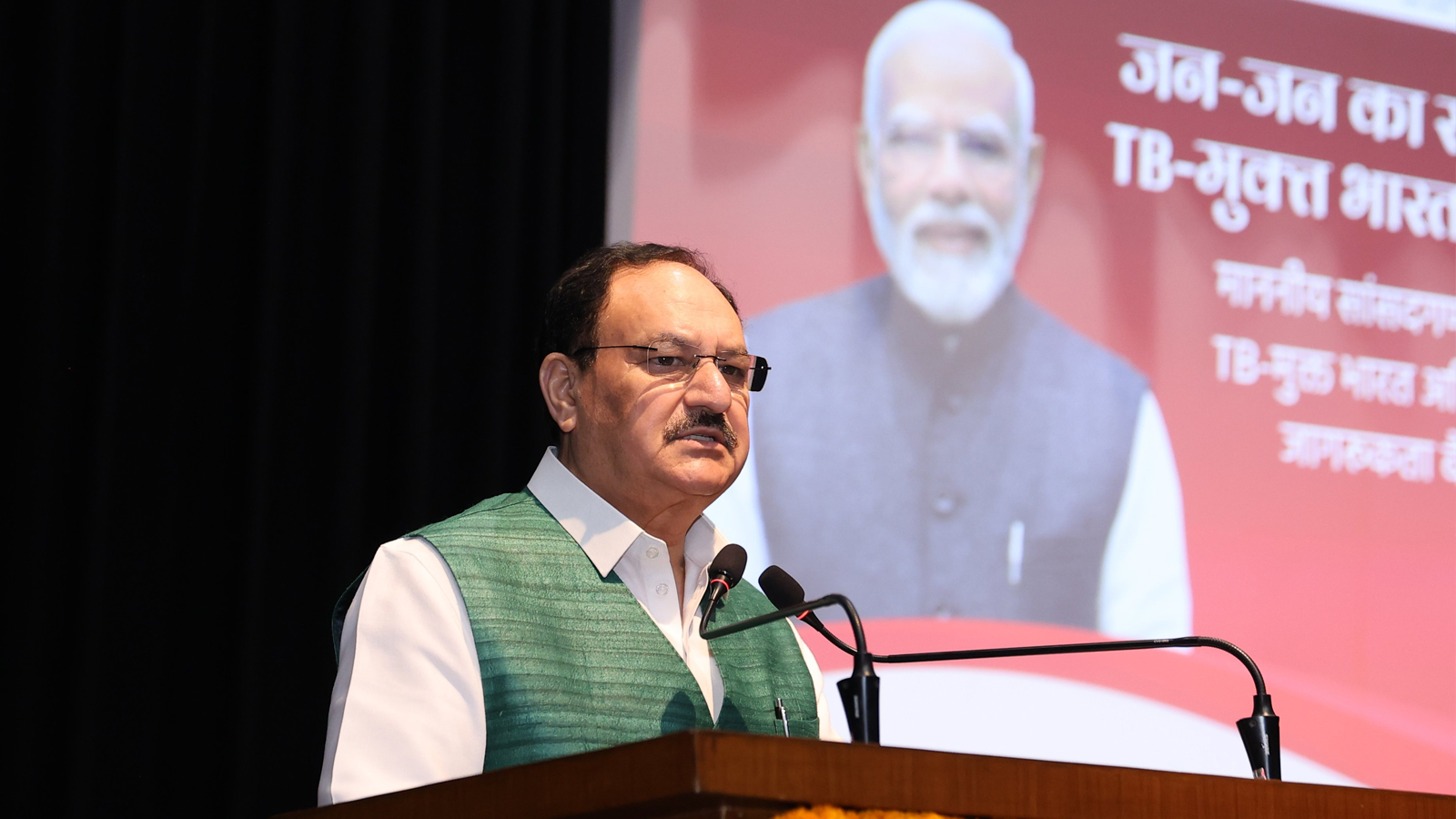
Union Health Minister Jagat Prakash Nadda on Wednesday called upon Members of Parliament from West Bengal to spearhead a nationwide people’s movement for tuberculosis (TB) elimination, urging them to strengthen community participation, early detection and district-level monitoring to help India achieve its target of eliminating the disease by 2030.
Chairing a meeting titled “Parliamentarians Championing a TB Mukt Bharat” on the sidelines of the Monsoon Session of Parliament, Nadda said tuberculosis elimination is not merely a health programme but a mass movement that requires active participation from elected representatives, governments, civil society and local communities.
The meeting, attended by Lok Sabha and Rajya Sabha MPs from West Bengal across party lines, was part of a series of consultations with parliamentarians from various states aimed at accelerating India’s TB elimination campaign. Union Minister of State for Education and Development of North Eastern Region Dr. Sukanta Majumdar also attended the meeting.
Highlighting India’s progress in tackling tuberculosis, Nadda cited the WHO Global TB Report 2025, saying the country recorded a 21 per cent decline in TB incidence between 2015 and 2024, nearly double the global average decline of 12 per cent during the same period. He added that India’s treatment coverage has reached 92 per cent, significantly higher than the global average of 78 per cent.
The Health Minister reviewed the progress of the 100-Day TB Mukt Bharat Abhiyaan, which was implemented in two phases to accelerate TB detection and treatment. The first phase, launched in December 2024, initially covered 347 high-priority districts before expanding nationwide, while the second phase, launched in March 2026, focused on nearly 1.58 lakh high-risk villages and urban wards across the country.
Calling the campaign a defining moment in India’s fight against tuberculosis, Nadda urged MPs to regularly review district-level TB elimination efforts with local administrations, promote awareness to reduce stigma, encourage early detection through Ni-kshay Shivirs, and strengthen screening among vulnerable and high-risk populations. He also asked parliamentarians to mobilise Ni-kshay Mitras and community organisations to provide nutritional, psychosocial and livelihood support to TB patients.
The minister highlighted several technological and policy initiatives that have strengthened India’s TB control programme. He said the mandatory notification of TB cases diagnosed in the private sector, along with the provision of free government-supplied medicines, has helped reduce the financial burden on patients.
Nadda described the proactive detection of asymptomatic TB cases as a major shift in India’s elimination strategy and highlighted the use of indigenous TruNat molecular diagnostic machines for rapid detection of multi-drug resistant tuberculosis (MDR-TB). He also pointed to the growing deployment of AI-enabled handheld X-ray machines and portable X-ray units supported through PM CARES, which have improved access to early diagnosis in remote and underserved areas.
He further highlighted patient-centric initiatives, including the enhancement of financial assistance under the Ni-kshay Poshan Yojana to ₹1,000 per month for TB patients, the introduction of shorter treatment regimens and the mobilisation of more than five lakh Ni-kshay Mitras across the country.
Union Health Secretary Punya Salila Srivastava said West Bengal’s continued efforts to expand screening, treatment and patient support would be crucial in translating national progress into improved health outcomes at the community level.
Additional Secretary and National Health Mission Mission Director Aradhana Patnaik highlighted the expansion of India’s diagnostic infrastructure, noting that molecular testing capacity has increased from a few hundred machines a decade ago to more than 9,000, supported by nearly 3,000 AI-enabled handheld X-ray units developed through indigenous innovation.
Presenting the state’s performance, she said West Bengal has made progress in TB notifications, treatment success and preventive therapy coverage. During the 100-Day Campaign, the state expanded screening through Ayushman Arogya Shivirs in urban slums, tea gardens, mining areas and migrant settlements to improve access for vulnerable communities.
The MPs from West Bengal collectively reaffirmed their commitment to intensifying awareness campaigns, reducing stigma, organising Ni-kshay Shivirs for early detection, strengthening monitoring of TB services and mobilising community support through Ni-kshay Mitras and local organisations to help achieve the goal of a TB Mukt Bharat by 2030.


