







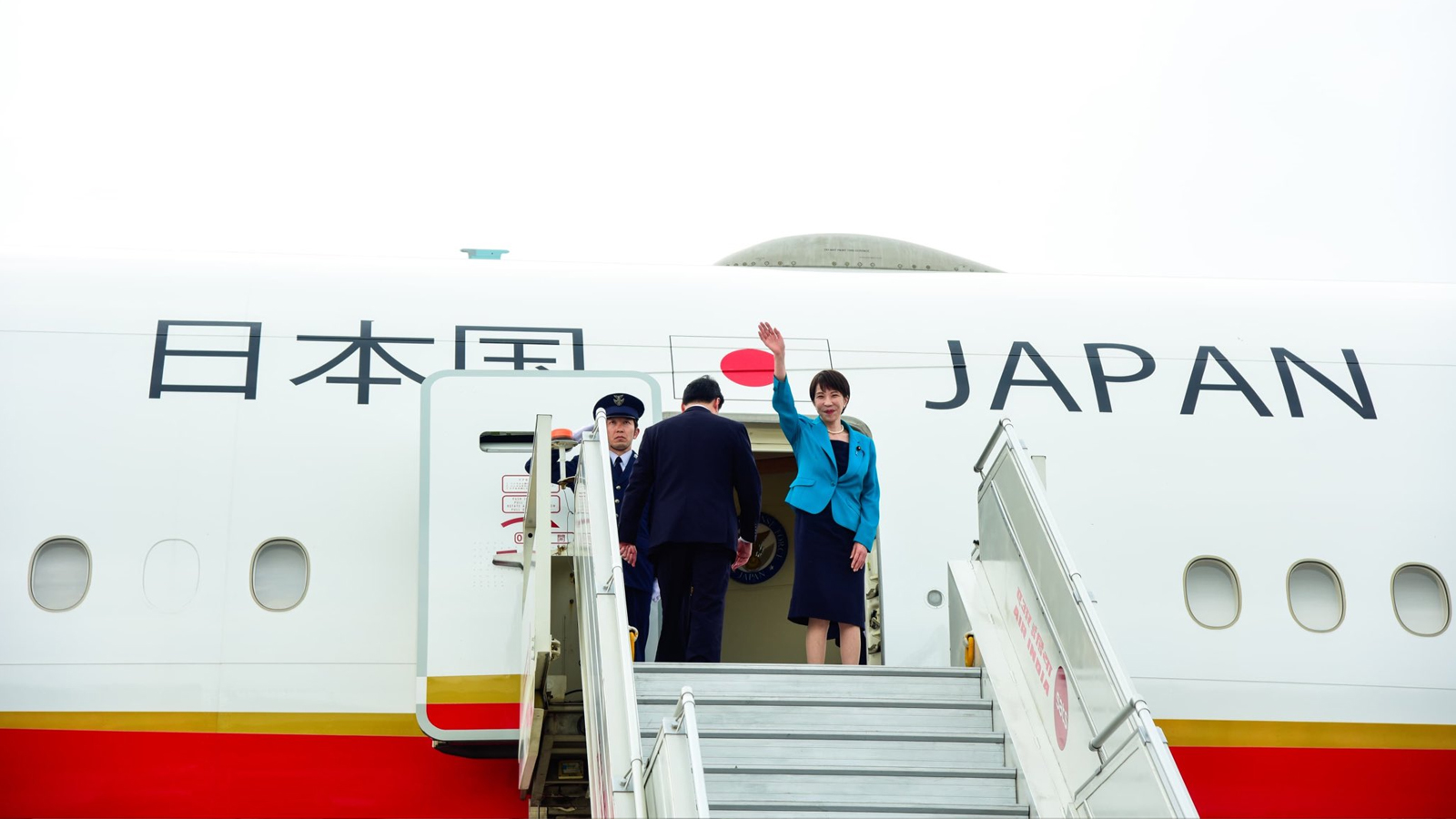
Japanese Prime Minister Sanae Takaichi concluded her three-day official visit to India on Friday after holding wide-ranging discussions with Prime Minister Narendra Modi during the 16th India-Japan Annual Summit, with both countries adopting a comprehensive set of agreements aimed at deepening cooperation in economic security, artificial intelligence, clean energy, critical technologies, defence, mobility and scientific research.
Takaichi departed for Tokyo after what both sides described as a highly successful visit that reaffirmed the India-Japan Special Strategic and Global Partnership.
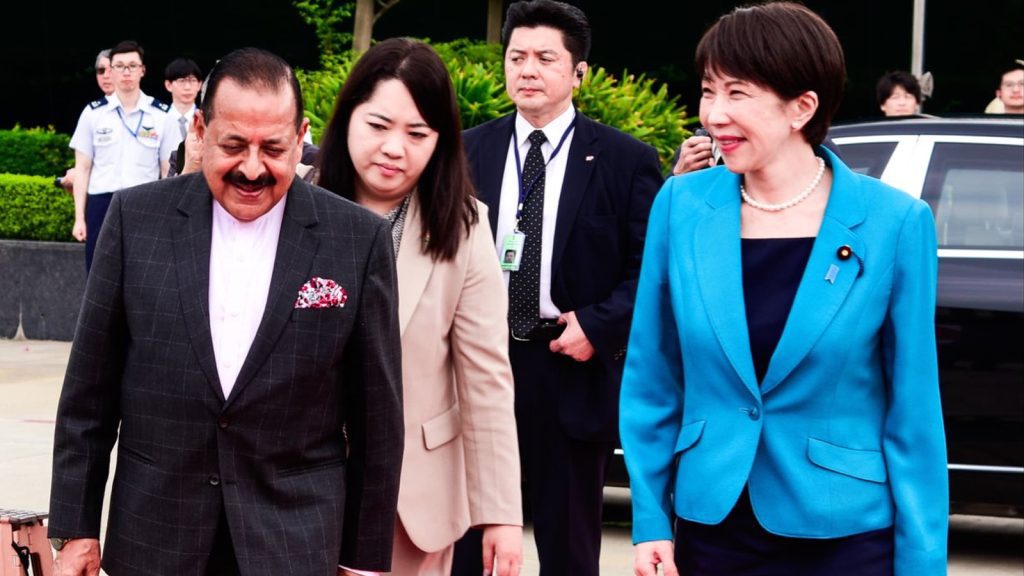
In a post on X, Ministry of External Affairs (MEA) spokesperson Randhir Jaiswal said, “A memorable visit concludes, advancing India-Japan partnership towards shared horizons. PM Sanae Takaichi of Japan departs from India following the highly successful 16th India-Japan Annual Summit. She was seen off by Minister of State Dr Jitendra Singh. The visit reaffirmed the commitment of both sides to nurture a partnership pivotal to the shared growth and prosperity of both countries and an anchor for promoting peace, prosperity and stability in the Indo-Pacific and beyond.”
Union Minister of State Dr. Jitendra Singh, who saw off the Japanese Prime Minister at the Palam Technical Airport in New Delhi, also shared on X, “Prime Minister Sanae Takaichi of Japan, left for Tokyo this morning, after a successful 3-day visit to India. She was officially seen off at the Palam Technical Airport, New Delhi.”
Sixteen Key Outcomes of the Summit
The MEA released the list of 16 major outcomes of the summit, reflecting an expansion of bilateral cooperation across strategic sectors.
Among the most significant was the India-Japan Joint Declaration on Economic Security, which promotes project-based collaboration to strengthen resilience in critical sectors such as semiconductors, critical minerals, artificial intelligence, information and communication technology, clean energy and pharmaceuticals. The declaration is accompanied by the updated India-Japan Fact Sheet 2.0, documenting growing government-to-government and business-to-business cooperation.
The two countries also adopted the India-Japan Joint Statement on Cooperation in the Field of Artificial Intelligence, elevating bilateral ties into a strategic AI research and development partnership. Building on the existing India-Japan AI Initiative, the roadmap aims to expand cooperation across the entire AI technology stack while promoting safe, secure, trusted, inclusive and human-centric artificial intelligence.
To strengthen energy cooperation, India and Japan adopted a Joint Statement on Energy Resilience, enhancing collaboration on strategic petroleum reserves, crude oil stockpiling mechanisms and joint investments across the maritime energy transport value chain.
The two sides also announced a roadmap to celebrate 2027 as the India-Japan Year of Shared Horizons, marking the 75th anniversary of the establishment of diplomatic relations through a series of commemorative events.
Major Sectoral Agreements
In a major breakthrough in defence cooperation, India and Japan signed their first-ever defence co-development project during the 16th India-Japan Annual Summit.
PM Modi said the agreement on the Naval Radio Antenna project would open a new chapter in the India-Japan defence technology partnership. He added that the two countries would jointly develop defence technologies aimed at strengthening regional peace, maritime security, and a rules-based order in the Indo-Pacific.
Among the key Memoranda of Cooperation signed during the visit was the India-Japan Cooperative Biogas for Growth (CBG) Initiative, under which both countries will work towards establishing 1,000 biogas and organic fertiliser plants across India by leveraging the country’s dairy cooperative network.
Another agreement focuses on battery technologies, promoting collaboration in battery manufacturing and strengthening trusted, resilient and sustainable supply chains.
India and Japan also signed a Memorandum of Cooperation covering the pharmaceuticals and medical devices sector, aimed at strengthening supply chains for Active Pharmaceutical Ingredients (APIs) and Key Starting Materials (KSMs) through investment, technical collaboration and industry-academia partnerships.
Cooperation was further expanded in geology and mineral exploration, with both sides agreeing to exchange technical expertise in upstream exploration of critical minerals.
AI, Technology and Research Collaboration
A dedicated Memorandum of Cooperation between the IndiaAI Mission and Japan’s Ministry of Economy, Trade and Industry (METI) will promote collaboration with Japan’s GENIAC initiative through business matchmaking, policy dialogues, webinars and support for joint AI projects using advanced computing infrastructure.
The summit also operationalised the Next Generation Mobility Partnership (NGMP), providing a framework for expanding private sector-led cooperation across railways, automobiles, aviation, shipbuilding, ports, logistics, urban development and road infrastructure, positioning India as a manufacturing hub under the “Make in India for the World” initiative.
Scientific collaboration received a significant boost through multiple institutional agreements, including partnerships between India’s Centre for Cellular and Molecular Platforms (C-CAMP) and RIKEN, Japan, for translational research and deep-tech innovation in healthcare, agriculture and environmental sciences.
Another agreement between the National Centre for Biological Sciences (NCBS)-Tata Institute of Fundamental Research and RIKEN aims to strengthen collaboration in biological sciences and neuroscience research.
Advancing AI and Digital Cooperation
Artificial intelligence collaboration was further expanded through an agreement involving IIT Bombay, BharatGen Technology Foundation and Japan’s National Institute of Informatics, focusing on developing large language models (LLMs) with enhanced scientific reasoning capabilities through joint research and academic exchanges.
Indian AI startup SarvamAI and Japan’s Preferred Networks also signed a Memorandum of Understanding to collaborate across the AI technology stack, including foundation model development.
In the digital infrastructure domain, the National Internet Exchange of India (NIXI) and the Japan Network Information Center (JPNIC) agreed to cooperate on internet registry operations, IPv6 adoption, cybersecurity, capacity building, internet governance and professional exchanges.
Financial Cooperation
The summit also witnessed an exchange of letters between the International Financial Services Centres Authority (IFSCA) and Japan’s Financial Services Agency (JFSA), establishing a framework for cooperation in financial sector regulation, supervision, FinTech, RegTech and information sharing on financial market developments.


