







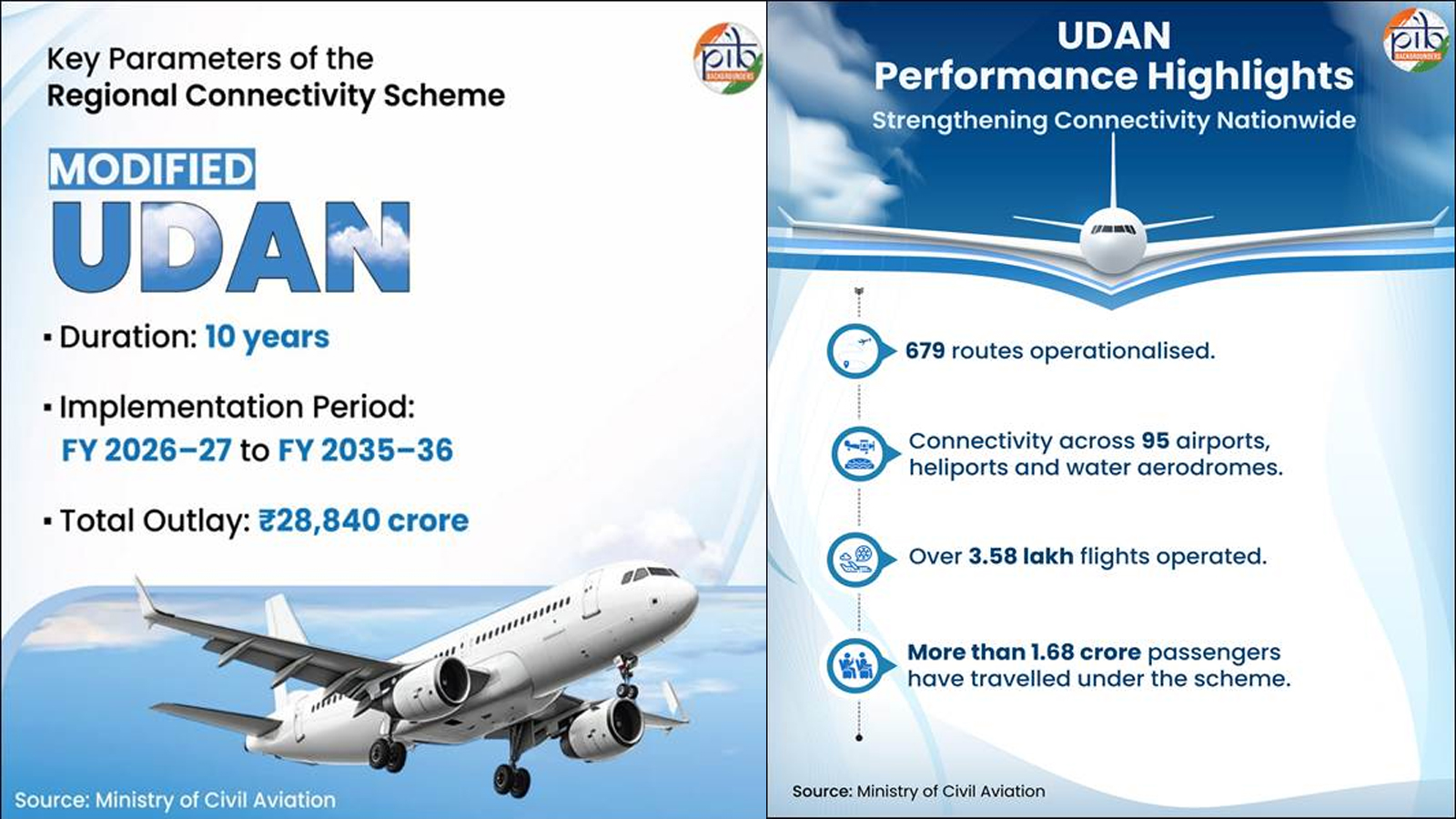
India’s regional aviation landscape is set for a major expansion with the launch of the Modified UDAN Scheme, a decade-long programme that aims to deepen air connectivity, strengthen aviation infrastructure and improve last-mile access across the country. Building on the success of the Regional Connectivity Scheme (RCS)-UDAN, which has transformed regional air travel over the past nine years, the modified scheme will be implemented from FY 2026-27 to FY 2035-36 with a total outlay of ₹28,840 crore.
The new phase seeks to consolidate the gains made under UDAN while addressing emerging infrastructure and operational requirements. It envisions the development of 100 new airports from existing unserved airstrips and 200 modern helipads, alongside sustained operational support for regional airports and financial assistance for airlines operating on underserved routes.
Launched in October 2016, the UDAN scheme was conceived to make air travel affordable and accessible for the common citizen while extending aviation services to underserved and unserved regions. Before its introduction, air connectivity in India remained concentrated in a limited number of metropolitan centres, leaving many smaller towns without regular air services.
Over the past decade, India’s civil aviation sector has witnessed rapid expansion. The number of operational airports has increased from 74 in 2014 to 165 as of July 15, 2026, helping the country emerge as the world’s third-largest domestic aviation market. The UDAN scheme has played a key role in this transformation by operationalising new regional routes and strengthening the country’s aviation ecosystem.
According to the Civil Aviation Ministry, the scheme has operationalised 679 routes connecting 95 airports, heliports and water aerodromes. Since its launch, more than 3.58 lakh flights have operated under UDAN, carrying over 1.68 crore passengers and significantly improving regional mobility.
The Modified UDAN Scheme places greater emphasis on infrastructure development and long-term sustainability. A central component of the programme is the development of 100 airports from existing unserved airstrips over the next eight years with an investment of ₹12,159 crore. The initiative is expected to integrate smaller towns and remote regions more effectively into the national transportation network, facilitating faster movement of passengers and goods while supporting regional economic growth.
Recognising that smaller airports often struggle with high operating costs and limited revenues during their initial years, the scheme also provides structured operation and maintenance support. Regional airports will receive financial assistance for up to three years, ensuring the continuity of air services while passenger demand gradually grows. This component has been allocated ₹2,577 crore and is expected to support approximately 441 aerodromes across the country.
The scheme also addresses connectivity challenges in geographically difficult regions by proposing the development of 200 modern helipads. Designed primarily for areas where conventional airport infrastructure is not feasible, these facilities are expected to improve access to healthcare, strengthen emergency response services and enhance administrative and economic connectivity. The helipad development programme has a projected investment of ₹3,661 crore over eight years.
To ensure the viability of regional air services, the government will continue to provide Viability Gap Funding (VGF) to airlines operating on smaller routes. The Modified UDAN framework allocates ₹10,043 crore towards VGF over a ten-year period. Airlines will receive financial support for up to five years, with assistance tapering from the third year, while route exclusivity will remain limited to three years. The structure is designed to encourage commercial sustainability while supporting route development during the initial phase.
The scheme also aligns with the government’s Atmanirbhar Bharat initiative by strengthening indigenous aviation capabilities. To improve operations in remote and difficult terrain, it proposes deploying two HAL Dhruv helicopters for Pawan Hans and two HAL Dornier aircraft for Alliance Air, supporting both regional connectivity and domestic aerospace manufacturing.
The Ministry said the impact of UDAN has been particularly visible in remote, hilly and island regions, including Tezpur, Passighat, Diu, Pithoragarh and Rourkela, where improved air connectivity has enhanced transportation, tourism, healthcare access and emergency services. Passenger experience has also improved through initiatives such as UDAN Yatri Cafés, Flybrary book-sharing facilities and free Wi-Fi services at airports.
The benefits of regional connectivity are also evident in reduced travel times. The Vijayawada-Kadapa air route, for instance, has transformed what was once an eight to ten-hour road journey into an air trip of about one hour. Travellers have noted that improved connectivity has made travel significantly faster and more affordable, highlighting the practical impact of the scheme on everyday mobility.
Geographically large countries such as the United States, Canada, Brazil and Australia often rely on public funding to sustain regional air connectivity. India, however, introduced a first-of-its-kind funding model through the Regional Connectivity Scheme (RCS) levy mechanism under the UDAN scheme, enabling the aviation sector to finance regional connectivity from within. The mechanism works by levying a nominal fee on select categories of domestic flights. Government participation has also strengthened coordination and enhanced ownership at the airport level, while a range of non-monetary concessions has helped reduce operational costs across the aviation ecosystem.
The Modified UDAN Scheme represents the next phase of India’s regional aviation strategy, focusing on stronger infrastructure, operational sustainability and wider accessibility. By expanding airport infrastructure, strengthening last-mile connectivity and supporting regional airline operations, the government aims to ensure that affordable air travel reaches every part of the country while creating a more inclusive, modern and resilient aviation network.


