







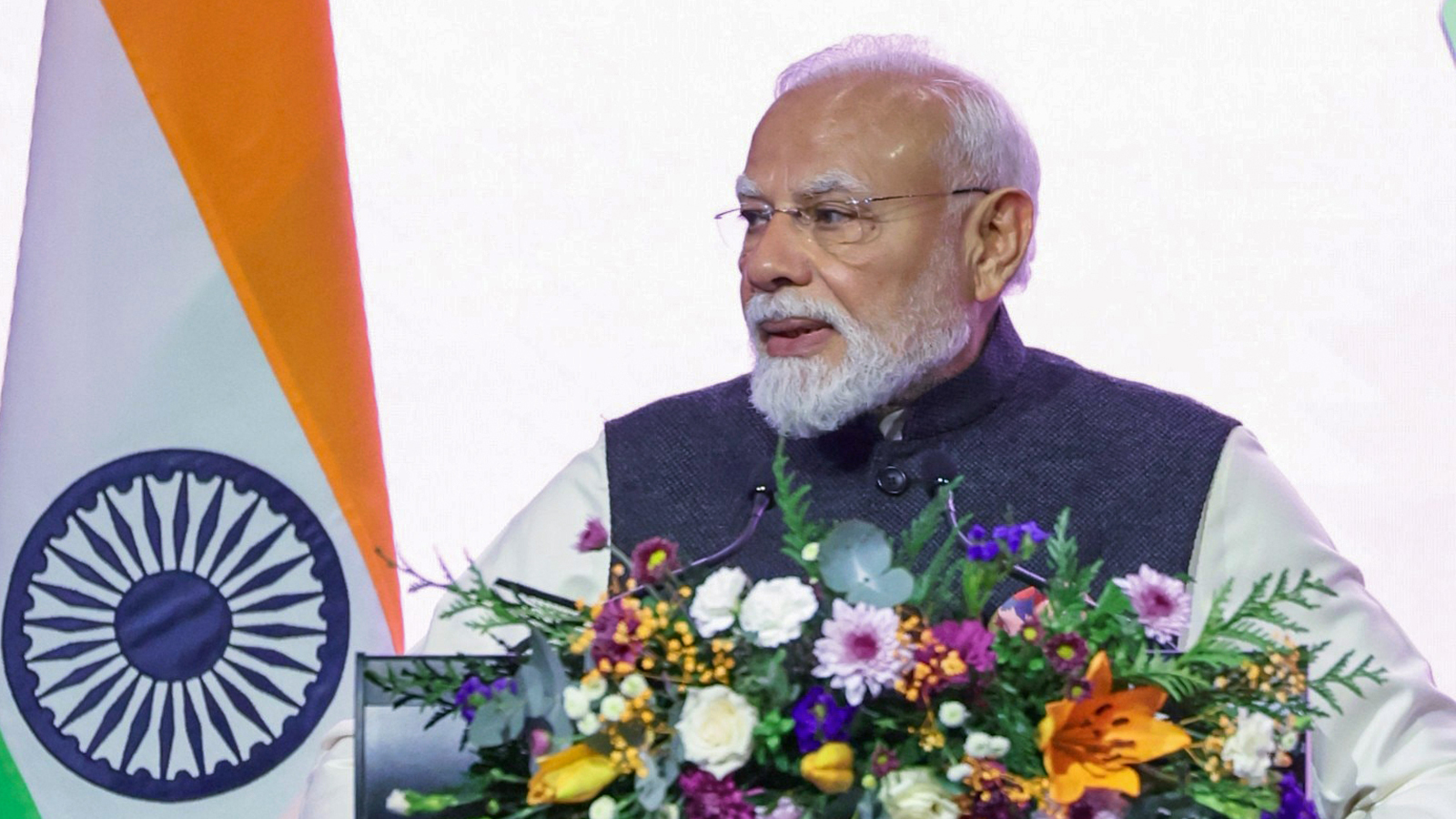
Prime Minister Narendra Modi on Thursday called for deeper economic and investment cooperation between India and Australia, urging businesses from both countries to seize emerging opportunities in clean energy, infrastructure, critical minerals, technology and education to strengthen the bilateral partnership.
Addressing the Economic Roadmap Business Reception in Melbourne, attended by business leaders from India and Australia, PM Modi said the presence of industry representatives reflected the shared confidence and aspirations of both countries.
He said that amid global uncertainty, supply chain disruptions and energy challenges, it was both natural and necessary for India and Australia to move forward as trusted strategic and economic partners.
Highlighting the progress in bilateral economic relations, PM Modi said the India-Australia Economic Cooperation and Trade Agreement (ECTA), signed in 2022, has significantly strengthened commercial ties between the two countries.
“Since its entry into force, exports from India to Australia have doubled, and businesses in both countries have benefited from new market access,” he said.
The Prime Minister also called for the early conclusion of the proposed Comprehensive Economic Cooperation Agreement (CECA), saying it would further elevate trade and investment ties by creating a stronger framework for long-term collaboration.
PM Modi highlighted India’s ambitious clean energy goals, noting that the country is building a robust manufacturing ecosystem for hydro projects, green hydrogen, solar modules and wind turbines. He reiterated India’s target of achieving 500 GW of renewable energy capacity by 2030 and net-zero emissions by 2070, and said Australia’s technology, capital and natural resources could accelerate this transition.
PM Modi also pointed to new opportunities in the civil nuclear sector following the opening of the sector to private companies under the SHANTI Act. India has set a target of generating 100 GW of nuclear energy by 2047, he said, adding that Australia’s vast uranium reserves create significant scope for expanding bilateral cooperation.
Inviting long-term Australian investment, the Prime Minister said India offers substantial opportunities in ports, airports, highways, railways and urban infrastructure. He highlighted the pace of infrastructure development in the country, stating that around 34 kilometres of national highways and more than eight kilometres of railway tracks are being built every day.
Describing the combination of scale, speed and policy stability as India’s key strengths, PM Modi said the country presents an attractive destination for global investors.
The Prime Minister also underlined opportunities for collaboration in steel and clean manufacturing, noting that India is the world’s second-largest crude steel producer. He said both countries could work together in areas such as low-carbon aluminium, green iron and sustainable manufacturing technologies.
Emphasising India’s focus on emerging technologies, PM Modi said the government has committed more than US$10 billion under the AI Mission, Quantum Mission and Semiconductor Programme. He invited Australian companies to partner with India in developing global solutions in artificial intelligence, quantum technologies, semiconductors, data centres and digital public infrastructure.
Referring to Australia’s pension industry, which manages assets worth over US$4 trillion, PM Modi invited Australian pension funds to invest in India’s long-term growth story. He said India considers pension savings a sacred trust and offers investors opportunities for safe, stable and sustainable returns.
Education and skills development also featured prominently in the Prime Minister’s address. He welcomed the establishment of campuses by Deakin University and the University of Wollongong in Gujarat International Finance Tec-City (GIFT City), describing it as a reflection of Australia’s growing confidence in India. He called for transforming student mobility into long-term talent partnerships.
PM Modi also proposed expanding cooperation beyond the national capitals by building stronger partnerships between Indian states and Australian provinces. He suggested collaborations in sectors aligned with regional strengths, including critical minerals, clean energy, agriculture, finance, education, medical technology, innovation, defence, space and advanced manufacturing.
He said such state-to-state and sector-specific partnerships could unlock new opportunities for both countries and create globally competitive solutions.
Concluding his address, the Prime Minister said India and Australia share deep strategic convergence based on democratic values and a common vision for the Indo-Pacific. Expressing confidence that the discussions would generate new ideas, partnerships and commitments, he reaffirmed India’s commitment to taking the bilateral business relationship to greater heights.


