







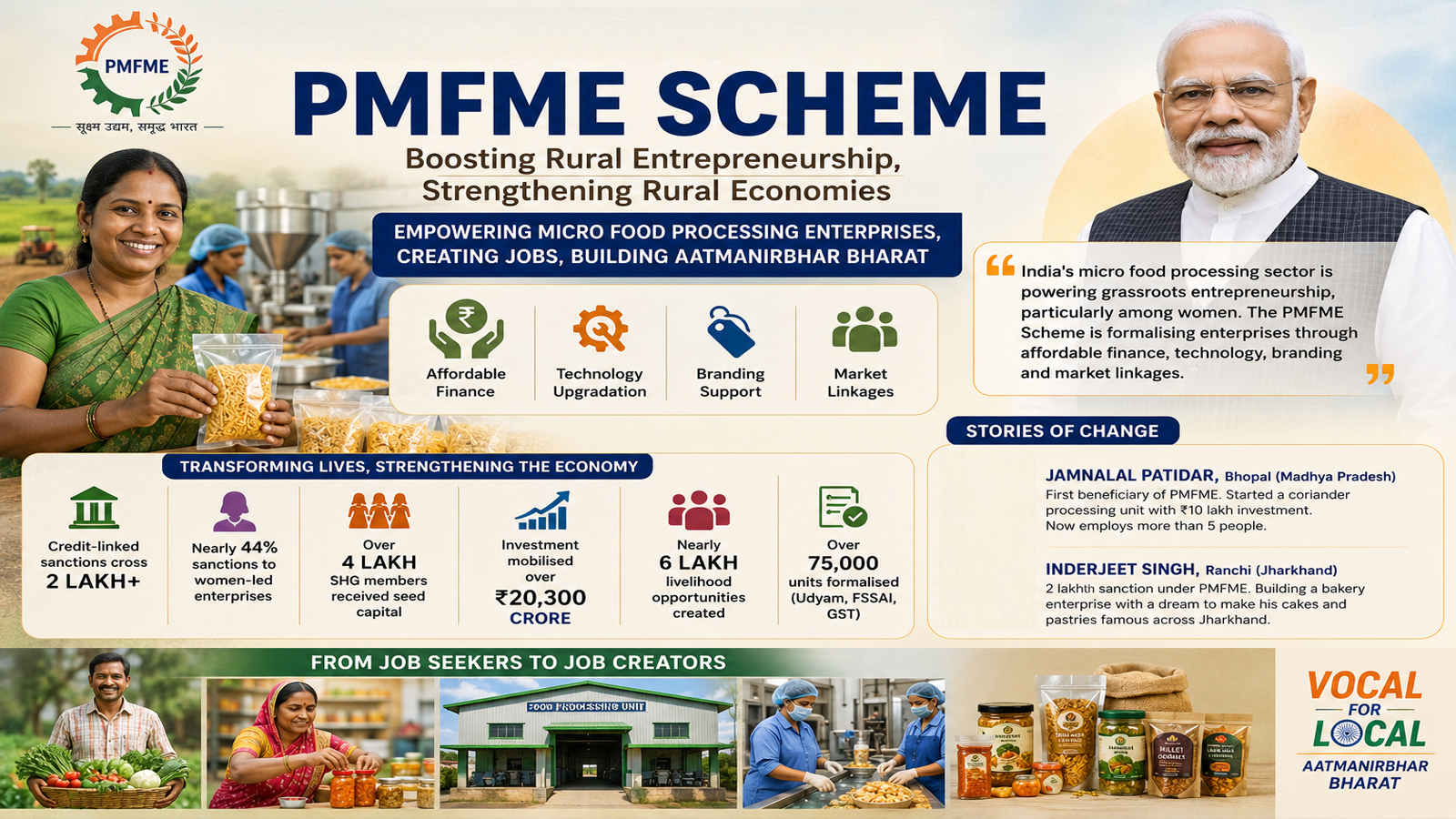
Prime Minister Narendra Modi on Tuesday shared an article by Union Minister Chirag Paswan highlighting the achievements of the Pradhan Mantri Formalisation of Micro Food Processing Enterprises (PMFME) Scheme and its role in promoting grassroots entrepreneurship, particularly among women, while strengthening rural economies.
Sharing the article on X, the Prime Minister said, “India’s micro food processing sector is powering grassroots entrepreneurship, particularly among women. Union Minister Shri Chirag Paswan highlights how the PMFME Scheme is formalising enterprises through affordable finance, technology, branding and market linkages. It is enabling local producers to become job creators, strengthen rural economies and build an Aatmanirbhar Bharat.”
In his article, Paswan said the PMFME Scheme, launched in 2020 under the Aatmanirbhar Bharat Abhiyan during the COVID-19 pandemic, was designed to support micro food processing enterprises that had long remained outside formal finance and institutional support. He said the initiative reflects the government’s vision of ensuring that economic growth begins at the grassroots by empowering small entrepreneurs in villages and towns.
The minister noted that the scheme’s credit-linked component has crossed the milestone of two lakh sanctions, enabling thousands of entrepreneurs to enter the formal credit system and expand their businesses.
He highlighted the story of Jamnalal Patidar, whose application became the first to be sanctioned under the PMFME Scheme. A Class X-pass entrepreneur with no prior experience in food processing, Patidar established a coriander-processing unit with an investment of ₹10 lakh. With access to finance, machinery and technical guidance under the scheme, his venture has grown into a functioning enterprise that now provides employment to more than five people.
Paswan said the PMFME Scheme aims to bridge key gaps faced by micro food processors by providing credit-linked assistance, capacity building, common infrastructure, branding support and market linkages, while bringing informal enterprises into the formal economy.
Women have emerged as major beneficiaries of the initiative. Nearly 44 per cent of the more than two lakh credit-linked sanctions have been extended to women-led enterprises, while over four lakh Self-Help Group members have received seed capital to strengthen and upgrade their businesses.
The scheme has attracted investments exceeding ₹20,300 crore and has supported nearly six lakh livelihood opportunities across the country. More than 75,000 enterprises have entered the formal economy through Udyam registration and compliance with Food Safety and Standards Authority of India (FSSAI) and Goods and Services Tax (GST) requirements.
Paswan said every successful enterprise under the scheme contributes to the local economy by purchasing agricultural produce, reducing post-harvest losses, generating employment and creating value-added products from locally grown crops. He said the initiative reflects the spirit of the “Vocal for Local” campaign by enabling household skills to evolve into recognised businesses.
The Minister also highlighted story of Ranchi’s Inderjeet Singh, who is building a bakery and dreams that his cakes and pastries will one day be known across Jharkhand. His bakery venture received the credit-linked sanction number two lakh under the PMFME Scheme. Paswan said Singh represents a new generation of first-time entrepreneurs who are using the scheme to build sustainable businesses with ambitions to expand their reach.
Looking ahead, the minister said the next phase of the PMFME Scheme will focus on ensuring quicker credit delivery, wider adoption of modern technology and packaging, improved market access and continued support to entrepreneurs beyond loan sanction. He said the government’s objective is to help enterprises not only secure finance but also establish long-term, sustainable businesses capable of generating employment and contributing to local economic growth.
Describing the achievement of two lakh sanctions as more than an administrative milestone, Paswan said the initiative has expanded opportunities for micro food processors across the country, helping them build enterprises that strengthen rural economies, create jobs and contribute to the vision of an Aatmanirbhar Bharat.


