







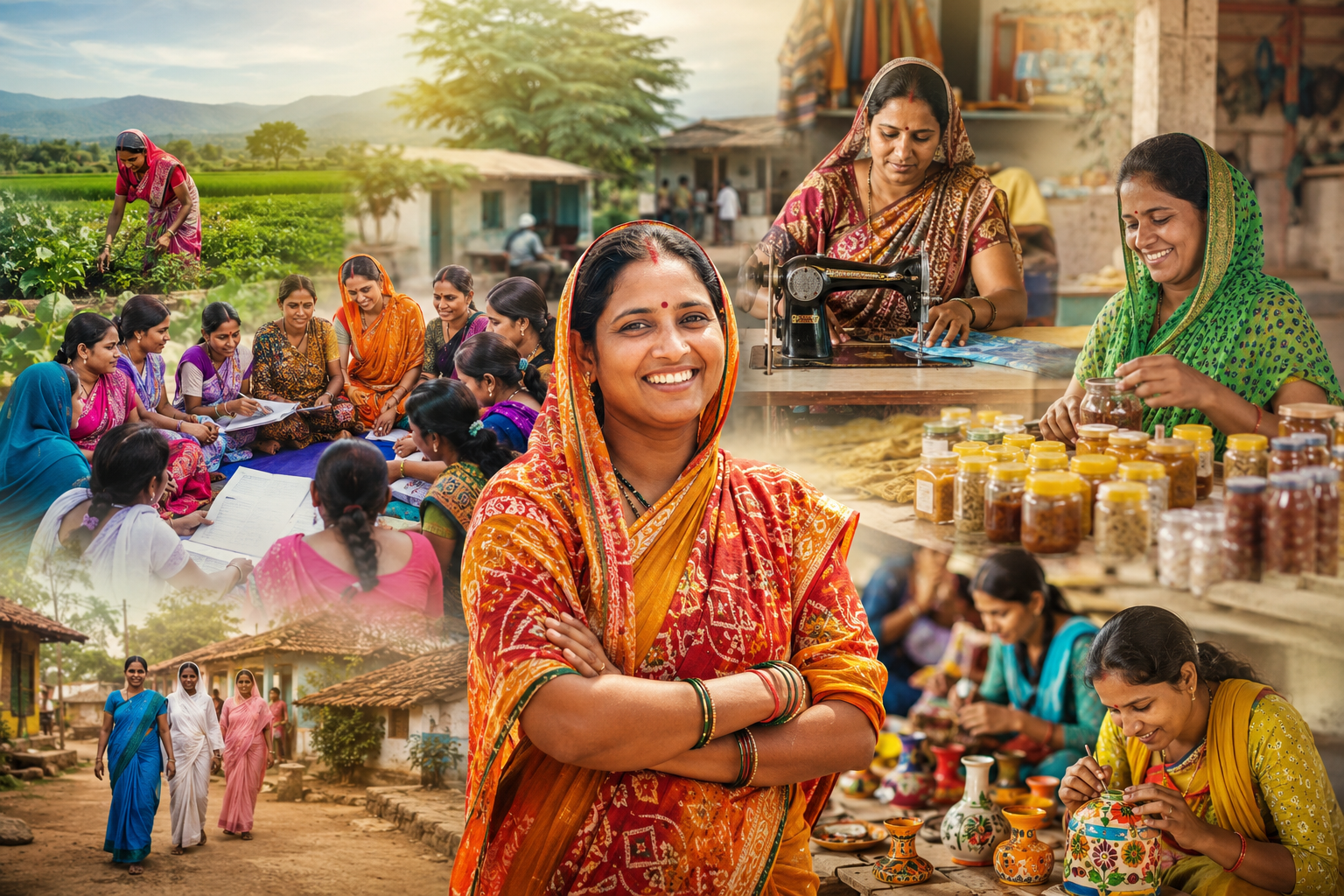
As India strengthens its position as the world’s third-largest start-up ecosystem, the focus is gradually extending beyond cities to villages. While urban centres continue to dominate the country’s innovation landscape, the government has sought to unlock entrepreneurial potential in rural areas through the Start-up Village Entrepreneurship Programme (SVEP)—a flagship initiative aimed at creating sustainable livelihoods by promoting small non-farm enterprises.
Launched in 2016 under the Deendayal Antyodaya Yojana–National Rural Livelihoods Mission (DAY-NRLM), SVEP supports Self Help Groups (SHGs) and their family members in establishing and expanding rural enterprises. The programme combines financial assistance, business training, mentoring, institutional support and access to credit, enabling aspiring entrepreneurs to build sustainable businesses within their own communities.
Strengthening Rural Livelihoods
SVEP focuses on promoting entrepreneurship in the non-farm sector, reducing dependence on agriculture while generating local employment opportunities. The programme provides business development services, soft skills training, financial literacy and market linkages, helping rural entrepreneurs convert ideas into viable enterprises.
By June 30, 2026, the programme had supported over 4.32 lakh rural enterprises across the country. It has also emerged as a strong model of inclusive development, with nearly 86 per cent of supported entrepreneurs belonging to Scheduled Castes, Scheduled Tribes, Other Backward Classes and minority communities.
The programme is implemented through State Rural Livelihoods Missions (SRLMs), with Block Resource Centres–Enterprise Promotion (BRC-EPs) coordinating implementation at the block level. Community Resource Persons–Enterprise Promotion (CRP-EPs) provide handholding support, business mentoring and credit facilitation to entrepreneurs, while SHGs and their federations identify potential beneficiaries and monitor enterprise performance.
Community-Led Model
One of SVEP’s distinguishing features is its community-driven implementation model. Entrepreneurs are identified by local community institutions based on entrepreneurial potential, livelihood needs and poverty status.
After assessing the viability of business proposals, beneficiaries receive training, mentoring and financial assistance through the Community Enterprise Fund (CEF) and bank credit. The programme also facilitates convergence with schemes such as the Pradhan Mantri Mudra Yojana, expanding access to institutional finance.
The programme mandates that at least 60 per cent of beneficiaries are women, while ensuring adequate representation of persons with disabilities and members of SC, ST and minority communities.
To support implementation, the Centre has released a cumulative ₹942.09 crore up to February 2026, reflecting a significant expansion in funding since the programme’s launch.
Backbone of Rural Entrepreneurship
SVEP operates through a structured ecosystem involving government agencies, financial institutions and community organisations.
Each block receives financial support of ₹6.50 crore, with an average investment of ₹27,083 per enterprise.
Community Resource Persons are selected jointly by SRLMs and implementing agencies after training and certification. At least 90 per cent of CRP-EPs are drawn from SHG households, while women constitute a minimum of 60 per cent of the cadre. Each trained CRP-EP mentors up to 50 enterprises, providing continuous support in business planning, market access and financial management.
Digital tools are also integrated into the programme for business planning, loan appraisal and enterprise tracking, enabling regular monitoring at both state and central levels through a centralized Management Information System (MIS).
Success Stories from the Ground
SVEP has produced several examples of rural entrepreneurship transforming lives.
In Maharashtra, Bhagyashri Londhe began producing masala, papad and pickles after joining a Self Help Group. A ₹45,000 Community Enterprise Fund loan enabled her to expand production using locally sourced raw materials. Her products gained recognition at Mahalaxmi Saras 2019-20, where she recorded ₹5 lakh in sales within ten days. Alongside managing her business, she completed her Class 10 education through an open university and received further training under NRLM and Krishi Vigyan Kendra programmes, eventually creating employment opportunities for other rural women.
Similarly, Poonam from Uttar Pradesh overcame financial and social challenges to become a Community Resource Person under SVEP. After completing a 54-day CRP-EP training programme, she began mentoring around 40 enterprises, assisting entrepreneurs with business planning, access to credit, market linkages and enterprise management. Her journey reflects the programme’s emphasis on building community-based entrepreneurship ecosystems.
Measuring the Impact
A mid-term evaluation conducted by the Quality Council of India (QCI) for the Ministry of Rural Development found encouraging outcomes from the programme.
According to the assessment:
- 99 per cent of SVEP-supported enterprises were profitable.
- These enterprises contributed 57 per cent of total household income.
- Average monthly enterprise revenue stood at approximately ₹39,000.
- Manufacturing enterprises reported the highest average monthly revenue of ₹47,800.
- 96 per cent of entrepreneurs reported increased savings.
- Nearly 75 per cent of enterprises were owned or managed by women.
The evaluation also highlighted improvements in financial inclusion, enterprise sustainability and women’s economic empowerment. Beneficiaries reported greater confidence, stronger financial management skills and better access to education, healthcare, nutrition and sanitation, reflecting broader improvements in household well-being.
Driving Inclusive Rural Growth
With over 10.29 crore rural households mobilised into Self Help Groups under DAY-NRLM, SVEP builds upon an extensive community network to promote entrepreneurship as a pathway out of poverty.
By supporting first-generation entrepreneurs, especially women and members of socially disadvantaged communities, the programme is helping diversify rural livelihoods, create local employment and strengthen village economies.


