







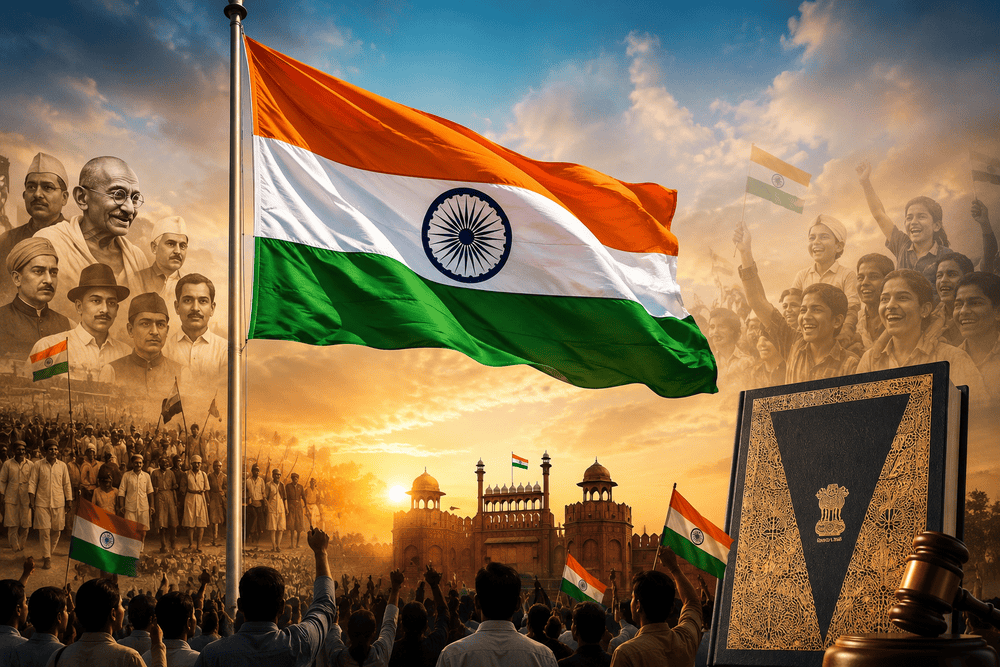
Seventy-nine years ago on July 22, 1947, the Constituent Assembly adopted the design of India’s National Flag, less than a month before the country attained Independence. The anniversary is observed as National Flag Day, celebrating the Tricolour in its present form.
As India prepares to celebrate its 80th Independence Day, the Tiranga continues to stand as the foremost symbol of the nation’s freedom, unity, sovereignty and constitutional values.
Popularly known as the Tiranga, the National Flag embodies the sacrifices of the freedom movement and the ideals of the Republic. Based on the design developed by freedom fighter Pingali Venkayya, it features three horizontal bands of saffron, white and green, with the navy blue Ashoka Chakra, a 24-spoke wheel, at its centre.
Evolution during the freedom movement
The Indian National Flag evolved over several decades alongside the country’s struggle against British rule, with each version reflecting the growing aspirations for self-rule and national unity.
One of the earliest known designs was created in 1904 by Sister Nivedita, a disciple of Swami Vivekananda. Featuring yellow and red colours, a Vajra symbol and a white lotus, it represented India’s emerging cultural and spiritual nationalism.
In 1906, during the Swadeshi Movement, a tricolour designed by Sachindra Prasad Bose and Hemchandra Kanungo was hoisted at Parsee Bagan Square in Calcutta. It featured eight lotus flowers, the words “Vande Mataram”, and symbols of the sun and crescent moon, reflecting unity and resistance to colonial rule.
A year later, freedom fighter Madam Bhikaji Cama unfurled an Indian flag at the International Socialist Congress in Stuttgart, Germany, the first known occasion on which an Indian national flag was hoisted on foreign soil. The flag, later known as the Saptarishi Flag, carried the message of India’s freedom struggle to the international community.
In 1917, during the Home Rule Movement, Annie Besant and Bal Gangadhar Tilak introduced another design featuring alternating red and green stripes, the Union Jack, seven stars and a crescent with a star. It symbolised the demand for self-government within the British Empire.
The foundation of the present-day Tricolour emerged in 1921, when Pingali Venkayya presented a flag design to Mahatma Gandhi during the All India Congress Committee meeting in Bezwada (now Vijayawada).
Gandhi suggested the inclusion of a white band and the Charkha, or spinning wheel, as a symbol of self-reliance and the Swadeshi movement. The resulting tricolour became the basis for the subsequent evolution of India’s National Flag.
In 1931, the Indian National Congress formally adopted a tricolour of saffron, white and green with the Charkha at its centre. Widely regarded as the precursor to the present National Flag, it became one of the defining symbols of India’s struggle for Independence.
Adoption of the National Flag
In June 1947, the Constituent Assembly appointed an ad hoc committee to recommend the design of the National Flag for independent India. The committee endorsed retaining the tricolour adopted by the Indian National Congress in 1931 while replacing the Charkha with the Ashoka Chakra to reflect the ideals of the new nation.
Acting on the committee’s recommendation, the Constituent Assembly formally adopted the present National Flag on July 22, 1947. The Ashoka Chakra was taken from the Dharma Chakra depicted on the Lion Capital of Emperor Ashoka at Sarnath. The navy blue wheel, with its 24 spokes, symbolises Dharma, justice, progress and the nation’s commitment to constant movement and righteous governance.
The Tricolour officially became India’s National Flag when the country attained Independence on August 15, 1947, and has remained the flag of the Republic ever since.
Constitutional and legal framework
The Constitution does not prescribe the design or technical specifications of the National Flag. However, its dignity is safeguarded through constitutional and statutory provisions.
Article 51A(a) of the Constitution makes it a Fundamental Duty of every citizen to abide by the Constitution and respect its ideals and institutions, the National Flag and the National Anthem.
The display, use and protection of the National Flag are governed by the Flag Code of India, 2002, the Emblems and Names (Prevention of Improper Use) Act, 1950, and the Prevention of Insults to National Honour Act, 1971. Together, these provisions regulate the proper display of the Tricolour and prohibit acts that disrespect or commercially misuse the National Flag.
Symbolism of the Tricolour
Each element of the National Flag embodies values central to India’s democratic ethos.
The saffron band represents courage, sacrifice and selflessness. White signifies peace, truth and integrity, while green stands for prosperity, growth and harmony with nature.
At the centre of the white band is the Ashoka Chakra, symbolising Dharma, justice and continuous progress. Its 24 spokes underscore the importance of constant movement, ethical governance and the rule of law.
Dimensions and specifications
The National Flag is manufactured in accordance with specifications prescribed by the Bureau of Indian Standards (BIS) under the Flag Code of India.
It maintains a 3:2 length-to-height ratio with three equal horizontal bands. The Ashoka Chakra, positioned at the centre of the white band, consists of 24 equally spaced navy blue spokes. The BIS also prescribes standard dimensions and colour specifications to ensure uniformity in the manufacture and display of the Tricolour.
Traditionally, the National Flag was made exclusively from hand-spun and handwoven khadi, reflecting the ideals of India’s freedom movement. However, amendments to the Flag Code in 2022 permitted the manufacture and use of machine-made flags as well as flags made from polyester, cotton, wool, silk and bunting, in addition to khadi.
Display of the National Flag
The Flag Code of India, 2002, which came into effect on January 26, 2002, consolidates the rules governing the display and use of the National Flag by citizens, private organisations and government institutions.
The code was amended in 2022 to allow the Tricolour to be flown both day and night, provided it is displayed in the open and occupies a position of honour. The amendments also permitted the use of machine-made polyester flags, broadening public access to the National Flag while retaining the standards governing its respectful display.
The National Flag may be flown on all days, provided it is displayed with dignity and respect. It must not touch the ground or water, be used as drapery or decoration, or be employed for commercial purposes. When displayed alongside other flags, it must occupy the position of honour. Damaged or soiled flags should be disposed of in a dignified manner.
Any act of disrespect towards the National Flag is punishable under the Prevention of Insults to National Honour Act, 1971.
Har Ghar Tiranga campaign
The Har Ghar Tiranga campaign is a nationwide initiative launched by the Government of India under the Azadi Ka Amrit Mahotsav programme to encourage citizens to hoist the Indian National Flag at their homes, workplaces and institutions. The campaign aims to strengthen people’s emotional connection with the Tiranga and promote awareness about the National Flag’s history, significance and the values it represents.
The Department of Youth Affairs has launched the National Flag Quiz 2026 on the MY Bharat Portal ahead of India’s 80th Independence Day celebrations.


