







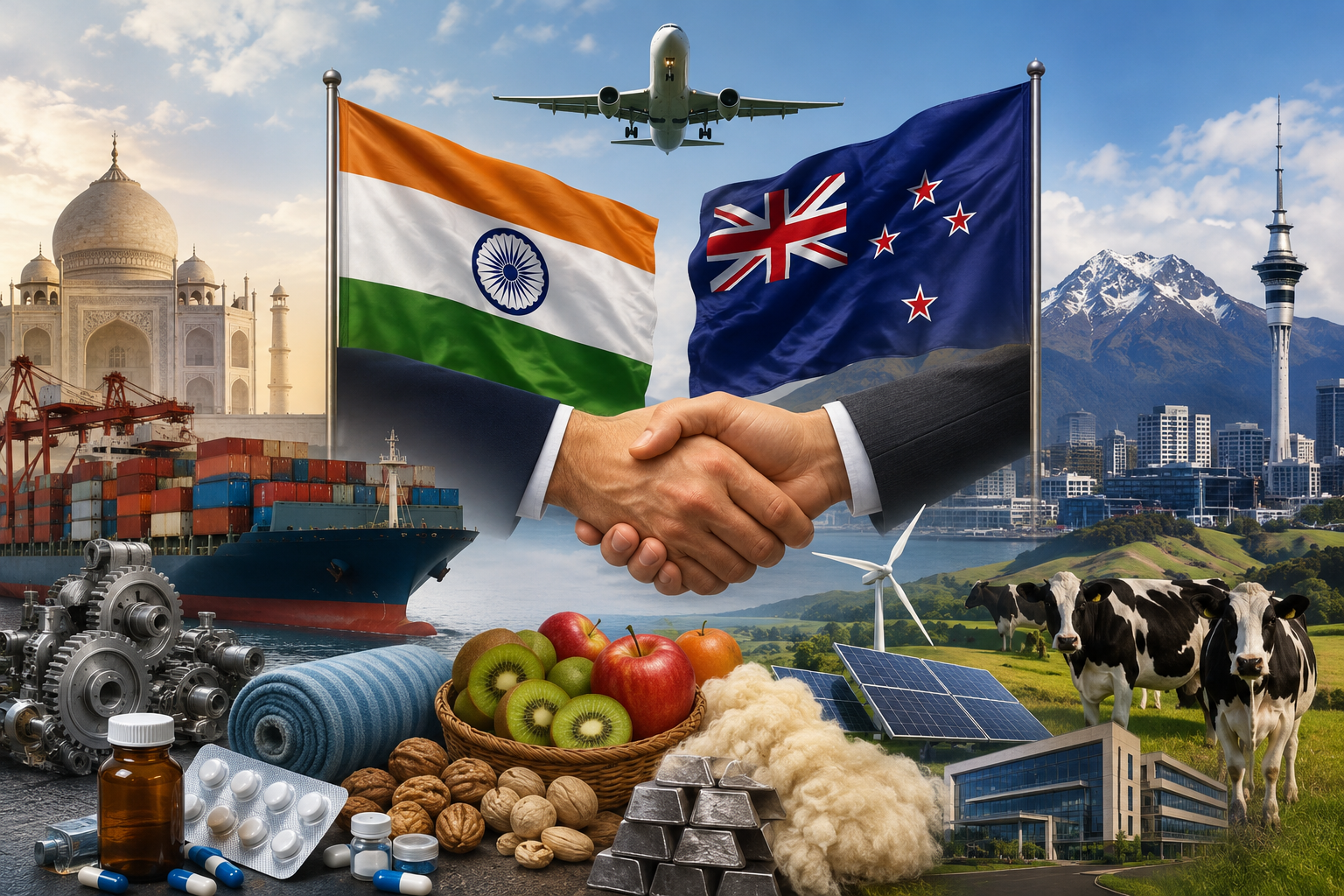
Prime Minister Narendra Modi’s official visit to New Zealand is expected to give fresh momentum to bilateral ties, particularly in trade, investment and economic cooperation.
India and New Zealand have significantly expanded their economic partnership over the past decade, with merchandise trade growing by 52 per cent, the conclusion of a landmark Free Trade Agreement (FTA) and stronger cooperation across trade, investment, connectivity and business.
According to official data, bilateral merchandise trade increased from USD 855 million in 2015-16 to USD 1.298 billion in 2024-25. India’s merchandise exports to New Zealand rose from USD 540 million to USD 711 million during the period, while imports from New Zealand increased by 7.2 per cent, enabling India to maintain a trade surplus. India’s services exports to New Zealand also grew, reaching USD 634 million in 2024, up 13 per cent year-on-year.
India’s key imports from New Zealand include wool, iron and steel, fruits and nuts, and aluminium, while exports are led by pharmaceuticals, mechanical machinery, made-up textile articles, and pearls and precious stones.
Trade engagement has been supported through the Joint Trade Committee, with the latest round of talks held in April 2024, focusing on cooperation in agriculture, pharmaceuticals, textiles, renewable energy and services.
A major milestone in bilateral economic relations came with the signing of the India-New Zealand Free Trade Agreement on April 27, 2026. India and New Zealand had announced the launch of FTA negotiations on March 16, 2025, and concluded them in a record nine months, making it India’s fastest-concluded free trade agreement.
The agreement provides enhanced market access and tariff preferences for Indian exports to New Zealand while positioning the country as a gateway to the wider Oceania and Pacific markets. It also covers investment, agricultural productivity, talent mobility, tourism, sports and people-to-people exchanges, and is expected to benefit manufacturers, farmers, MSMEs, women entrepreneurs, students and skilled professionals. The FTA also opens opportunities for cooperation in AYUSH and services, including Yoga instructors, Indian chefs, music teachers, information technology, engineering, healthcare, education and construction.
Connectivity has also improved. The updated Air Services Agreement signed in 2023 liberalised air services and expanded code-sharing opportunities. During New Zealand Prime Minister Christopher Luxon’s visit to India in 2025, Air India and Air New Zealand signed a memorandum of understanding covering a codeshare partnership across 16 routes and agreed to explore the launch of direct flights by 2028.
Indian companies including Infosys, Tech Mahindra, HCL, Mahindra Motors, Dr. Reddy’s Laboratories, Royal Enfield, Bank of India, Bank of Baroda and New India Assurance have expanded their presence in New Zealand. At the same time, New Zealand companies such as Gallagher Group, HamiltonJet, Sealegs, Valocity and Rakon have strengthened their operations in India across sectors including security technology, logistics, financial technology and telecommunications manufacturing.
The India New Zealand Business Council, the New Zealand-Bharat Chamber of Commerce and Industry, and the High Commission of India have also played an important role in promoting bilateral trade and investment through business forums and sector-specific engagements in pharmaceuticals, agriculture, engineering, manufacturing, tourism and technology.


