







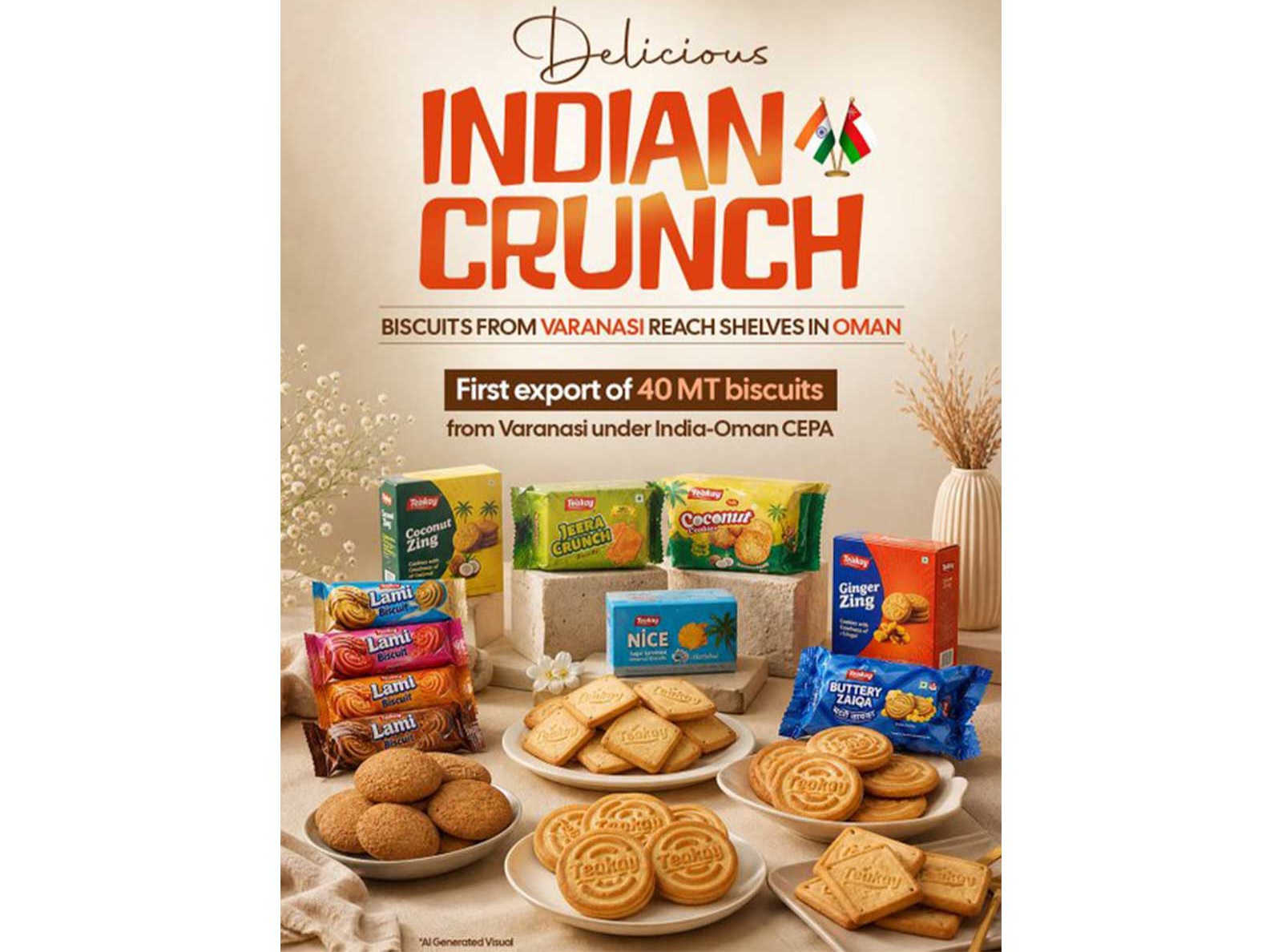
Commerce Minister Piyush Goyal on Friday said that, for the first time, 40 metric tonnes (MT) of biscuits manufactured in Varanasi have been exported to Oman under the India-Oman Comprehensive Economic Partnership Agreement (CEPA).
Goyal also announced that an MoU has been signed for the supply of nearly 700 MT of biscuits to Oman and other Gulf Cooperation Council (GCC) countries during the 2026-27 financial year. In a post on X, the minister said the preferential tariff benefits available under the CEPA have enabled duty-free access for biscuits made in India, making them more price-competitive than products from other key suppliers in the Omani market. “This is expected to translate into higher export volumes and repeat orders from importers in the region. Clearly a big boost to our food processing sector with increased production and job generation,” he said.
The India-Oman CEPA, signed on December 18, 2025, during Prime Minister Narendra Modi’s visit to Muscat, came into effect on June 1. Trade has remained a key pillar of bilateral ties, with both countries seeking to further expand and diversify economic engagement. Bilateral trade stood at $10.61 billion in FY 2024-25, up from $8.94 billion in FY 2023-24, while trade during April-October 2025 reached $6.48 billion.
According to an official statement, the CEPA integrates trade in goods and services, investment, professional mobility and regulatory cooperation into a single framework aimed at deepening bilateral economic integration. Rather than being limited to tariff reductions, the agreement seeks to promote sustained long-term economic engagement by facilitating trade, encouraging investment and expanding cooperation in sectors of mutual interest. It is expected to create opportunities for labour-intensive industries, services and emerging sectors, while maintaining a balanced approach to market access with clearer rules, greater predictability and wider opportunities for businesses and investors in both countries without compromising domestic priorities and safeguards.
(IANS)


