







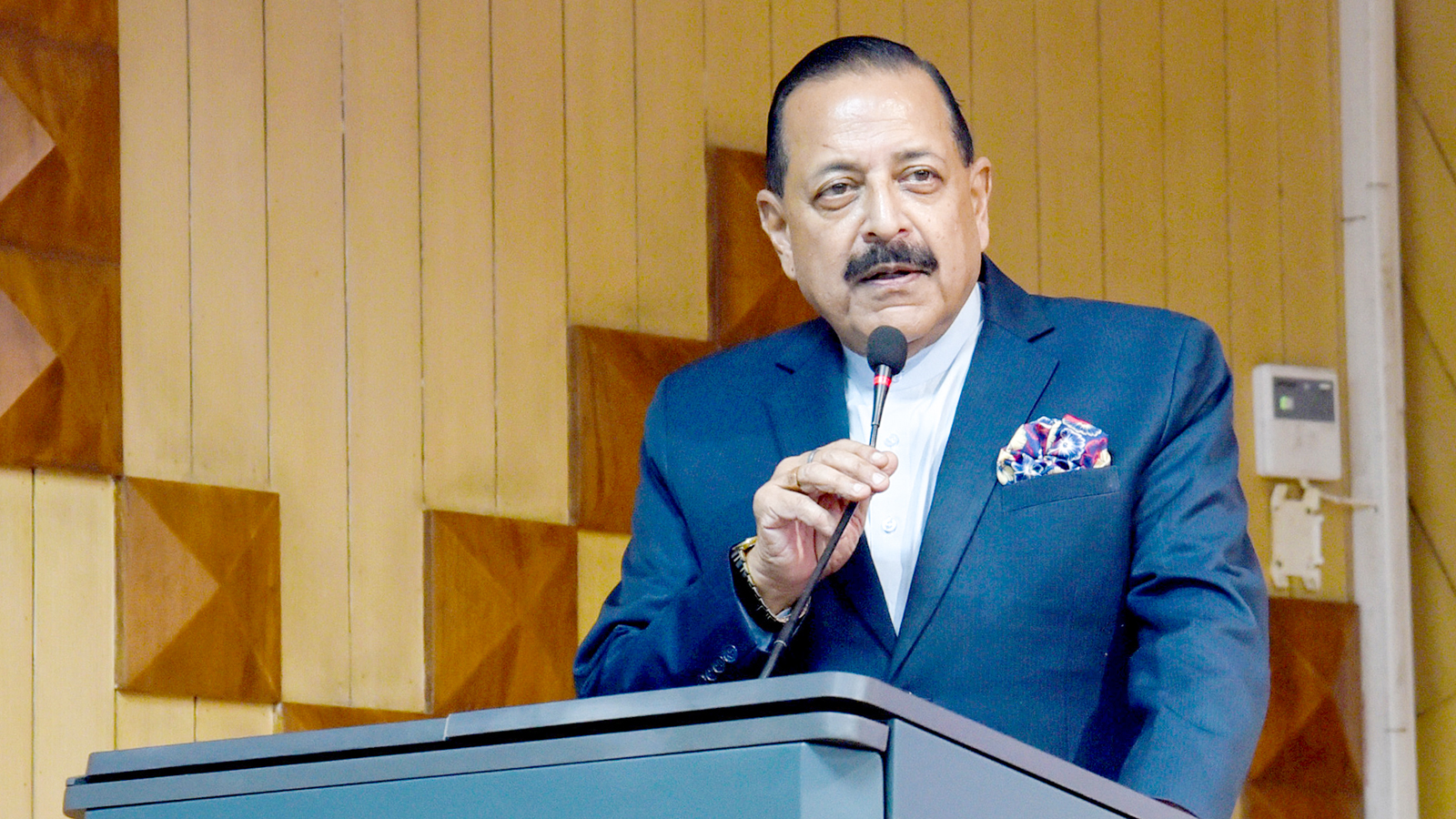
Union Minister of State (Independent Charge) for Science & Technology, Earth Sciences, and Minister of State in the Prime Minister’s Office, Personnel, Public Grievances & Pensions, Department of Atomic Energy and Department of Space, Dr. Jitendra Singh, on Saturday hailed the successful launch of Vikram-1, India’s first privately developed orbital launch vehicle, as a landmark achievement that establishes the country as a serious global player in the rapidly expanding space economy.
Witnessing the launch of Mission Aagaman at the Satish Dhawan Space Centre in Sriharikota, the minister said the success of Skyroot Aerospace’s Vikram-1 vindicates Prime Minister Narendra Modi’s decision to open India’s space sector to private participation through landmark reforms introduced in 2020.
The mission saw Vikram-1 successfully place its payload into the designated Low Earth Orbit, making Skyroot Aerospace the first Indian private company to achieve an orbital launch from Indian soil. The achievement marks a major milestone in India’s space journey and highlights the growing strength of the country’s public-private partnership model involving the Department of Space, the Indian Space Research Organisation (ISRO), the Indian National Space Promotion and Authorization Centre (IN-SPACe) and India’s space start-up ecosystem.
PM Modi congratulated the Skyroot Aerospace team on the historic achievement, describing it as a proud milestone for India’s expanding space ecosystem and a reflection of the country’s scientific capability, entrepreneurial spirit and innovation-driven growth.
Congratulating Skyroot Aerospace founders Pawan Kumar Chandana and Bharath Daka, Singh said the government’s reforms had unlocked the immense potential of Indian innovators by providing them access to national space infrastructure and creating an ecosystem where world-class space technologies could be conceived, developed and launched entirely from India.
The minister also praised ISRO, IN-SPACe and the Department of Space for creating a seamless framework for collaboration between the government and private industry. He said the success of Vikram-1 demonstrated how visionary policymaking, scientific excellence and entrepreneurial talent could combine to produce globally competitive technological achievements.
Recalling his long association with the Skyroot team, Singh said he had followed the company’s journey from its early days and admired the founders’ technological confidence and innovative approach. He described the successful mission as the result of years of perseverance and scientific excellence by India’s young entrepreneurs.
Highlighting the significance of the mission, the minister said Vikram-1 displayed a high level of technological maturity despite being a maiden orbital launch. Unlike many first launches worldwide that carry only dummy payloads, Vikram-1 carried experimental payloads to validate advanced technologies in orbit, along with customer payloads and technology demonstrations from Indian and international partners, reflecting growing global confidence in India’s commercial launch capabilities.
Singh said India’s space ecosystem has undergone a remarkable transformation since the sector was opened to private participation in 2020. He noted that India now has more than 400 space start-ups, its first space unicorn and a space economy valued at nearly USD 9 billion, with a vision of expanding it to approximately USD 44 billion over the next decade.
Built entirely in India, Vikram-1 is capable of placing payloads of up to 350 kilograms into Low Earth Orbit. Standing about 22 metres tall, the launch vehicle incorporates several indigenous technological innovations, including India’s first all-carbon composite orbital rocket, a 100 per cent 3D-printed liquid engine powering its Orbital Adjustment Module, advanced ultra-low-shock pneumatic separation systems and one of the country’s longest monolithic carbon-composite rocket stages.
The minister said the mission successfully validated critical propulsion, avionics, telemetry, navigation and flight-control systems, laying the foundation for future commercial orbital launch services from India.
Describing the mission as more than the success of a single launch, Singh said Vikram-1 marked the beginning of a new era in which Indian innovation, backed by bold policy reforms and strong public-private collaboration, would play a greater role in shaping the global space economy.
“For India, the sky is no longer the limit,” he said.


