







Sustainability is emerging as the next growth driver for India’s textile and apparel industry as the country accelerates efforts to build a circular textile economy through policy support, cleaner production technologies, waste recovery, eco-labelling and responsible sourcing.
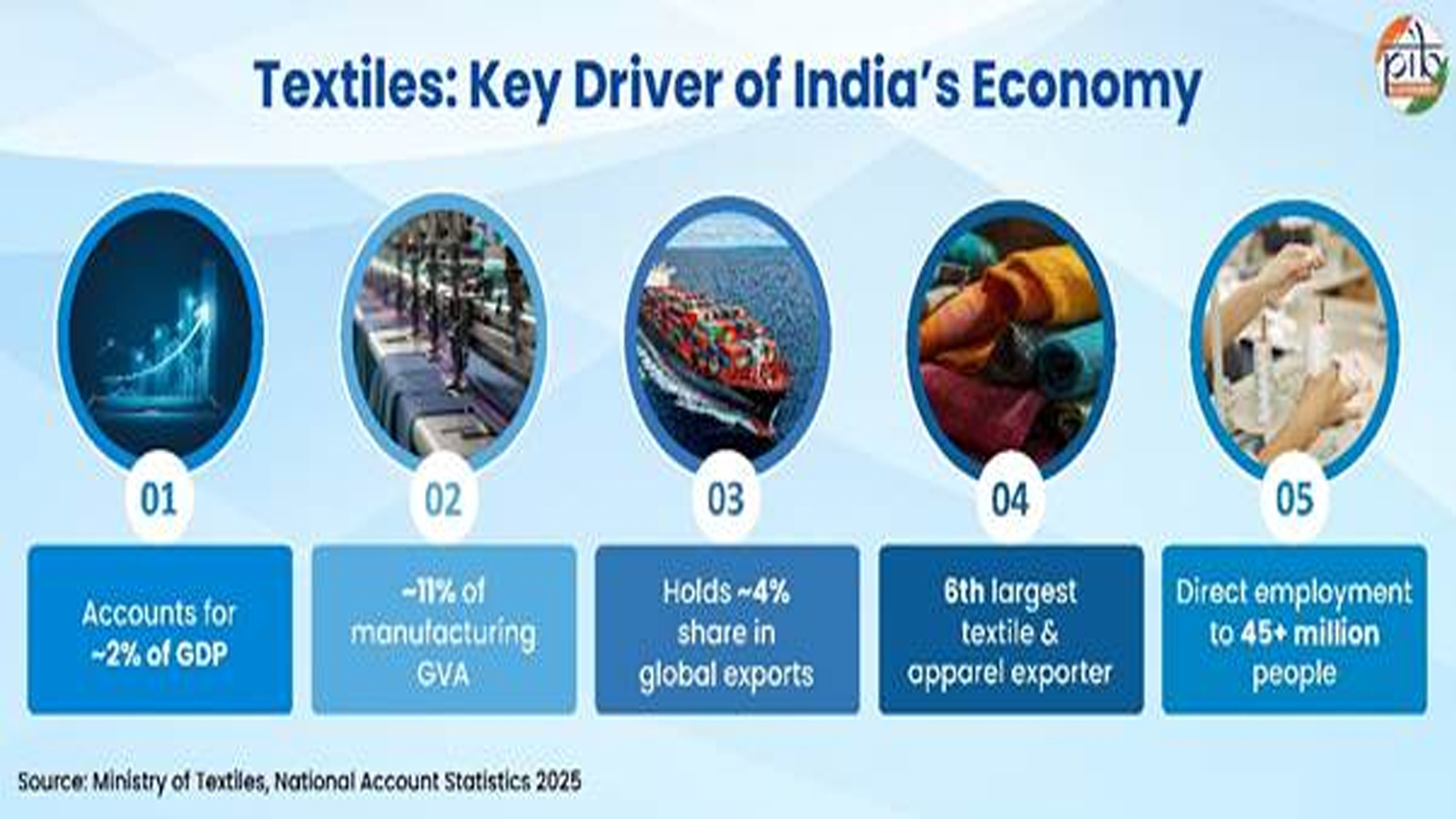
One of India’s largest manufacturing sectors, the textile and apparel industry contributes nearly 2 per cent to the country’s Gross Domestic Product (GDP) and around 11 per cent of manufacturing Gross Value Added (GVA), according to the National Account Statistics 2025. India is also the world’s sixth-largest exporter of textiles and apparel, accounting for about 4 per cent of global exports while providing direct employment to more than 45 million people, including a large number of women and rural workers.
As global demand increasingly favours environmentally responsible products, India is positioning sustainability at the centre of its textile value chain to enhance global competitiveness while reducing environmental impact.
At the heart of this transition is the concept of a circular economy, where materials are reused, recycled and kept in circulation for as long as possible. In the textile sector, this approach reduces waste, conserves water and energy, lowers the use of hazardous chemicals and extends the life cycle of textile products.
India already demonstrates significant progress in textile circularity. Of the nearly 7.8 million tonnes of textile waste managed annually, more than 90 per cent originates from domestic pre-consumer and post-consumer waste streams. Over 70 per cent of this waste is recovered through recycling, upcycling, downcycling or reuse. Recovery is particularly strong in the pre-consumer stage, where nearly 95 per cent of textile waste is collected and reintegrated into production. Nearly all spinning waste is reused within the manufacturing process, while around 55 per cent of post-consumer textile waste is diverted from landfills through an extensive collection and sorting network.
The country’s textile waste recovery ecosystem also serves as an important source of employment, supporting nearly 40 to 45 lakh livelihoods, with women from marginalised communities playing a major role in collection, sorting and redistribution activities.
Several local initiatives highlight the growing momentum of textile circularity. India’s first Municipal Textile Recovery Facility at Belapur in Navi Mumbai has integrated collection, sorting, upcycling, technology and livelihood generation into a single recovery ecosystem. The facility has collected 30 metric tonnes of post-consumer textile waste, sorted 25.5 metric tonnes, processed more than 41,000 textile items and developed over 400 upcycled product samples while reaching nearly 1.14 lakh families.
Panipat has strengthened its position as one of India’s largest downstream textile recycling hubs by processing nearly 3,500 to 5,250 tonnes of textile waste every day. The cluster supports collection, sorting, knitting, processing and recycling, creating opportunities for higher-value textile-to-textile recycling.
In Delhi, the Katran Market at Mongolpuri has emerged as an important link in the recycling chain, where cutting waste collected from industrial clusters across North India is sorted by colour before being supplied to recycling units in Panipat.
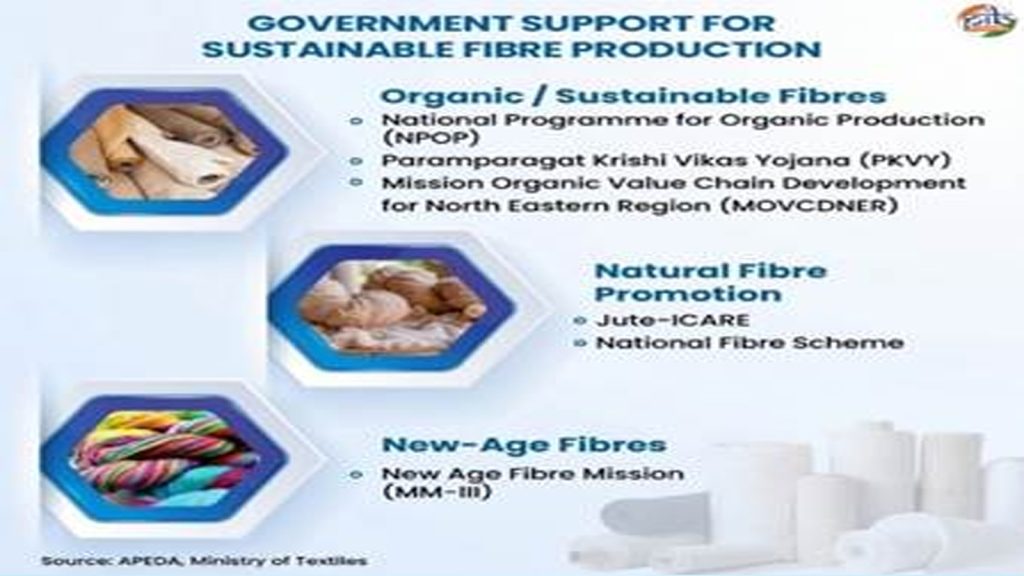
The government’s sustainability strategy extends across every stage of the textile value chain, beginning with fibre production. Programmes such as the National Programme for Organic Production (NPOP) are promoting certified organic cotton through internationally recognised standards, while the Jute-ICARE initiative is encouraging scientific and sustainable jute cultivation. Since its launch in 2015, Jute-ICARE has expanded from 130 blocks across seven states to 289 blocks in ten states, with coverage increasing from around 1.11 lakh hectares to nearly 2.15 lakh hectares during 2024-25.
The New Age Fibre Mission under the Mission for Cotton Productivity is promoting sustainable natural fibres such as ramie, sisal and flax as environmentally friendly alternatives to synthetic materials. Complementing this effort, the National Fibre Scheme aims to strengthen self-reliance across natural, man-made and new-age fibres while encouraging innovation in advanced textile materials.
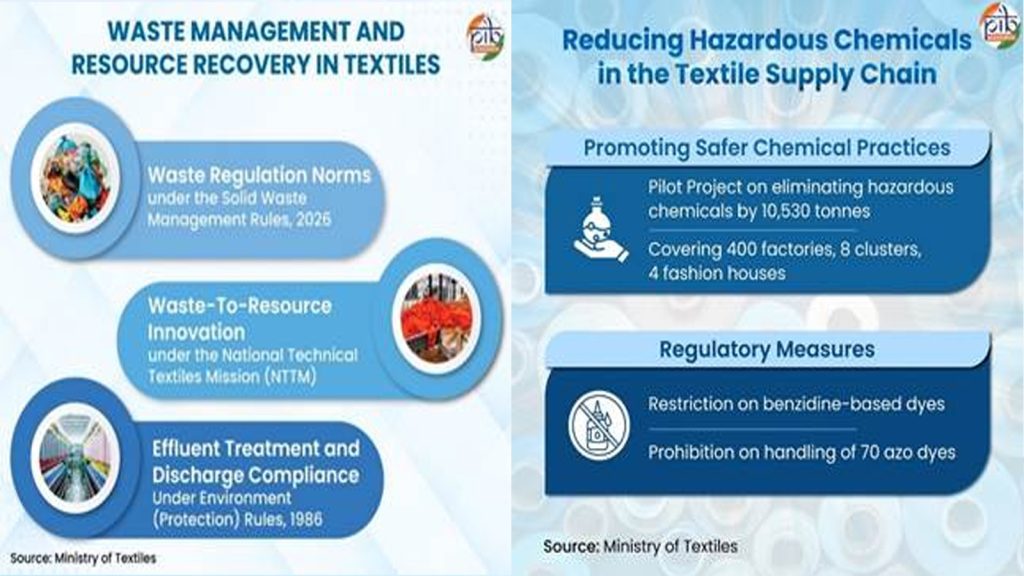
Reducing the use of hazardous chemicals is another important pillar of sustainable textile production. Pilot projects promoting safer chemicals, eco-friendly textiles and organic production have been launched across the country. One ongoing initiative covering 400 factories across eight textile clusters and four fashion houses is expected to mitigate 1,47,000 tonnes of carbon dioxide equivalent emissions while reducing hazardous chemical use by more than 10,530 tonnes. Restrictions on benzidine-based dyes and 70 azo dyes, along with India’s commitment under the Stockholm Convention on Persistent Organic Pollutants, further support cleaner textile production.
On the manufacturing side, sustainability has been integrated into the development of PM Mega Integrated Textile Region and Apparel (PM MITRA) Parks. Built around the “Farm to Fibre to Factory to Fashion to Foreign” vision, these integrated textile hubs include common effluent treatment plants, wastewater recycling systems, scientific waste management and shared infrastructure. Seven PM MITRA Parks have been approved with a total outlay of ₹4,445 crore up to 2027-28 across Tamil Nadu, Telangana, Gujarat, Karnataka, Madhya Pradesh, Uttar Pradesh and Maharashtra. By December 2025, memoranda of understanding involving potential investments exceeding ₹27,434 crore had already been signed.
Recognising the important role of Micro, Small and Medium Enterprises (MSMEs), which account for more than 80 per cent of India’s textile and apparel production capacity, the government has introduced green support measures under the Raising and Accelerating MSME Performance (RAMP) Programme. The MSE-GIFT scheme promotes adoption of green technologies through interest subvention and credit guarantees, while the MSE-SPICE scheme provides capital subsidy for investments supporting circular economy practices.
The textile sector has also been brought under the Indian Carbon Market through the Carbon Credit Trading Scheme (CCTS), notified in 2023. Textile units are required to disclose direct and indirect greenhouse gas emissions, while industries exceeding emission reduction targets become eligible to earn tradable Carbon Credit Certificates, encouraging greater adoption of cleaner technologies.
Further support for sustainable manufacturing is being provided through studies on best available technologies, comprehensive industry documents and the Tex Eco Initiative, which aims to align India’s textile industry with global sustainability standards.
The post-production stage is also witnessing significant policy intervention. India’s textile recycling market is projected to reach USD 3.5 billion by 2030 and is expected to generate nearly one lakh green jobs over the next five years.
The Solid Waste Management Rules, 2026, which came into force on April 1, 2026, incorporate circular economy principles and extended producer responsibility while promoting improved waste segregation and resource recovery. The rules also mandate the phased increase in the use of Refuse Derived Fuel (RDF), including textile waste, by industries such as cement and waste-to-energy plants.
The National Technical Textiles Mission is supporting research projects that convert textile waste, biomass and bio-residues into advanced green materials, including carbon fibres and functional textiles. Environmental standards also require textile industries and clusters to operate effluent treatment plants or common effluent treatment plants to ensure compliance with prescribed discharge norms.
The recently released report, Mapping of Textile Waste Value Chain in India, provides a comprehensive assessment of textile waste generation and identifies opportunities for strengthening recycling, upcycling and resource recovery across the value chain.
Beyond production and recycling, sustainability is also being promoted through market incentives and certification systems. Under the Eco-Mark Scheme, 2024, textiles have been identified as one of the product categories eligible for eco-labelling, with 13 Indian Standards notified for certification. Initiatives such as Kasturi Cotton and Silk Mark are strengthening traceability and quality assurance, helping Indian textile products gain greater acceptance in international markets.
To encourage demand for sustainable products, a tripartite memorandum of understanding signed in 2024 between the Textiles Committee, Government e-Marketplace (GeM) and the Standing Conference of Public Enterprises (SCOPE) seeks to promote procurement of upcycled textile products by public agencies.
Industry awareness is also being strengthened through initiatives such as Sustainable Resolution (SURE), the Circle Back campaign, Circular Samvaad and the ESG Task Force, which encourage adoption of sustainable production practices and knowledge sharing across the textile ecosystem.
India’s flagship global textile event, Bharat Tex, has further reinforced the sustainability agenda by bringing together the entire textile value chain. Following successful editions in 2024 and 2025, Bharat Tex 2026 is being planned with a stronger focus on circular textiles, technical textiles, innovation, MSME participation and global market access.
Drawing upon centuries-old traditions of reuse, repair and resource-conscious production, India is integrating its cultural heritage with modern industrial practices to build a more sustainable textile economy. Through initiatives spanning organic fibre cultivation, cleaner manufacturing, waste recovery, recycling, certification and market support, the country is steadily weaving sustainability into the future of one of its most significant manufacturing sectors.


