







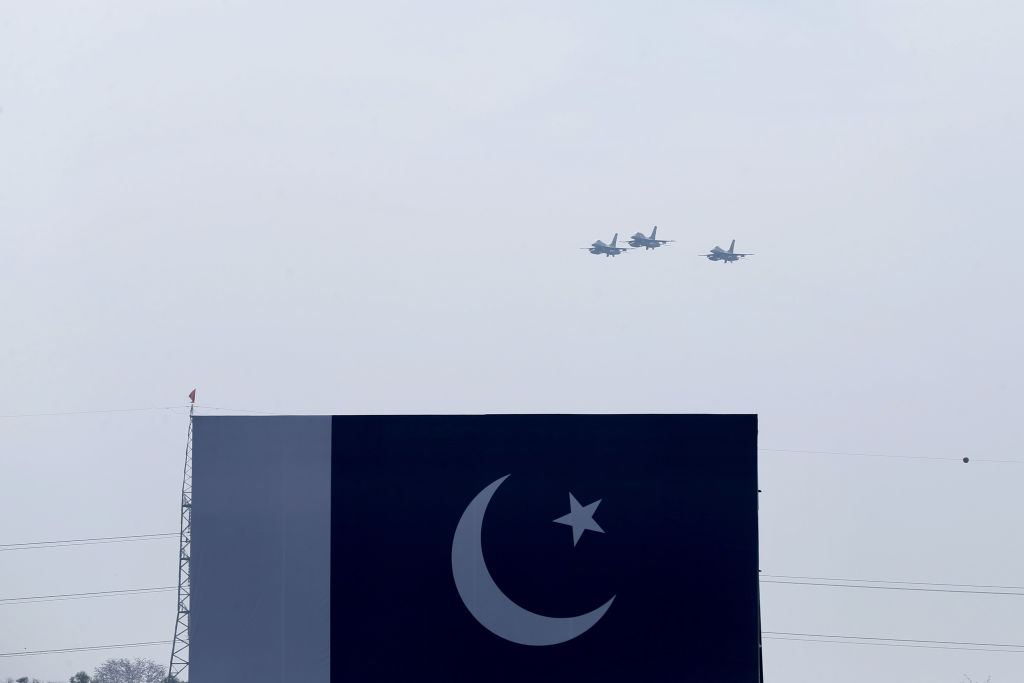
A massive, secretive 60-hour military airlift into Pakistan has put South Asian security planners on high alert. Between 19th and 21st August, open-source flight-tracking telemetry captured an extraordinary logistical surge: A continuous, high-frequency cargo bridge executed by Turkish and Chinese military transport aircraft into Pakistan’s primary airbases.
The round-the-clock operation has turned local runways into hotbeds of intense military activity. While the official cargo manifests remain strictly classified, media reports suggest that this is a rapid, strategic emergency replenishment. Islamabad is scrambling to patch up critical structural vulnerabilities exposed during India’s devastating air strikes under Operation Sindoor.
The flight-tracking data links this massive logistical surge directly to three strategically vital Pakistan Air Force hubs:
— Nur Khan Airbase in Rawalpindi, the nerve centre of Pakistan’s military headquarters;
— Masroor Airbase in Karachi, the country’s largest strategic logistics and maritime air operations hub; and
— Murid Airbase in Punjab, the primary facility dedicated to Pakistan’s unmanned aerial vehicle operations.
What exactly was inside those military cargo-holds? Reports point to high-value hardware meant to replace assets completely destroyed by the Indian Air Force. At the top of the list: Next-Generation Mobile Mission Control Centre units. These advanced, truck-mounted modules serve as the “back-up brain” of Pakistan’s air-defence network. During Operation Sindoor, the I.A.F. successfully targeted and destroyed two of these control hubs at Nur Khan Airbase, shattering the real-time data link between Pakistani commanders, ground sensors, and combat jets.
Turkiye has reportedly rushed these replacements to restore Islamabad’s broken command-and-control capabilities. The Turkish military bridge also allegedly delivered cutting-edge, satellite-enabled Bayraktar T.B.-2 tactical drones and the heavier, longer-range Bayraktar Akıncı combat U.A.V.s. Furthermore, the shipments reportedly contained Yiha-3 loitering munitions, Songar armed drones, and component parts for Turkiye’s stealth Anka-3 unmanned combat aircraft and Super Simsek decoy drones.
Simultaneously, Beijing has flown in its heavy hardware. Chinese military aircraft reportedly offloaded advanced H.Q.-series surface-to-air missile systems at both Nur Khan and Masroor airbases to rebuild a heavily compromised radar and air-defence umbrella.
This sudden, aggressive military build-up comes on the heels of a major geopolitical shift. Just weeks ago, on 7th August, Pakistan, Turkiye and Saudi Arabia signed the Mecca Joint Defence Agreement. It treats an attack on one as an attack on all.
Yet, this multi-billion-dollar military expansion stands in staggering contrast to Pakistan’s domestic collapse. As of August 2026, Pakistan’s economy remains on life support, surviving entirely on international bailouts with an outstanding I.M.F. credit line exceeding 8 billion dollars. While ordinary Pakistani citizens flood the streets protesting soaring fuel prices, astronomical electricity bills, and an unmanageable cost-of-living crisis, Islamabad’s spending priorities tell a very different story.
Case in point: The headquarters of the U.N.-designated terrorist organisation, Jaish-e-Mohammed, in Bahawalpur. Heavily damaged during recent Indian military actions, intelligence confirms the Markaz Subhanallah Complex has been fully restored. The facility features brand-new marble cladding and fresh paint. Reports say that the Pakistani Government directly funnelled State funds to the terrorist outfit for this reconstruction. It’s a glaring paradox. Islamabad actively begs global financial institutions for economic survival, while simultaneously spending its scarce funds on rebuilding terror infrastructure and executing emergency multi-billion-dollar military hardware imports.
The massive Turkish and Chinese airlifts leave South Asia with a definitive question — how long can Pakistan continue to prioritise its aggressive military ambitions and terror proxies over the basic economic survival of its people? Sample this. 90 per cent of overseas beggars arrested in the Gulf come from just one country — Pakistan! This, according to Pakistan’s Overseas Ministry Secretary, Zulfikar Haider, who shared this statistic with a parliamentary standing committee on overseas Pakistanis in September 2023.
Organised human-trafficking syndicates have been exploiting Umrah and Hajj pilgrim visas to send large groups into Saudi Arabia, Iran, and Iraq solely to engage in begging and pickpocketing at holy sites. Now, Islamabad is scrambling to stop what officials call a “reputational disaster”. The Pakistani embassy in Saudi Arabia has issued a blunt public advisory warning its nationals — beg, and face immediate arrest, heavy fines, and permanent deportation. To drive the message home, the embassy even released a video.
Things have come to such a pass that certain politicians have become emboldened to challenge the Army. Maulana Fazlur Rehman, the chief of the Jamiat Ulema-e-Islam, has launched an unprecedented, direct attack on Pakistan’s military establishment, specifically targeting Army Chief Gen. Asim Munir. In a series of recent speeches, he openly mocked the Army’s “chest-thumping and tall claims” by reminding them of their historical and humiliating 1971 surrender to India. He questioned why ordinary Pakistani citizens are continuously subjected to extreme financial hardships and rising inflation while the unelected military establishment manipulates political mandates from behind the scenes. He openly praised India’s surging economic strength as a reality check for Pakistan. In fact, Rehman warned Pakistan’s leadership to stop its persistent, empty rhetoric of war and confrontation with India. He explicitly pointed out that India has successfully grown to become the world’s fourth-largest economy, backed by foreign exchange reserves running into hundreds of billions of dollars.
While India moves rapidly ahead, Pakistan is perpetually stuck on the economic precipice, constantly surviving on foreign bailouts. He also exposed the military’s strategic hypocrisy regarding India and Afghanistan. Rehman said that if Pakistan justifies its military strikes inside Afghanistan, it has no ground to object when India targets terrorist centres inside Pakistani cities such as Bahawalpur and Muridke. Rehman has gone on to publicly dare Army Chief Asim Munir to hang up his uniform, retire, and contest democratic elections to see if he actually has any genuine support among the public.
(Ramesh Ramachandran is a senior consulting editor with D.D. India)


