






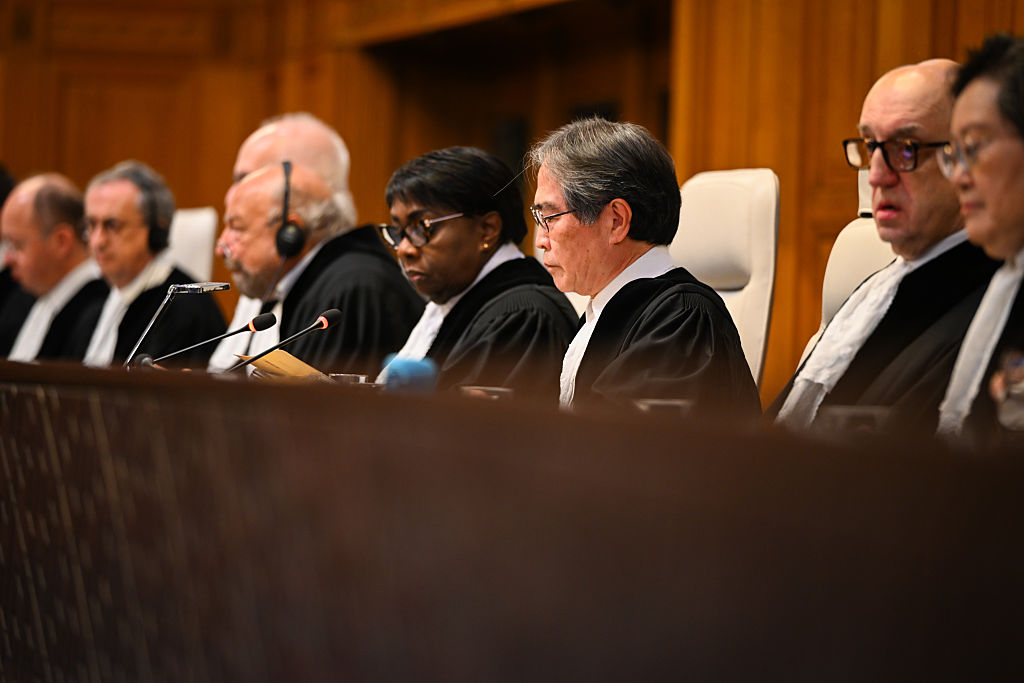
In a landmark decision on 19th November, the International Court of Justice ruled that Myanmar committed genocide against the Rohingya population in northern Rakhine State. Delivering the judgment in The Hague, Court President Yuji Iwasawa announced that nine of the 15 judges on the panel voted against Myanmar.
Following the ruling, the world court ordered Myanmar to take immediate, concrete steps to address the atrocities:
• Investigate and prosecute those responsible for the crimes;
• pay reparations and compensation to the victims; and
• guarantee the safe, voluntary return of displaced Rohingya refugees.
Myanmar has been given a two-year deadline to report back to the court on its plans to compensate survivors.
While many headlines have framed the verdict as Myanmar being found “guilty”, legal experts point out an important distinction. Strictly speaking, the I.C.J. is a civil court that settles disputes between nations, not a criminal tribunal that jails individuals. Rather than handing down criminal guilt, the court holds a State legally responsible for breaching international law — specifically, the 1948 Genocide Convention.
As the principal judicial arm of the United Nations, all 193 U.N. member-states, including Myanmar, are automatically parties to the I.C.J. Statute. Non-member observer States, such as Palestine or the Holy See, are not automatic members, though they can accept the court’s jurisdiction under special conditions.
The judgment marks two major milestones in international law. In previous cases — such as the Bosnian genocide case — the I.C.J. ruled that a State failed to prevent genocide, stopping short of declaring that the State itself committed the crime. In this instance, the judges crossed that threshold for the first time.
Additionally, it is the first time a nation with no direct connection to the conflict successfully invoked the Genocide Convention on behalf of humanity. The case was brought forward by the West African nation of The Gambia.
Legal analysts say that the ruling will have ripple-effects on international justice. The I.C.J. is currently hearing two other high-stakes genocide cases: South Africa’s case against Israel over the war in Gaza, and Ukraine’s case against Russia.
In the Myanmar ruling, judges inferred “genocidal intent” from a pattern of systematic conduct rather than requiring a written, “smoking-gun” order from top leadership. Experts note that this evidentiary standard could heavily influence how the court evaluates the cases involving Israel and Russia in the coming months.
For the Rohingya people, the ruling is less about legal theory and more about survival and identity. Stripped of their citizenship under Myanmar’s 1982 nationality law, the Rohingya were rendered Stateless in their own homeland.
In August 2017, following militant attacks on security posts, Myanmar’s military launched a brutal crackdown that the U.N. branded a “textbook example of ethnic cleansing.” More than 7,00,000 Rohingya fled into neighbouring Bangladesh, where over a million now live in sprawling refugee camps. Ahead of the verdict, Rohingya refugee Mohammed Furkhan, who fled in 2017, told The New York Times that he hoped the world court would officially recognise the violence as genocide, pushing the global community to finally find a lasting solution.
International response to the verdict has been swift and sharply divided.
• The Myanmar military regime rejected the ruling, dismissing it as a “great disappointment” and “unfair.”
• U.K. Foreign Secretary Ed Miliband announced immediate diplomatic action, ordering the expulsion of Myanmar’s defence attache from London and calling for an urgent U.N. Security Council session.
• And India, for its part, said that it has “taken note” of the verdict, reiterating New Delhi’s consistent support for the safe, speedy, and sustainable return of displaced Rohingyas to Rakhine State.
Despite the weight of the verdict, the central question remains whether it can be enforced. While I.C.J. judgments are legally binding on paper, the court possesses no police force or military to compel compliance. If Myanmar refuses to abide by the ruling, enforcement falls to the U.N. Security Council. However, permanent members Russia and China — both close allies of Myanmar’s military junta — hold veto power, making decisive Security Council action unlikely.
Meanwhile, inside Myanmar, a raging civil war triggered by the 2021 military coup continues to leave Rakhine State in turmoil.
While the world’s highest court has shattered decades of denial and handed the Rohingya a monumental legal victory, a wide chasm of geopolitics and ongoing conflict still separates the courtroom in The Hague from the burnt villages of Rakhine State. Until legal declarations translate into physical safety, restored citizenship, and a guaranteed path home, true justice for the Rohingya remains a promise waiting to be kept.
Ramesh Ramachandran is a senior consulting editor with D.D. India


