







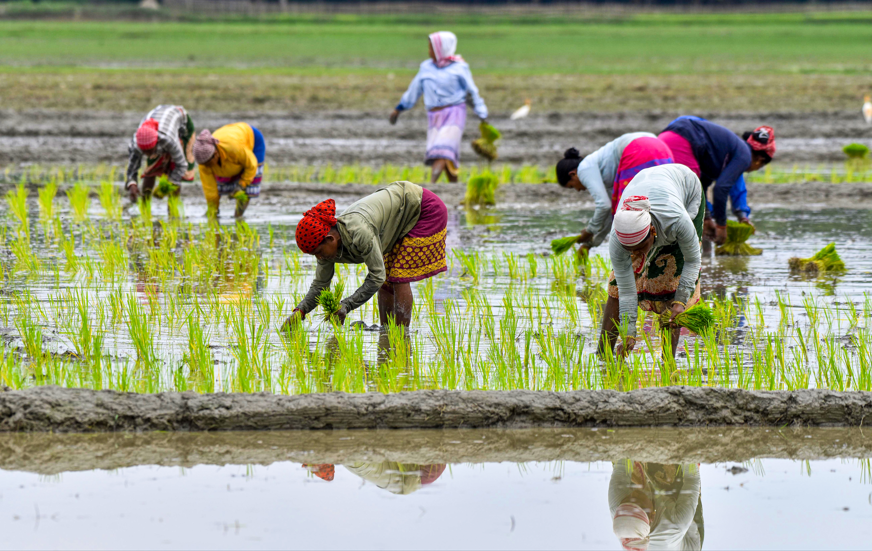
India’s agriculture and allied sectors have witnessed significant expansion over the past decade, with higher agricultural production, increased farmer support, wider access to institutional credit and growing adoption of technology and sustainable farming practices.
Agriculture and allied-sector Gross Value Added rose from Rs 20.94 lakh crore in 2014-15 to an estimated Rs 52.08 lakh crore in 2025-26. The budget allocation for the Department of Agriculture and Farmers Welfare also increased from Rs 27,663 crore in 2013-14 to Rs 1,40,528.78 crore in 2026-27.
Foodgrain production increased from 265.05 million tonnes in 2013-14 to 376.56 million tonnes in 2025-26, according to the Third Advance Estimates. Horticulture production rose from 280.70 million tonnes to an estimated 377.78 million tonnes during the same period, while oilseeds production increased from 27.51 million tonnes in 2014-15 to 43.06 million tonnes in 2025-26.
Direct support to farmers has also expanded through schemes such as PM-KISAN. More than Rs 4.47 lakh crore has been transferred directly into farmers’ bank accounts through 23 instalments. Under the 23rd instalment, more than 9.49 crore farmers received over Rs 18,984 crore.
Under the Pradhan Mantri Fasal Bima Yojana, more than 92.46 crore farmer applications have been insured since the scheme’s launch in 2016-17. Claims worth Rs 1.96 lakh crore had been disbursed up to December 2025, benefiting around 24.31 crore farmers.
Government procurement and Minimum Support Price have also increased. Total procurement rose from 698.7 million tonnes during 2004-2014 to 1,229.2 million tonnes during 2014-2026, while the total MSP value increased from Rs 7.41 lakh crore to Rs 26.32 lakh crore during the same periods.
Institutional credit remains another major component of farmer support. As of August 3, 2026, 7.28 crore Kisan Credit Card accounts were operational, with outstanding credit under the scheme standing at Rs 10.08 lakh crore.
The government has also expanded efforts towards sustainable agriculture. More than 26.09 crore Soil Health Cards had been issued by July 2026, while 18.93 lakh hectares had been covered under the Paramparagat Krishi Vikas Yojana, benefiting 33.63 lakh farmers.
Under the National Mission on Natural Farming, 18,893 clusters covering 10.32 lakh hectares and involving 20.93 lakh farmers were formed during 2025-26. More than 14.43 lakh farmers had been certified under the Natural Farming Certification System.
Solar energy is also being integrated into agriculture. Under PM-KUSUM, nearly 11.49 lakh off-grid solar pumps had been installed by August 2, 2026, while more than 15.89 lakh agricultural pumps were covered through feeder-level solarisation. Around 1,726 MW of decentralised solar power capacity had been commissioned on farmers’ land, benefiting more than 21.77 lakh farmers.
The agricultural marketing network has expanded alongside production. As of June 2026, 1,656 mandis had been integrated with the National Agriculture Market, with 1.89 crore farmers and 2.78 lakh traders registered on the e-NAM platform.
Over the last decade, 12,353 storage infrastructure projects with a combined capacity of 369.18 lakh metric tonnes have also been sanctioned.
Food processing has emerged as another area of growth. The allocation for the Ministry of Food Processing Industries increased from Rs 785.86 crore in 2014-15 to Rs 4,064 crore in 2026-27.
Under the Production Linked Incentive Scheme for Food Processing, Rs 3,271.44 crore had been disbursed up to June 2026, while supported investments created food processing capacity of 34 lakh metric tonnes per annum.
Under the Pradhan Mantri Kisan Sampada Yojana, 1,256 post-harvest infrastructure and processing projects had been completed or made operational by June 2026, benefiting about 37.76 lakh farmers and creating 9.16 lakh employment opportunities.
Agricultural exports have also increased, with their value rising from USD 32.08 billion in 2014-15 to USD 54.70 billion in 2025-26, an increase of about 70.5 per cent. The share of processed food in exports rose from 13.7 per cent in 2014-15 to 20.4 per cent in 2024-25.
Technology is increasingly being used at the farm level. More than 10.31 crore Farmer IDs had been created under the Digital Agriculture Mission as of August 3, 2026. During the Rabi 2025-26 season, the Digital Crop Survey covered more than 31.3 crore plots across 648 districts.
Artificial intelligence-based initiatives are also being used for farm advisory services. The National Pest Surveillance System was being used by more than 10,000 extension workers covering 73 crops and 436 pests, while BharatVistaar had served more than three lakh farmers and addressed over 72 lakh farmer queries by July 2026.
The agriculture transformation also extends to allied sectors such as livestock, dairy and fisheries. India remains the world’s largest milk producer, accounting for nearly 25 per cent of global output. Milk production increased from 146.31 million tonnes in 2014-15 to 248 million tonnes in 2024-25, a rise of 70 per cent.
Fish production increased from 95.79 lakh tonnes in 2013-14 to 197.75 lakh tonnes in 2024-25, while seafood exports rose from USD 3.64 billion to around USD 8.46 billion between 2013-14 and 2025-26.
Under the livestock sector, more than 38.53 crore Pashu Aadhaar numbers had been issued and 168.67 crore vaccinations recorded as of August 6, 2026. Mobile Veterinary Units operating across 29 States and Union Territories had benefited 119.77 lakh farmers and treated 245.05 lakh animals by July 2026.


