







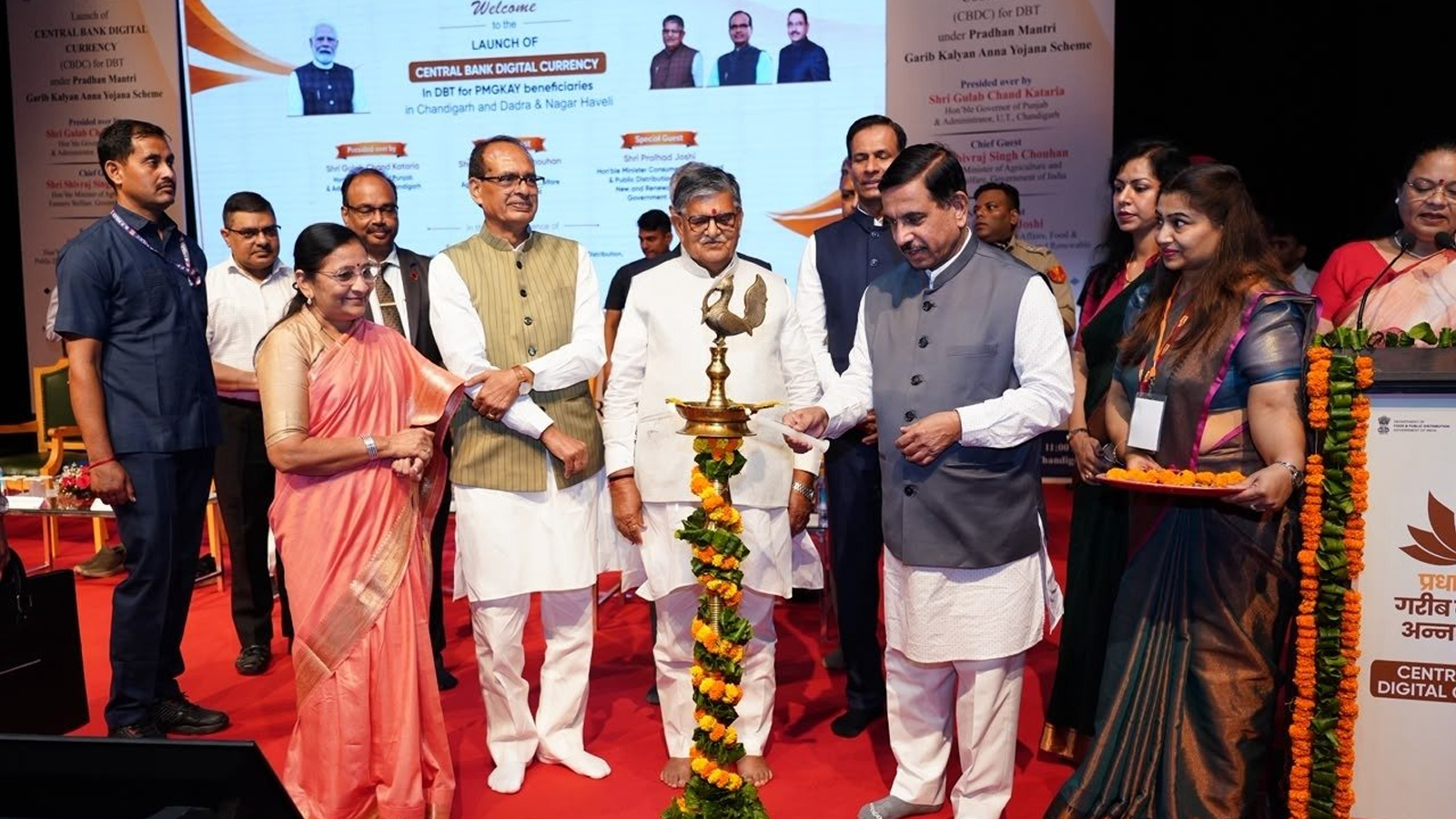
The Centre on Friday launched a Central Bank Digital Currency (CBDC)-based Direct Benefit Transfer (DBT) of food subsidies under the Pradhan Mantri Garib Kalyan Anna Yojana (PMGKAY) in Chandigarh and Dadra & Nagar Haveli, marking the first large-scale application of CBDC in a Central Government welfare programme.
The initiative was inaugurated by Union Minister for Education, Consumer Affairs, Food and Public Distribution, and New and Renewable Energy Pralhad Joshi, along with Punjab Governor and Chandigarh Administrator Gulab Chand Kataria and Union Minister for Rural Development, Agriculture and Farmers Welfare Shivraj Singh Chouhan.
Under the new system, eligible PMGKAY beneficiaries will receive food subsidies directly in their Digital Rupee wallets instead of conventional bank accounts. The purpose-bound digital subsidy can then be used to purchase foodgrains from empanelled merchants through a secure, traceable and real-time digital payment mechanism.
The system is designed to ensure instant transfer of subsidies, reduce dependence on cash handling, improve transparency and monitoring, and prevent diversion or misuse of benefits.
Smartphone users can make payments by scanning QR codes, while feature-phone users can access the facility through OTP-based mechanisms.
Joshi described the launch as a significant step in the digitalisation of the world’s largest food security programme. He said the initiative seeks to ensure that eligible beneficiaries are not excluded and that subsidies reach the intended recipients without intermediaries, under the principle of “Har Dana, Har Rupya, Har Adhikar.”
He said the DBT framework had resulted in savings of more than Rs 4 lakh crore by reducing leakages and ensuring direct delivery of benefits. He also highlighted the use of ASHA, an AI-based solution, through which around 20 lakh calls are made to beneficiaries to gather feedback on the quality of foodgrains and whether they are receiving their entitlements. Feedback and complaints are subsequently shared with states and Union Territories for resolution.
Kataria said the introduction of CBDC would further strengthen the dignity and respect of poor and vulnerable beneficiaries while providing merchants with a more transparent and efficient payment system. He said digitisation of the Public Distribution System (PDS) had significantly reduced the scope for pilferage and diversion.
Chouhan said food security remained the government’s top priority and highlighted the country’s improved foodgrain availability. He said the programmable nature of CBDC would help prevent misuse of food subsidies and ensure that benefits were used for their intended purpose. He also suggested expanding the initiative to other parts of the country.
Minister of State for Consumer Affairs, Food and Public Distribution Nimuben Jayantibhai Bambhaniya highlighted the government’s reforms in the PDS, including portability through the One Nation One Ration Card (ONORC) and strengthened grievance redressal mechanisms.
She said more than 80 crore beneficiaries are currently receiving free ration under PMGKAY and noted that the government’s welfare and development initiatives had contributed to lifting more than 25 crore people out of poverty.
The Secretary, Department of Food and Public Distribution, said the CBDC-based DBT represented the next step in India’s digital financial inclusion journey built on the JAM trinity – Jan Dhan, Aadhaar and Mobile.
He said more than 59 crore Jan Dhan accounts had been opened, with deposits exceeding Rs 3.10 lakh crore. He also highlighted the expansion of UPI, which processed more than 2,400 crore transactions worth over Rs 30 lakh crore in July 2026.
Chandigarh, Dadra & Nagar Haveli first to operationalise CBDC food subsidy
With the launch, Chandigarh and Dadra & Nagar Haveli have become the first Union Territories to operationalise food subsidy transfers to all eligible PMGKAY beneficiaries through programmable CBDC tokens credited directly to their digital wallets.
The initiative builds on earlier pilots conducted in Gujarat and Puducherry. The CBDC-based food subsidy pilot was launched in Gujarat on February 15, 2026, followed by Puducherry on February 26.
Drawing on the experience of these pilots, the government has now expanded the model to Chandigarh and Dadra & Nagar Haveli.
Under the system, beneficiaries receive the subsidy in their Digital Rupee wallets and can use it to purchase foodgrains from empanelled merchants. The mechanism is intended to reduce leakages, diversion and cash handling while enabling real-time monitoring of subsidy utilisation.
The government said the initiative would serve as a proof of concept and scalable template for other states and Union Territories, providing operational experience in integrating CBDC with welfare programmes.
The rollout builds on technology-driven reforms already undertaken in the PDS, including digitisation of ration cards and beneficiary databases, Aadhaar-based verification, electronic Point of Sale (ePoS) authentication, online supply-chain management and nationwide portability under ONORC.
Other initiatives, including Rightful Targeting, SMART-PDS, NIRMAL, VLTS and SAKSHAM, are also being used to strengthen data-driven monitoring, transparency and last-mile delivery of food subsidies.
The government said the CBDC-based model would further strengthen Digital Public Infrastructure and help create a more transparent, accountable and beneficiary-centric food distribution system.


