







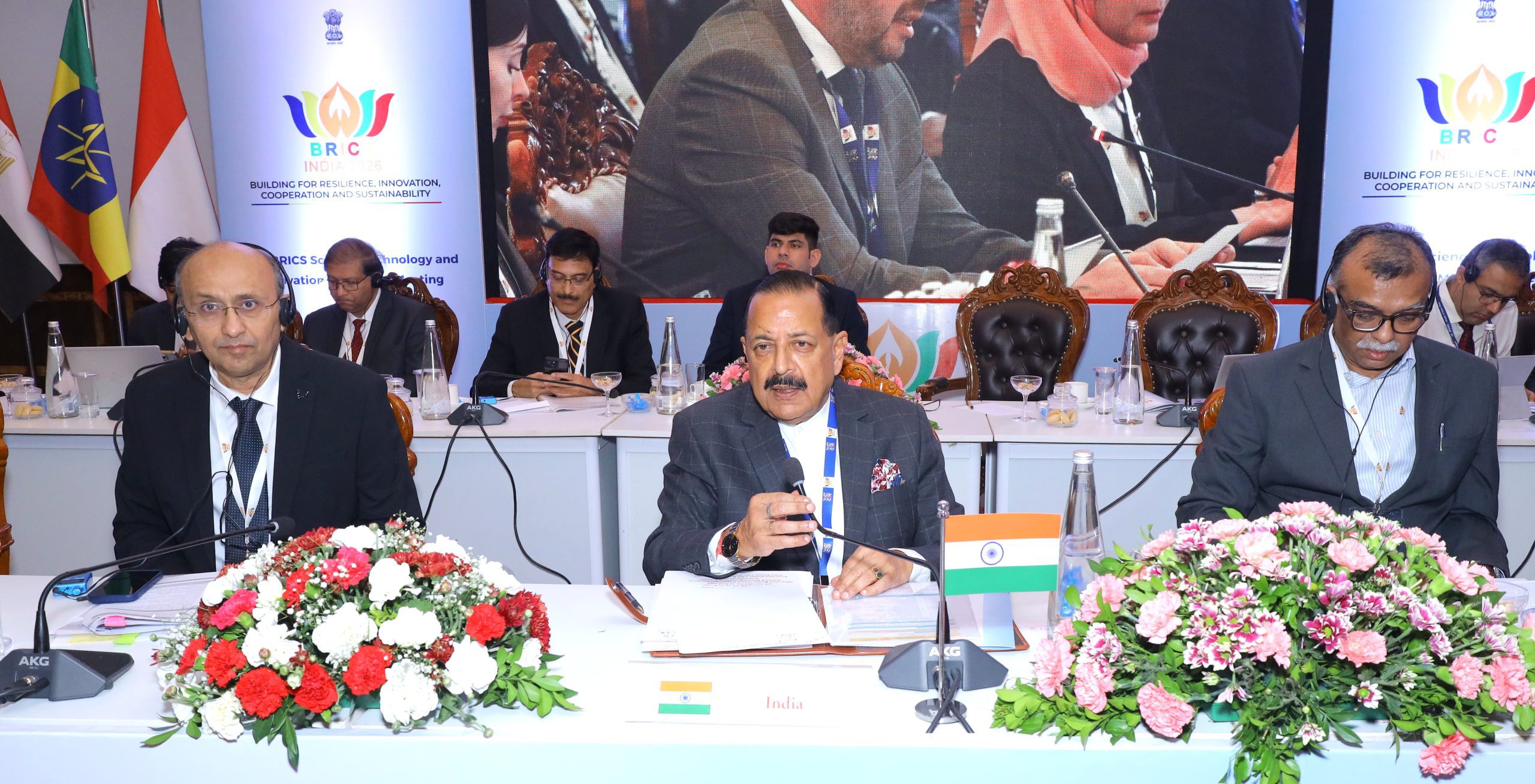
In his inaugural address at the 14th BRICS Science, Technology and Innovation (STI) Ministerial Meeting in Chennai today, Union Minister of State (Independent Charge) for Science and Technology and Earth Sciences, Dr Jitendra Singh, said that emerging technologies demand stronger global collaboration to ensure that the benefits of innovation reach all, remain cost-effective, inspire public confidence and are sustainable.
“The world is undergoing rapid transformation, driven by emerging technologies such as Artificial Intelligence, quantum technologies, advanced materials, biotechnology, photonics, geospatial technologies and high-performance computing,” said Dr Jitendra Singh.
“While these technologies are creating unprecedented opportunities for progress, they also call for stronger international collaboration to ensure that innovation remains accessible, affordable, trusted and sustainable,” he added.
Welcoming the delegations from BRICS member countries, Dr Jitendra Singh said the theme of India’s 2026 BRICS Presidency, “Building for Resilience, Innovation, Cooperation and Sustainability”, reflects the shared conviction that science, technology and innovation must serve humanity by strengthening resilience, driving inclusive growth, advancing sustainable development and fostering equitable partnerships among nations.
In his inaugural address, Dr Singh highlighted India’s expanding global engagement in science, technology and innovation under the leadership of Prime Minister Narendra Modi.
He said BRICS, with its vast population, rich scientific talent and expanding research capabilities, is well positioned to foster a cooperative, responsible and future-oriented innovation ecosystem. Dr Jitendra Singh also acknowledged the contributions of the STI Steering Committee, Senior Officials and various STI Working Groups in sustaining dialogue and translating it into practical cooperation, tangible outcomes and meaningful progress.
The Minister said BRICS STI cooperation has evolved into a robust platform encompassing research collaboration, innovation partnerships, exchanges among young scientists, shared research infrastructure and thematic working groups.
“During India’s Presidency, a comprehensive review of BRICS STI priorities was being undertaken to align cooperation with emerging scientific and technological frontiers and the developmental aspirations of societies,” he said.
Dr Jitendra Singh said India remains committed to advancing an open, inclusive and human-centric approach to science and innovation. He highlighted key initiatives, including the National Quantum Mission, National Supercomputing Mission, BioE3 Policy, National Geospatial Policy and the expanding Digital Public Infrastructure ecosystem, as examples of an approach in which innovation is ultimately geared towards improving people’s lives, strengthening societal resilience and driving sustainable economic transformation.
He invited BRICS partners to explore ambitious yet practical avenues for deeper collaboration in frontier research, innovation financing, talent mobility, research infrastructure sharing, startup partnerships and capacity building. He said such cooperation would help build a future-ready BRICS STI architecture capable of responding effectively to emerging global challenges while advancing the aspirations of the Global South.
Dr Jitendra Singh expressed confidence that the deliberations in Chennai would further strengthen the spirit of BRICS partnership and make a meaningful contribution towards building a more innovative, resilient and sustainable world.
-(with inputs from PIB)


