







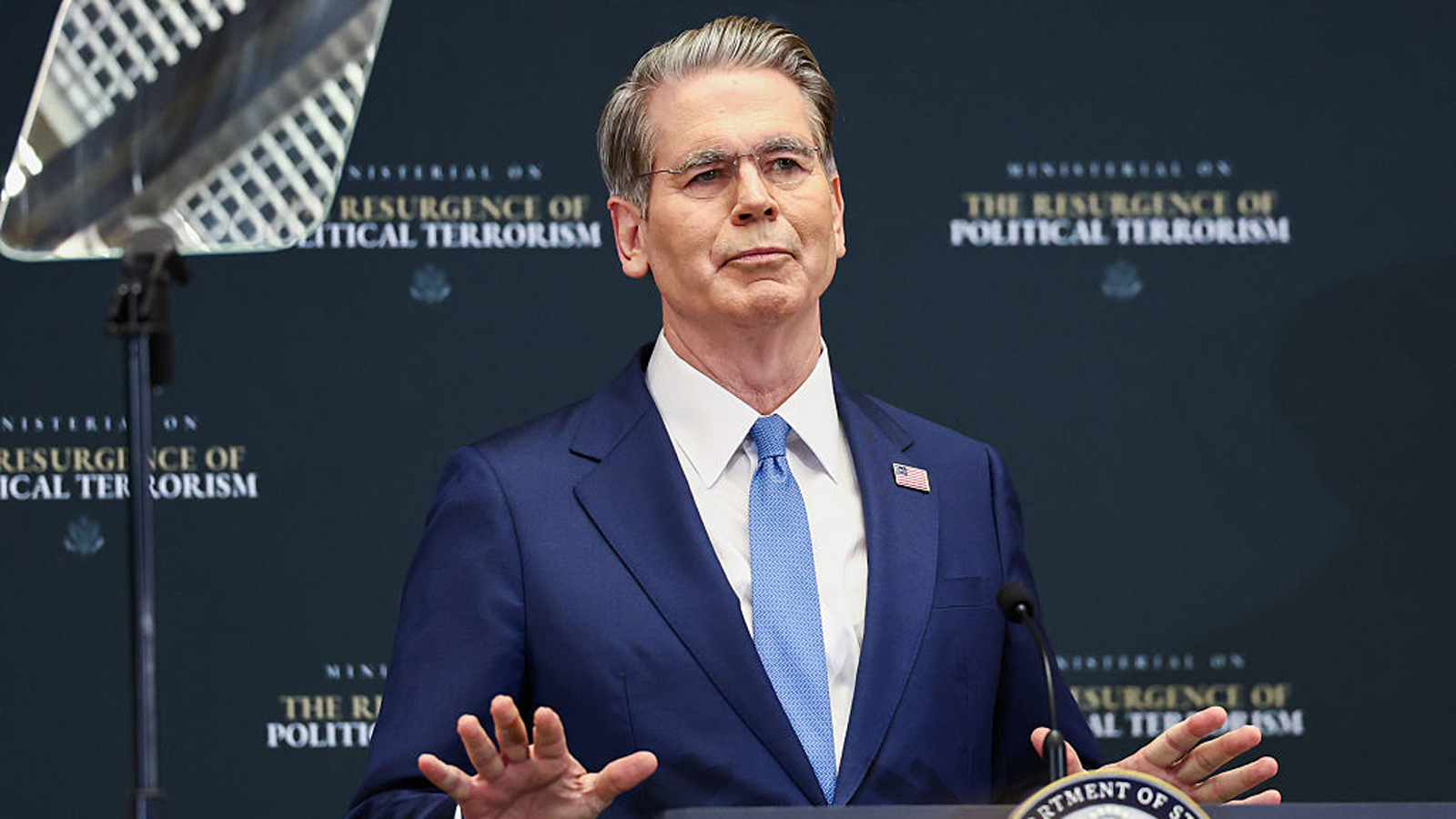
US Treasury Secretary Scott Bessent on Sunday (local time) said the Trump administration was entering the “endgame” in its campaign against Iran and announced what he described as an “economic D-Day” aimed at severing the Iranian regime’s economic lifelines.
In a post on X, Bessent said, “President Trump has dismantled Iran’s military capabilities, destroyed nearly 100 percent of its military factories, and buried its nuclear program.”
“We are now entering the endgame. At dawn begins an economic D-Day – the single greatest financial offensive ever marshaled against an adversary,” he said.
Bessent accused Iran of using security guarantees as a form of “extortion” and said Tehran had relied on the expectation that Iranian retaliation was certain, while US enforcement could be negotiated.
“The Islamic Republic has subsisted by dressing extortion as security guarantees. It has drawn strength from a calculus that regards Iranian retaliation as certain and American enforcement as negotiable,” Bessent said.
“Under President Trump, that era is over. And those who fear the danger of defying Tehran ought not to discount the cost of testing Washington,” he added.
Bessent said Trump had created the conditions for the US government to deploy its full range of legal and administrative authorities against Iran.
“The President has created the conditions to leverage every agency, every authority and action many assumed we would never summon,” he said.
“Our objective is to sever every economic lifeline that sustains the tyrannical regime until Tehran stands alone,” Bessent added.
Iran warns of oil export halt
Iran has responded with a warning of its own. Supreme National Security Council Secretary Mohsen Rezaei said on Monday that Tehran could halt all oil exports through the Strait of Hormuz and elsewhere in the Persian Gulf if the US economic campaign against Iran continues.
In a post on X, Rezaei also warned that Iran would consider any country supporting or participating in the US economic campaign against Tehran to be committing an “act of war”.
“If the economic war continues, not a single drop of oil will be exported, neither through the Strait of Hormuz nor from anywhere in the Persian Gulf. Iran will regard any country’s participation in or support for America’s economic war against the Iranian people as an act of war,” he said.
The warning comes amid heightened tensions between Washington and Tehran over the Trump administration’s plans to impose tougher economic measures on Iran.
Iranian Parliament Speaker Mohammad Bagher Ghalibaf also criticised Washington’s sanctions threat on Sunday, using a sarcastic post on X to argue that economic restrictions could ultimately backfire.
“Importing frozen meat to fix meat prices. Okay, that might work. What’s the plan for bonds, import frozen yields? Frozen homebuyers for housing? Frozen paychecks for wages? A frozen foreign policy delivers a frozen economy. The only thing still moving? The Iran boomerang,” he wrote.
Iranian Foreign Ministry spokesperson Esmaeil Baghaei also criticised the US sanctions threat, saying that war and sanctions were not unfamiliar to Iran. According to Al Jazeera, Baghaei noted that Iran had been under sanctions for two decades.
Trump threatens tougher sanctions
The latest escalation follows President Donald Trump’s announcement on Wednesday of what he called an “Economic D-Day” campaign against Iran.
Trump described the planned measures as the “most crushing economic operation ever taken against any country” and called on US allies to join Washington in isolating Tehran.
“We have things that we could sanction. We have very draconian sanctions, and we’ll see what happens,” Trump said while addressing technology leaders.
He indicated that Washington would decide its next course of action based on developments, saying the situation could either lead to a significant fall in oil prices or result in the continuation of existing measures.
Bessent had also warned Iran on Thursday of what he described as the “toughest sanctions in history”, saying Washington would pursue coordinated economic isolation of Tehran.
He urged US allies to join the campaign, arguing that the measures would weaken Iran’s ability to project influence globally.
Bessent is expected to provide further details at a media conference on August 24, when he said Washington would reveal “exactly what we’re going to do” against Iran.
(With ANI inputs)


