







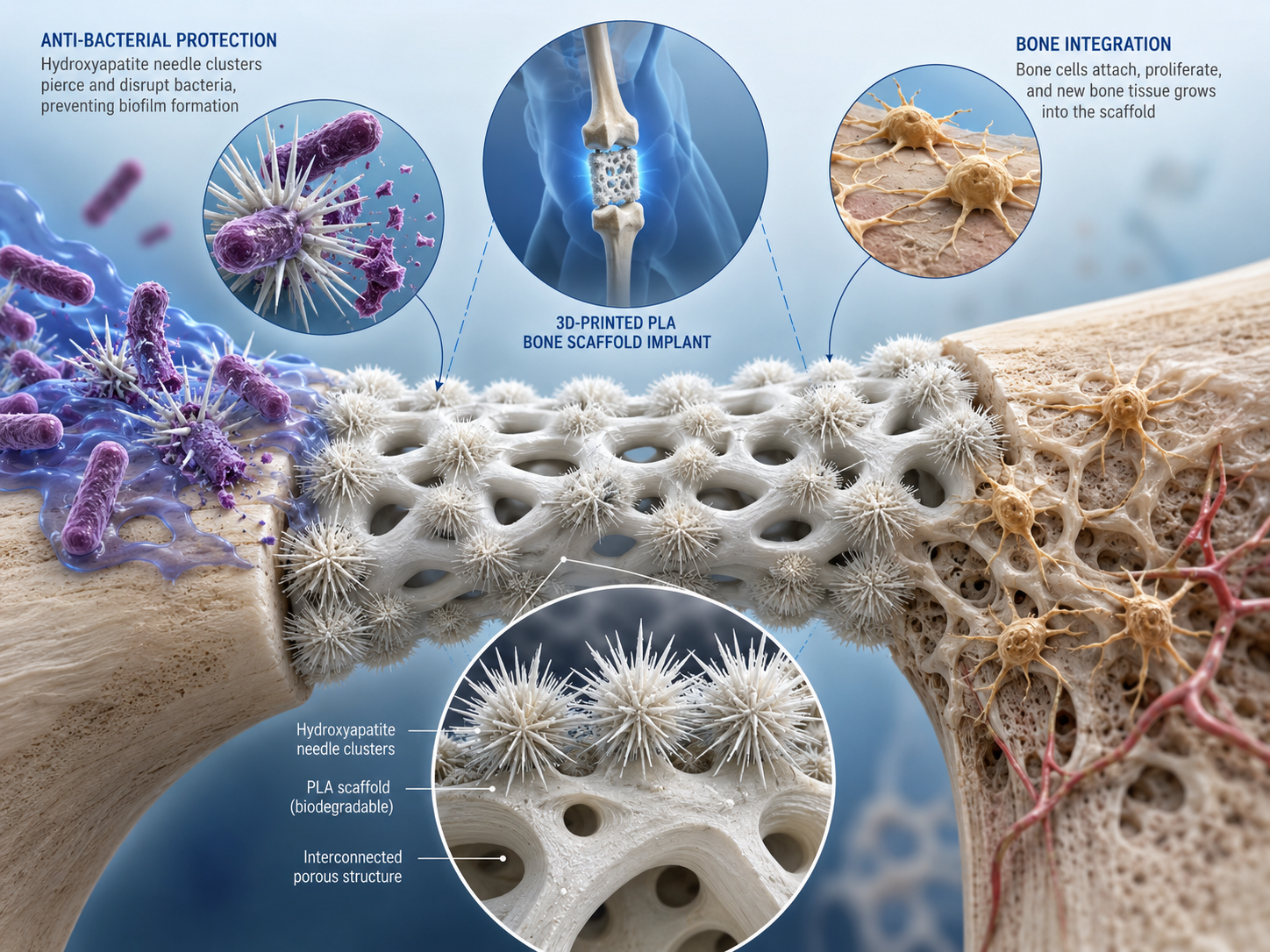
Researchers from IIT Mandi have created a bio-inspired surface coating on 3D-printed bone implants capable of mechanically disrupting bacteria and accelerating integration of the implant with bones.
The research has been published in the Chemical Engineering Journal.
It employs tiny hydroxyapatite structures, resembling sea urchins, on biodegradable plastic scaffolds to tackle two key problems with orthopaedic implants – bacterial infections and poor bone integration, a statement issued here said.
The research team led by Dr Sumit Murab along with Ankita Negi, Aakash Verma, KM Mohammed Sufiyan and Vedante Mishra, developed a dual-layer coating using hydroxyapatite, which is the major constituent of human body bone.
Large bone defects resulting from traumatic injury, infections or removal of a tumour still pose great challenges. Although 3D-printed implants use polylactic acid (PLA), which can be tailored to fit the individual’s bone defect, the hydrophobic nature of PLA does not allow it to easily bond with bones.
Infections caused by the adhesion of bacteria and formation of biofilms may also lead to implant failure and subsequent surgery.
The preparation of this layer involves a two-stage process where the 3D-printed PLA scaffold first undergoes activation of the surface by treating it with an alkaline solution that provides sites of minerals.
In the second stage, the scaffold undergoes hydrothermal treatment at 90 degrees Celsius, leading to the formation of hydroxyapatite needle clusters in the form of a sea urchin structure.
This creates a surface that utilises bone-compatible mineralisation together with micro-structures that can cause mechanical damage to bacteria, unlike the use of antibiotics or antibacterial chemicals.
When the benefits of customisation through 3D printing and the hydroxyapatite-based biomimicry surface coating technique are considered together, it appears that this is a promising way to create implants that allow bone integration and decrease the likelihood of bacterial colonisation, the statement added.
This relatively easy low-temperature modification technique may also become one of the possible options for changing properties of degradable polymer constructs, the researchers said on Tuesday.
According to the research team, it could also become applicable to orthopaedic and dental implants, as well as other biomedical devices in which prevention of infection is crucial.
The research illustrates how nature-inspired surface design and new 3D-printing technologies may be used together in order to create advanced biomedical materials.
(PTI)


