





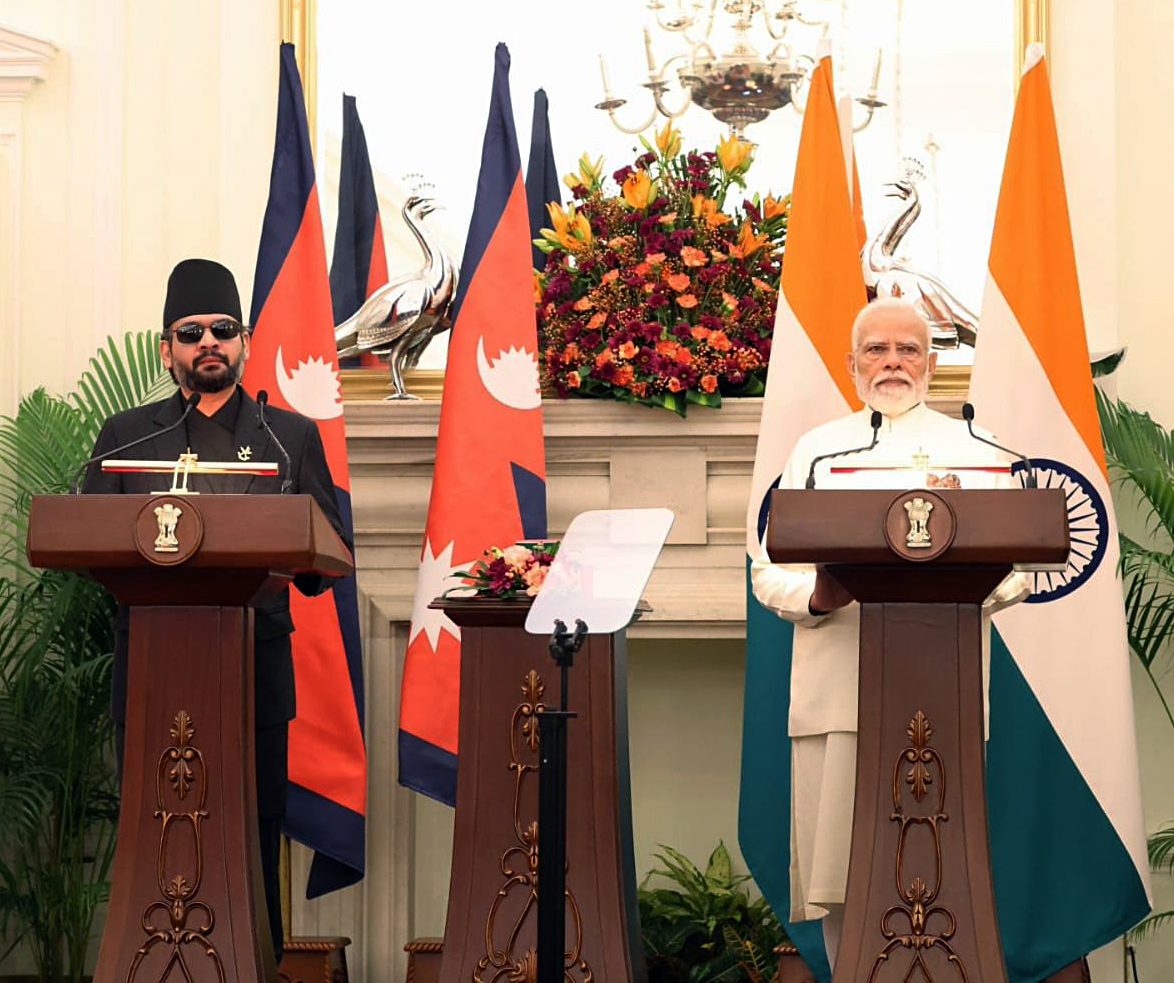
India and Nepal have adopted a comprehensive 10-pillar Joint Vision titled ‘Viksit Bharat and Samunnat Nepal’, outlining an ambitious roadmap to modernise bilateral relations and strengthen cooperation across economic development, connectivity, energy, technology, education, sports, tourism, healthcare and agriculture.
The vision document was adopted during the State Visit of Nepalese Prime Minister Balendra Shah to India from November 22 to 23, at the invitation of Prime Minister Narendra Modi.
The two leaders held wide-ranging discussions in New Delhi and reviewed the entire spectrum of bilateral relations, reaffirming their commitment to strengthening the longstanding partnership based on mutual respect, trust and shared interests.
The Joint Vision seeks to align India’s national goal of ‘Viksit Bharat 2047’ with Nepal’s aspiration of ‘Samunnat Nepal’, with particular emphasis on creating opportunities for young people and delivering tangible benefits to citizens of both countries.
As part of the economic partnership, India announced development assistance worth ₹15,000 crore to Nepal, comprising ₹3,500 crore in grant assistance for post-disaster reconstruction and infrastructure projects and ₹11,500 crore through a rupee-denominated Line of Credit for energy sector projects.
The two countries will also explore cross-border special economic zones, export-oriented industrial parks and IT parks to strengthen manufacturing and supply-chain linkages. India will encourage investments in Nepal’s priority sectors and work towards improving investor confidence and ease of doing business.
Major push to physical and digital connectivity
Connectivity forms a key pillar of the new partnership, with both countries agreeing to expand railway, road, air and digital links.
The leaders welcomed the launch of a direct express rail service between Ayodhya and Janakpur and the inauguration of a motorable bridge across the Mahakali River connecting Dharchula in India with Darchula in Nepal.
They also agreed to expedite railway projects, including the Jayanagar-Bardibas and Jogbani-Biratnagar lines, and collaborate on the proposed Raxaul-Kathmandu railway link and Nepal’s East-West Railway network.
Cooperation will also be expanded in cross-border petroleum infrastructure through the proposed Siliguri-Jhapa pipeline, while the possibility of a gas pipeline between the two countries will be explored.
Building on the existing linkage between India’s Unified Payments Interface (UPI) and Nepal’s national payment system, both sides agreed to expedite cross-border retail payments.
Cooperation in energy and climate resilience
Energy, water resources and climate resilience will be another major area of cooperation.
India will encourage greater investment in Nepal’s hydropower and transmission infrastructure, while both countries will work towards expanding mutually beneficial electricity trade.
The two sides agreed to accelerate the implementation of ongoing and proposed hydropower and multipurpose projects, including the Pancheshwar, Saptakoshi and Sunkoshi projects.
Recognising the growing challenges posed by climate change and natural disasters, both countries will strengthen cooperation in disaster risk reduction, early warning systems and post-disaster recovery.
They also agreed to institutionalise real-time sharing of hydrometeorological data, monitor glacial lakes and enhance joint humanitarian assistance and disaster relief exercises.
Cooperation will extend to renewable energy sources, including a proposed pilot project on green hydrogen in Nepal.
Technology, education and innovation in focus
The Joint Vision places significant emphasis on emerging technologies, digital infrastructure and innovation.
Both countries will expand the India-Nepal Startup Partnership Network through mentorship and training opportunities for Nepalese entrepreneurs. Plans include establishing a Startup Centre of Excellence in Kathmandu and a Digital Nomads and Innovation Hub in Pokhara.
Cooperation in artificial intelligence will also be strengthened, including the development of a Large Language Model for the Nepali language through collaboration with India’s Bhashini initiative.
The two sides will explore cooperation in satellite development, earth observation, remote sensing and disaster management, along with emerging telecommunications technologies such as 5G and 6G.
In education, India and Nepal will explore the establishment of branches of reputed Indian higher educational institutions in Nepal, beginning with an IIT campus. India will also expand scholarship opportunities for Nepalese students in emerging disciplines, including law, technology and artificial intelligence.
A vocational training institute will be established with Indian assistance to equip Nepalese youth with skills relevant to manufacturing, services and entrepreneurship.
New initiatives in sports, culture, health and agriculture
The partnership also envisages stronger cooperation in sports, tourism, healthcare and agriculture.
India will support the establishment of a national cricket coaching and training academy in Nepal and assist in developing cricket infrastructure at national and provincial levels. Opportunities for cooperation in badminton, tennis, shooting and athletics will also be explored.
In the cultural and tourism sector, both countries will work towards developing Ramayana, Buddhist and Shiv-Shakti tourism circuits by connecting important religious destinations, including Janakpur, Ayodhya, Lumbini, Bodh Gaya, Sarnath, Kushinagar, Kathmandu and Varanasi.
The two sides also agreed to organise an annual youth cultural festival alternately in India and Nepal and strengthen academic cooperation between Nalanda University and Lumbini Buddhist University through the establishment of a Nalanda Centre at the latter.
Healthcare cooperation will focus on strengthening medical infrastructure, upgrading Nepal’s National Medical Laboratory and establishing India-Nepal Jan Aushadhi Kendras to improve access to affordable medicines.
In agriculture, both countries will establish an Agro-Industrial Park in Chitwan with Indian grant assistance to promote value addition to Nepalese agricultural products. They will also strengthen research collaboration, agricultural training and institutional partnerships.
Monitoring mechanism for timely implementation
To ensure effective implementation of the initiatives, the two Prime Ministers agreed to activate a High-Level Monitoring Group led by Nepal’s Foreign Secretary and India’s Ambassador to Nepal.
The group will meet at least once every six months to review progress, expedite projects and facilitate necessary clearances and approvals. It will report to the India-Nepal Joint Commission, co-chaired by the Foreign Ministers of both countries.
The next meeting of the Joint Commission is scheduled to be held in 2027.
The two leaders expressed confidence that the Joint Vision would provide a blueprint for a modern, forward-looking and mutually beneficial partnership, reflecting the aspirations of the people of both countries.


