







The Government has proposed a ₹10,000 crore Container Manufacturing Assistance Scheme (CMAS) to strengthen domestic production of shipping containers, reduce import dependence and enhance the resilience of India’s trade and logistics network.
Announced in the Union Budget 2026-27, the scheme will have an outlay of ₹10,000 crore over five years and will provide financial and institutional support for setting up new manufacturing facilities and expanding existing units.
The initiative aims to build a globally competitive container manufacturing ecosystem and expand India’s annual domestic production capacity to around 7.5 lakh Twenty-foot Equivalent Units (TEUs).
The scheme will provide capital assistance for new Greenfield manufacturing facilities, support expansion of existing Brownfield units and operational assistance to improve the competitiveness of domestic manufacturers. It will also support testing infrastructure, skilling and capacity building.
India currently imports nearly two million empty containers annually to meet domestic requirements and for repositioning. The Government has said that strengthening domestic manufacturing will help reduce vulnerabilities arising from global supply-chain disruptions and freight-rate volatility.
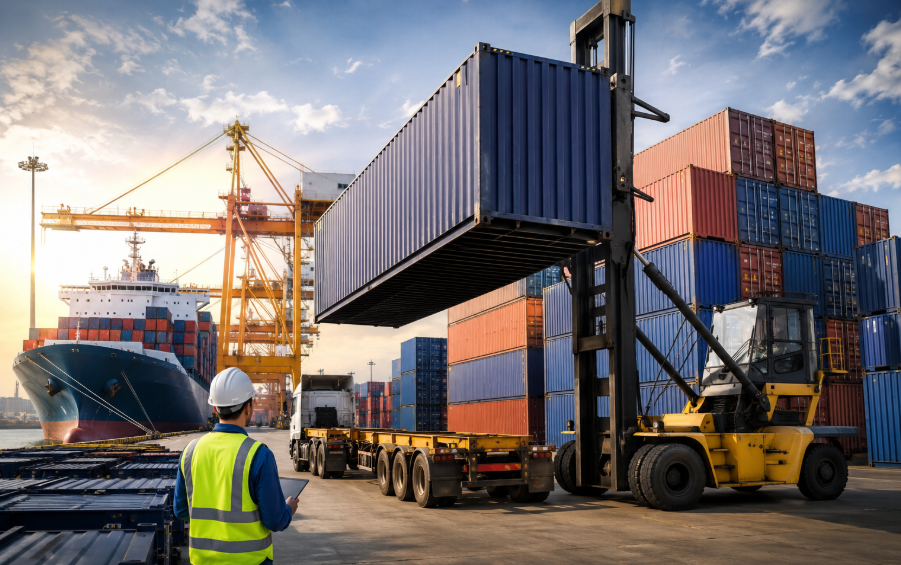
Shipping containers are standardised steel freight units that enable cargo to move between ships, railways and road vehicles without the need for unloading and repacking. The 20-foot and 40-foot containers are the most commonly used sizes, with capacity measured in TEUs.
The container manufacturing push is part of a wider effort to strengthen India’s maritime and logistics infrastructure under initiatives such as the Maritime Amrit Kaal Vision 2047, PM Gati Shakti, the National Logistics Policy and the Sagarmala Programme.
In February 2026, the Ministry of Ports, Shipping and Waterways signed an MoU for establishing the Bharat Container Shipping Line. The proposed initiative brings together the Shipping Corporation of India, Container Corporation of India, Jawaharlal Nehru Port Authority, V.O. Chidambaranar Port Authority and Sagarmala Finance Corporation Limited.
The initiative envisages investments of around ₹99,149 crore for developing a fleet of 51 container vessels of different sizes and procuring domestic containers.
The Government expects CMAS to generate around 3,000 direct jobs and more than 50,000 indirect jobs across container manufacturing and allied sectors. The scheme is also expected to support industries involved in the production of components and materials such as corner castings, wooden frames and Corten steel.
India has already recorded progress in domestic container manufacturing. In July 2026, the country’s first India-manufactured EXIM shipping container for global shipping major A.P. Moller–Maersk was rolled out at the Maersk-CONCOR Inland Container Depot in Dadri, Uttar Pradesh.
The container was manufactured in accordance with internationally recognised ISO standards and the International Convention for Safe Containers (CSC), enabling its use across global shipping networks.
Maersk has also placed an order for 1,000 additional Made-in-India shipping containers with the DCM Shriram Group, providing an early commercial endorsement of India’s emerging container manufacturing capabilities.
The Government is simultaneously pursuing wider reforms in the maritime sector. These include the Merchant Shipping Act, 2025, Coastal Shipping Act, 2025 and Indian Ports Act, 2025, aimed at updating the regulatory framework for shipping, coastal trade and port governance.
Digital initiatives including One Nation One Port Process, the Maritime Single Window and e-Samudra are also aimed at simplifying procedures, reducing documentation and improving efficiency in port and shipping operations.
The Government has additionally announced a ₹70,000 crore Shipbuilding Financial Assistance Package to strengthen domestic shipbuilding and attract investment in maritime manufacturing.
Major port projects, including Vadhavan Port, the International Container Transshipment Port at Galathea Bay, Tuna Tekra Container Terminal and the Outer Harbour Container Terminal at V.O. Chidambaranar Port, are also being developed to expand cargo-handling capacity.
Three Indian ports have been ranked among the world’s top 30 in the Container Port Performance Index 2025, reflecting improvements in port efficiency.


