







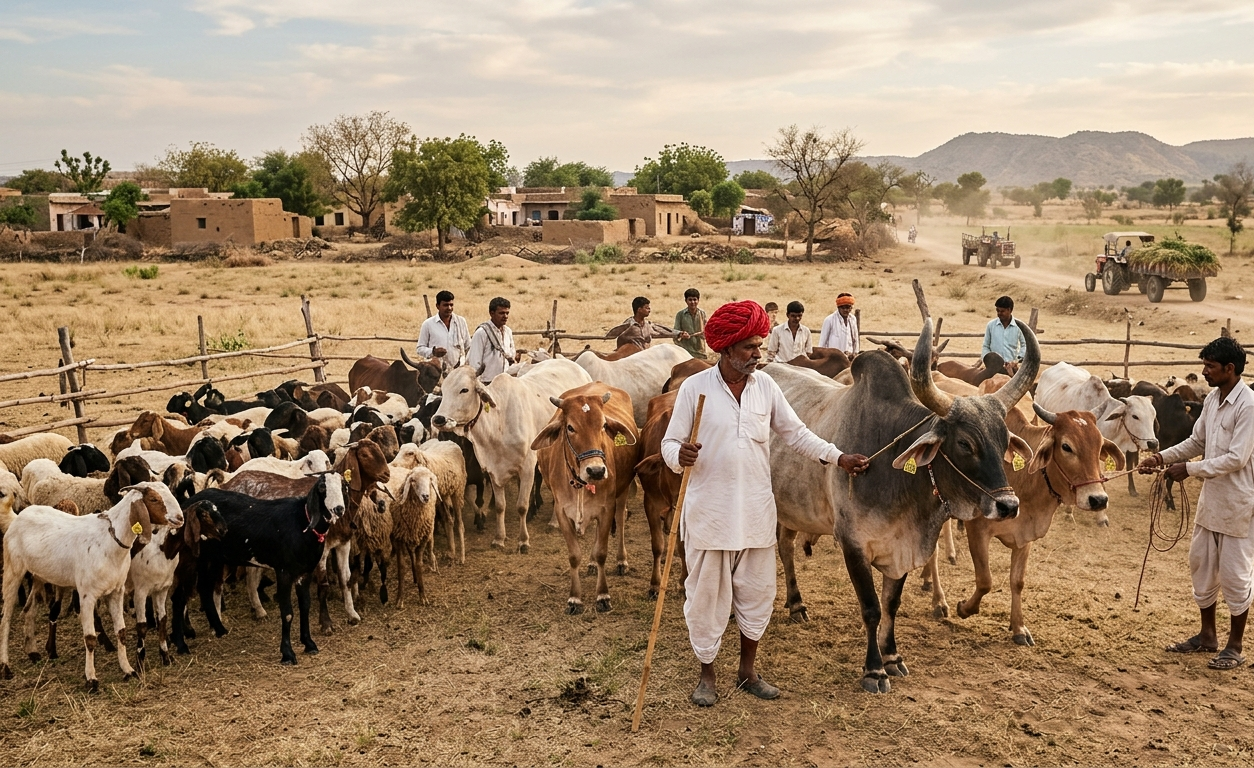
The Centre has highlighted a series of measures aimed at strengthening India’s dairy and livestock sectors, with a focus on expanding dairy infrastructure, improving indigenous breeds, promoting livestock entrepreneurship and enhancing preparedness against animal diseases.
Union Minister for Fisheries, Animal Husbandry and Dairying, Rajiv Ranjan Singh, informed the Lok Sabha on Tuesday that milk procurement prices are decided by dairy cooperatives and private dairies based on market conditions. He said the department had not received any report suggesting that dairy farmers were not getting remunerative prices due to differences between procurement and retail prices.
Under the National Programme for Dairy Development (NPDD), 36,611 new Dairy Cooperative Societies have been organised, while 34,557 village-level dairy cooperative societies have been strengthened till June 2026. The programme has created around 168 lakh litres per day of milk chilling capacity and distributed 76,748 milk quality testing devices.
The Animal Husbandry Infrastructure Development Fund (AHIDF) has approved projects with a combined milk processing and value addition capacity of 418 lakh litres per day. The Milk Supply Review Dashboard Portal, integrated with the National Cooperative Database, currently reflects three active dairy cooperative societies in Delhi.
Breed improvement, artificial insemination efforts expanded
The government said the Rashtriya Gokul Mission (RGM) has been driving efforts to improve indigenous breeds, enhance genetic quality and increase livestock productivity.
Tamil Nadu received central assistance of ₹12,521.83 lakh over the last three years under the mission, which was fully utilised by the state. The funds supported 36.13 lakh artificial inseminations, strengthening of four semen stations, training of 475 MAITRIs, establishment of two IVF laboratories, sex-sorted semen facilities, three Breed Multiplication Farms and Heifer Rearing Centres.
At the national level, more than 17.27 crore artificial inseminations have been carried out under the Nationwide Artificial Insemination Programme in the last five years, benefiting nearly 5.98 crore farmers.
The government also highlighted that 47,687 MAITRIs have been trained, 24 IVF laboratories established, 48 semen stations sanctioned and 28 heifer rearing centres approved under livestock development initiatives.
Livestock entrepreneurship and disease preparedness
The National Livestock Mission has approved 4,084 breed multiplication farms and facilitated the production of 1.61 lakh metric tonnes of quality fodder seed. It has also sanctioned 204 silage and Total Mixed Ration units.
Through the Entrepreneurship Development Programme under the mission, 4,291 projects have been approved with a total project cost of ₹2,956.79 crore and subsidies amounting to ₹1,356.53 crore. The projects are expected to generate nearly 21,000 direct jobs and provide indirect benefits to around 91,000 farmers.
The government said the programme is being implemented through a fully digitised platform, with subsidy payments processed through the Public Finance Management System.
Alongside infrastructure expansion, animal health preparedness has also been strengthened through vaccination programmes against diseases including Foot and Mouth Disease, Brucellosis, Peste des Petits Ruminants and Classical Swine Fever under the Livestock Health and Disease Control Programme.
A national mock exercise, Pashujanya Yudh Abhyas (PYA), was conducted in Madhya Pradesh from June 29 to July 3, 2026, to assess readiness for zoonotic disease outbreaks. The exercise focused on improving coordination between agencies, surveillance systems, biosafety measures, laboratory protocols and emergency response mechanisms.
The department continues to assist states through disease surveillance, vaccination drives, laboratory strengthening, standard operating procedures, crisis management plans and capacity-building measures under the Livestock Health and Disease Control Programme.


