







India’s chemicals and petrochemicals sector has witnessed significant expansion over the past 12 years, driven by policy reforms, infrastructure development, investment promotion, skill development and research initiatives undertaken by the Department of Chemicals and Petrochemicals (DCPC), the Ministry of Chemicals and Fertilizers said on Wednesday.
The Ministry said these initiatives have strengthened domestic manufacturing, attracted investments, generated employment and supported the vision of Viksit Bharat @2047 and Atmanirbhar Bharat.
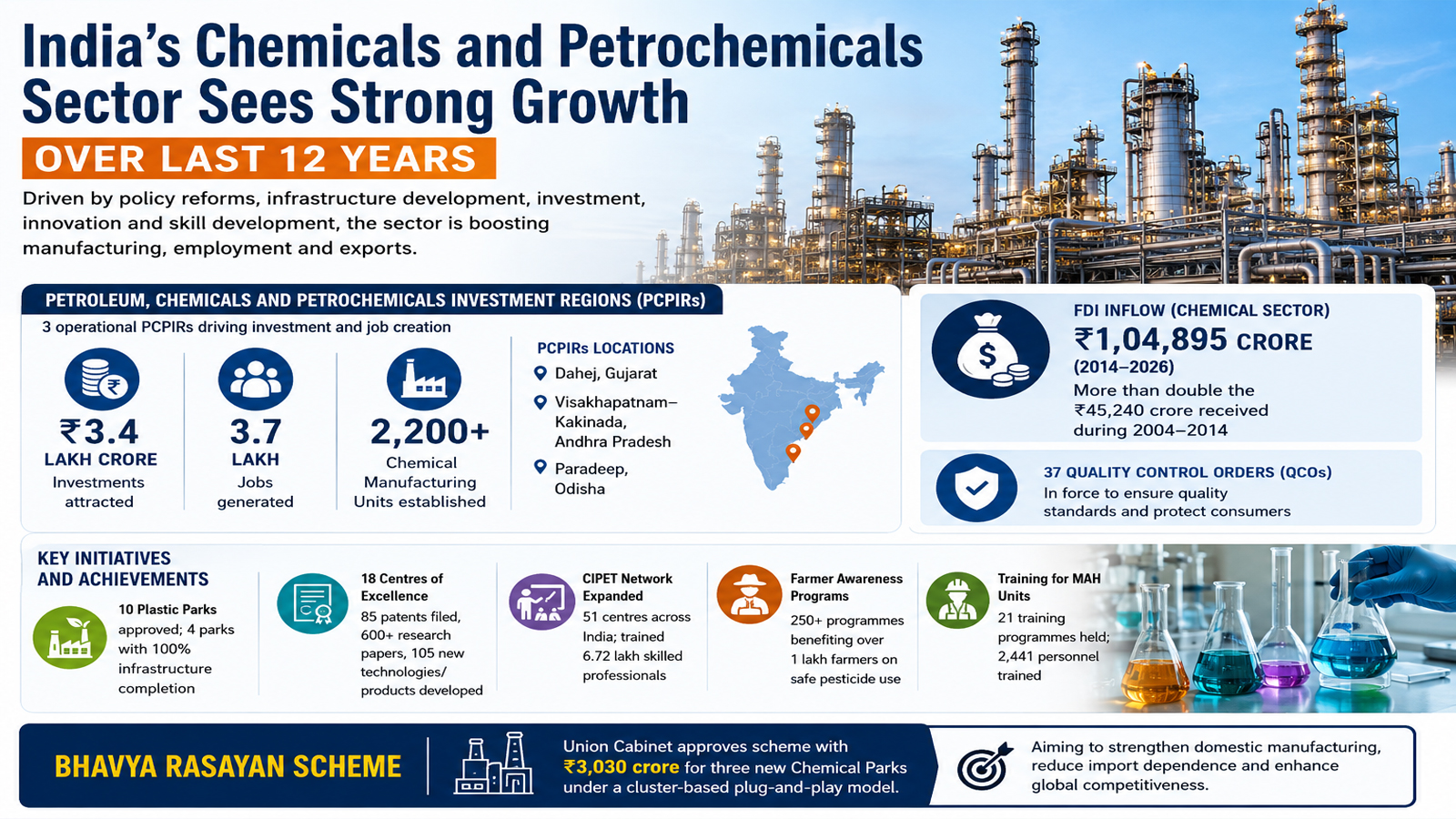
A key contributor to the sector’s growth has been the development of Petroleum, Chemicals and Petrochemicals Investment Regions (PCPIRs). The three operational PCPIRs at Dahej (Gujarat), Visakhapatnam-Kakinada (Andhra Pradesh) and Paradeep (Odisha) have collectively attracted investments worth ₹3.4 lakh crore, generated employment for nearly 3.7 lakh people, and facilitated the establishment of more than 2,200 chemical manufacturing units.
The government has also approved the BHAVYA Rasayan Scheme (Bharat Audyogik Vikas Yojana Rasayan) for establishing three new Chemical Parks under a cluster-based plug-and-play model. Approved by the Union Cabinet with an outlay of more than ₹3,030 crore, the scheme aims to strengthen domestic manufacturing, reduce import dependence, enhance global competitiveness and promote an integrated circular economy in the chemical sector.
According to the Ministry, India’s liberal foreign direct investment (FDI) policy, which permits 100 per cent FDI under the automatic route for most chemical sectors, has significantly boosted investments. Between 2014 and 2026, the sector attracted ₹1,04,895 crore in FDI, more than double the ₹45,240 crore received during the 2004–2014 period.
The Department has also expanded infrastructure for downstream plastic processing industries by approving 10 Plastic Parks, of which four have achieved complete infrastructure development, including three completed during 2025-26.
To encourage innovation, the network of 18 Centres of Excellence has filed 85 patents, published more than 600 research papers, and developed 105 new technologies and products.
The Central Institute of Petrochemicals Engineering and Technology (CIPET) has considerably expanded its national footprint, increasing its network to 51 centres, including 19 established since 2014. These include specialised facilities such as Plastic Waste Management Centres, advanced research laboratories and skilling centres. CIPET has trained nearly 6.72 lakh skilled professionals, including over 5.21 lakh between 2014 and 2024, while completing 8.53 lakh technology support service assignments during the same period.
The Ministry highlighted the role of the Chemical Promotion and Development Scheme (CPDS) in supporting industry development through conferences, exhibitions, training programmes, studies and awareness initiatives under the New Scheme of Petrochemicals.
Efforts to promote safe agricultural practices have also been intensified through HIL (India) Limited and the Institute of Pesticide Formulation Technology (IPFT). More than 250 farmer awareness programmes have been organised across the country, benefiting over one lakh farmers by promoting the safe and judicious use of pesticides and Integrated Pest Management practices.
In addition, the Department has launched a nationwide training programme for workers in Major Accident Hazardous (MAH) Units under the Viksit Bharat @2047 Action Plan. The programme aims to cover all 2,393 MAH units over five years. So far, 21 training programmes have been conducted, covering 1,376 industrial units and training 2,441 personnel in the safe handling of hazardous chemicals.
To strengthen product quality and protect consumers, the Department has issued 37 Quality Control Orders (QCOs) to curb substandard imports and promote quality manufacturing.
The Ministry also highlighted the achievements of IPFT, Gurugram, which has developed 64 pesticide formulation technologies and transferred them to industry over the past 12 years. The institute has received ₹28.69 crore from the Department of Biotechnology to establish a Biofoundry Facility for biopesticides and advanced biological formulations. It has also been recognised as an authorised laboratory for biostimulant testing under the Fertilizers Control Order, 1985.
IPFT has additionally conducted 45 farmer awareness programmes benefiting 16,436 farmers and earned an “A” rating in the 59th Organisation for the Prohibition of Chemical Weapons (OPCW) Proficiency Test, securing a global OPCW contract to conduct advanced analytical training for international participants.
The Ministry said the combined focus on policy reforms, infrastructure creation, investment promotion, research, skill development and quality enhancement has strengthened the chemicals and petrochemicals sector, contributing to manufacturing growth, employment generation, exports and sustainable industrial development in the country.


