






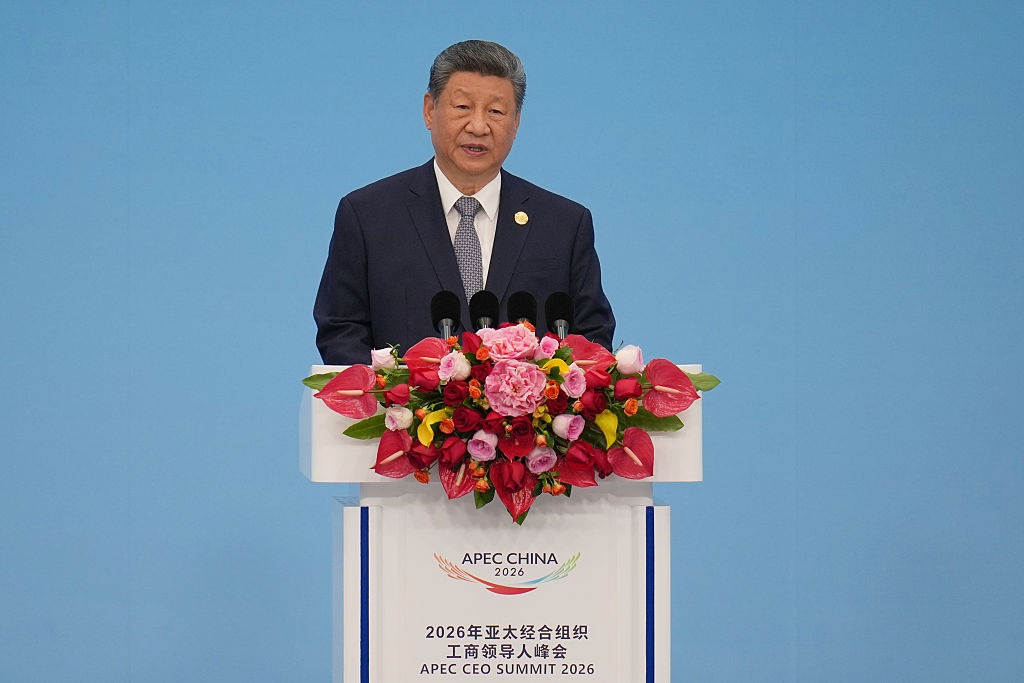
Chinese President Xi Jinping on Wednesday urged support for “free and open trade,” while expressing opposition to “protectionism” in an opening speech at an Asia-Pacific summit where he was due to meet his US and Russian counterparts.
Xi’s remarks came after Washington announced further restrictions on China’s access to advanced AI chips from companies such as Nvidia, which could further complicate a fragile trade truce with Beijing. China has pledged to retaliate.
“We must firmly uphold the rules-based multilateral trading system with the World Trade Organization at its core, support free and open trade and investment, maintain the stability and smooth operation of global industrial and supply chains,” Xi told an audience of business executives, after posing a series of rhetorical questions on how the Asia Pacific should respond to a changing world.
Western trade partners have criticised China for running annual trade surpluses in excess of $1 trillion through policies that support its manufacturing sector at the expense of its consumers.
Beijing says its growth model is appropriate for an economy still catching up with the world’s richest, but Washington, Brussels and others are concerned about China’s supply chain dominance providing the country with geopolitical leverage and say its policies threaten their industries and jobs.
Xi said China will continue to invest in its industrial complex and develop new technologies that would also benefit other countries. The world’s second-largest economy will lower tariffs and further open up its markets, while standing up against protectionism and unilateralism, he added.
His “message is likely to resonate with many Global South countries and reinforces Beijing’s effort to contrast its technology strategy with that of Washington,” said George Chen, partner and chair of digital practice at The Asia Group.
HIGH-STAKES MEETINGS
Xi was at the opening of the Asia-Pacific Economic Cooperation CEOs summit in the southern Chinese tech hub of Shenzhen, ahead of a gathering of the member states’ leaders in the evening.
Russian President Vladimir Putin landed overnight, after Ukraine destroyed the vital Kerch road bridge linking Crimea to Russia in a major blow to his four-year-old war. US President Donald Trump was due to arrive later on Wednesday after concluding meetings with Southeast Asian and other regional leaders in Manila.
The three leaders are set for high-stakes talks on Thursday on the Iran and Ukraine wars, with flashpoints such as trade, AI and nuclear weapons also on the agenda.
The US president also floated the possibility that he might meet North Korean leader Kim Jong Un, but that has not been confirmed.
Trump’s trip to Asia is his first since his Republican Party’s defeat in midterm elections, while allegations involving Nvidia founder Jensen Huang and a suspected Chinese spy add to the tension.
Still, most analysts expect Washington and Beijing to keep ties relatively stable as Trump and Xi are due to meet for the fourth time this year at the Group of 20 gathering in Miami in December.
Trump and Xi have a working lunch on Thursday before the two meet with Russian President Vladimir Putin.
The three-way meeting has drawn comparisons with the 1945 Yalta Conference between the US, Britain and the Soviet Union that formalized spheres of influence, set the stage for the post-World War Two order and became shorthand for great-power deals imposed on smaller countries.
The Kremlin this week dismissed the comparisons as “games of political scientists,” but said the meeting will have a major impact on global affairs. Beijing said the trilateral is of “groundbreaking significance” and will promote world peace.
But smaller powers in Europe and Asia not at the table fear any deal that might emerge between the three men that disregards their security interests. On Tuesday, Taiwan and Japan flagged incursions by Russian aircraft into their airspace.
(Reuters)


