







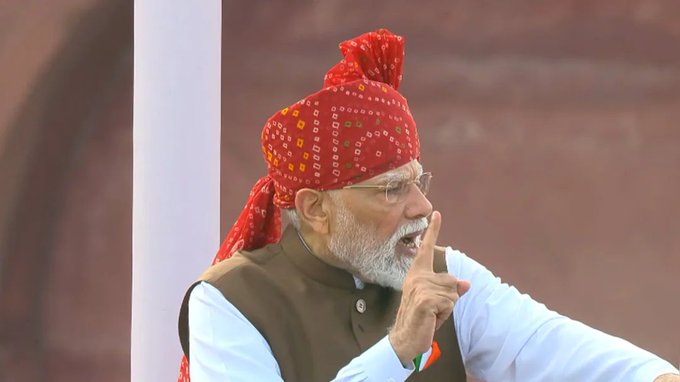
Prime Minister Narendra Modi on Saturday unveiled ‘Shakti Ki Saptadhara’, outlining seven key strengths that he said will drive India’s next phase of growth and shape the country’s journey towards Viksit Bharat.
Addressing the nation from the ramparts of the Red Fort on the occasion of India’s 80th Independence Day, PM Modi said the seven pillars would provide the foundation for India’s future development.
The first pillar, he said, is manufacturing, calling for India to emerge as a reliable hub in global supply chains.
“From Design to Manufacturing, India must become a reliable hub in the global supply chain. For this, I want to place special emphasis on three things. My brothers and sisters in the field of Manufacturing, do not let this opportunity slip away. For this, we will have to meet global standards on cost, quality, and scale,” he said.
The second strength, PM Modi said, is agriculture and food processing. He called for India’s farmers and food products to gain a larger presence in global markets, particularly as free trade agreements open access to new markets.
“We must go from the farm to the export market. Our traditional cuisine, millets, spices, and fruits and flowers should become global brands,” he said.
Technology and innovation constitute the third pillar of ‘Saptadhara’, according to the Prime Minister.
Highlighting the growing importance of artificial intelligence, quantum technology, space, robotics and data centres, PM Modi said India must establish itself as a global hub of innovation.
He highlighted India’s achievements in UPI and Digital Public Infrastructure and called for the country to take the next leap in next-generation communication technologies, including Made-in-India 6G.
The fourth pillar is Gati Shakti, with the Prime Minister calling for seamless and high-speed connectivity across the country.
“We need seamless high-speed rail connectivity, modern highway connectivity, inland waterways, airports, multi-modal logistics hubs and ports. We have to work towards port-led development,” he said.
Defence production is the fifth pillar, with PM Modi stressing the need for self-reliance and for India to emerge as a global supplier of defence equipment and technologies.
“It is essential to be self-reliant in the defence sector; this has now been experienced by both India and the world. When the world is immersed in its own thoughts, India cannot remain merely a market for the world. We must become self-reliant in the field of defence,” he said.
He called for the development of next-generation defence technologies to strengthen India’s position as a global supplier.
The sixth pillar, PM Modi said, is green energy. He called for greater innovation in renewable energy, energy storage and green hydrogen, while also highlighting opportunities in the Blue Economy.
“India must achieve global leadership in green hydrogen, renewable energy and energy storage, while continuing to provide solutions to global challenges. The Blue Economy, too, offers immense opportunities in fisheries, coastal tourism and ocean technology, opening new pathways for India’s growth,” he said.
The seventh strength of ‘Saptadhara’ is India’s soft power, with PM Modi highlighting Yoga, Ayurveda, handicrafts, culture, films, animation, gaming and digital content.
“Today, Yoga has connected the world to India. Our Ayurveda, holistic healthcare, handicrafts, culture, films, animation, gaming, digital content. The world is recognizing and looking forward to India’s WAVES summit,” he said.
He also highlighted India’s national parks and said the country’s cultural and natural heritage could help attract more international tourists.
Earlier, PM Modi hoisted the National Flag at the Red Fort. The flag hoisting was synchronised with a 21-gun salute by the 1721 Field Battery (Ceremonial), which used indigenous 105 mm Light Field Guns.
-ANI


