







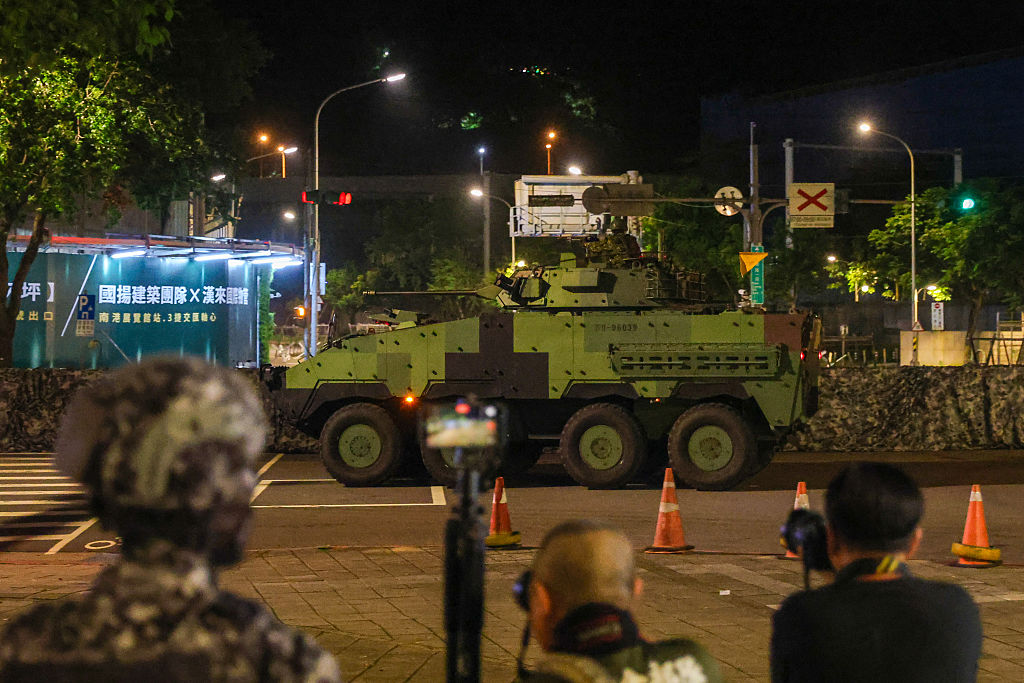
Taiwan’s annual Han Kuang military exercises, running from August 5 to 14, are revealing a strategy built around a difficult reality: Taipei is not preparing only for the opening hours of a Chinese attack. It is preparing for a conflict in which its forces may have to keep fighting after bases are damaged, ammunition is depleted, communications are disrupted and key infrastructure comes under pressure.
Over the 10-day exercise, Taiwan has turned military bases, roads, ports and civilian spaces into a simulated battlefield. Fighter jets have scrambled, warships deployed, troops fired live ammunition, damaged runways have been repaired and civilians have practised responding to air-raid warnings.
The latest drills on August 11 added another dimension.
Taiwan’s military rehearsed resupplying a Patriot air-defence system after simulated combat, testing its ability to sustain air-defence operations. At the same time, special forces conducted a nighttime ambush using drones, anti-tank weapons and sniper teams, while troops at an air force base in Chiayi practised detecting, jamming and intercepting an invasive drone.
The focus on resupply is particularly important. In a major conflict, Taiwan could face sustained missile and drone attacks rather than a single opening barrage. Keeping air-defence systems supplied and operational would be critical to protecting command centres, air bases, ports and other strategic infrastructure.
The special-forces exercise points to another concern: an adversary could seek to disrupt Taiwan’s command and logistics network rather than rely exclusively on conventional battlefield attacks. Drones can provide surveillance and targeting information, while small, mobile teams could attack vulnerable points and complicate an advancing force’s operations.
This fits the broader evolution of Han Kuang.
Taiwan is increasingly testing resilience, mobility and decentralisation. Commanders are being trained to respond when events diverge from the original plan. Damaged runways are repaired so aircraft can return to operations. Military units practise moving rapidly between different parts of the island. Ports are defended against simulated enemy landings. Civilians train to take shelter during air raids. Taiwan has also tested communications disruption, including deliberately slowing mobile internet in parts of the island.
The underlying logic is straightforward.
China claims Taiwan as part of its territory and has not renounced the use of force. Beijing’s Anti-Secession Law, adopted in 2005, provides for “non-peaceful means” under specified circumstances if it considers peaceful reunification possibilities exhausted. Taiwan, meanwhile, is a self-governing democracy that rejects Beijing’s sovereignty claim.
That makes the Taiwan Strait one of Asia’s most dangerous potential flashpoints.
The United States remains Taiwan’s most important potential external supporter, providing arms and maintaining significant military capabilities in the wider region. Japan could also become strategically important because of its geography, its alliance with Washington and the presence of US forces on Japanese territory.
But there is no automatic US treaty obligation to defend Taiwan. Washington continues to maintain a policy of strategic ambiguity.
That makes Taiwan’s own preparations particularly important.
President Lai Ching-te has called for defence spending to reach 5% of GDP by 2030, while Taiwan is also moving towards defence expenditure above 3% of GDP. The debate over how much Taiwan should spend, and how that money should be allocated, remains politically contentious.
But the direction of the military exercises is clear.
Taiwan is preparing not simply for an invasion, but for a prolonged and highly disruptive conflict involving missile strikes, drones, cyber and communications disruption, damaged infrastructure, supply shortages and possible blockade.
The 10-day Han Kuang exercise is therefore testing a much bigger question than whether Taiwan can respond to an attack. It is testing whether its military, government, infrastructure and civilian society can continue functioning under sustained pressure.
The question is not only whether Taiwan can survive the first strike.
It is whether Taiwan can stay in the fight after it.


