







Geographical Indication (GI) tags are emerging as a key driver of India’s heritage economy by protecting traditional products, improving rural livelihoods, and expanding access to domestic and international markets. Backed by policy support, legal protection, and export promotion initiatives, the country’s GI ecosystem is steadily transforming local craftsmanship into globally recognised brands.
A GI tag certifies that a product originates from a specific geographical region and possesses qualities or characteristics linked to that location. Beyond safeguarding traditional knowledge and preventing imitation, the certification helps artisans, weavers, farmers, and producer groups receive greater recognition and better prices for their products.
The impact is evident in products such as the Banarasi saree, where GI certification assures buyers of authenticity and traditional craftsmanship, enabling genuine handwoven products to command premium prices in both domestic and international markets. Similarly, Karnataka’s Channapatna wooden toys, known for their distinctive lacquerware art, have benefited from GI recognition by enhancing consumer confidence and market visibility.
According to the Ministry of Textiles, GI recognition can increase rural artisans’ incomes by 20-30 per cent by improving market access and strengthening their bargaining power. The certification also contributes to preserving India’s rich cultural heritage while creating sustainable livelihood opportunities.
India’s GI ecosystem has witnessed significant expansion in recent years. The country is now home to more than 800 registered GI products, with 607 GIs granted since 2014. The number of authorised GI users has also grown sharply, rising from just 365 to around 29,000 as of January 2025. Darjeeling Tea remains India’s first GI-registered product, followed by several iconic products across textiles, handicrafts, agriculture, food, manufacturing and natural products.
Among the states, Uttar Pradesh leads with 81 GI-tagged products, followed by Tamil Nadu with 76 and Maharashtra with 55, reflecting the growing geographical spread of India’s traditional product ecosystem.
The economic benefits of GI certification are increasingly visible. Muzaffarnagar Jaggery, after receiving GI recognition, entered international markets when Brijnandan Agro Farmer Producer Company exported 30 metric tonnes of jaggery to Bangladesh in 2025. The certification enhanced buyer confidence, improved marketability, and increased income opportunities for its 545 farmer members.
The legal framework governing GI protection in India is provided under the Geographical Indications of Goods (Registration and Protection) Act, 1999. In 2025, amendments to the rules reduced the application fee for GI registration and related procedures by 80 per cent, while the renewal fee was brought down from ₹3,000 to ₹500, making the registration process more affordable for producer groups.
The government has also introduced several initiatives to strengthen the GI ecosystem. PM Ekta Malls are being developed to promote One District One Product (ODOP) items and GI-tagged products, while railway stations under the One Station One Product (OSOP) initiative provide dedicated retail spaces for regional crafts, textiles, and food products. GI clusters are also being integrated into tourism through initiatives such as GI Trails, with Assam recently announcing the Muga Silk Trail to promote silk heritage tourism.
Financial support is being extended through the MSME Innovative Scheme, which provides reimbursement of up to ₹2 lakh for GI registration. The Ministry of Textiles also offers assistance for GI protection and legal enforcement, while schemes such as the National Handloom Development Programme and National Handicrafts Development Programme support promotion and marketing of GI products.
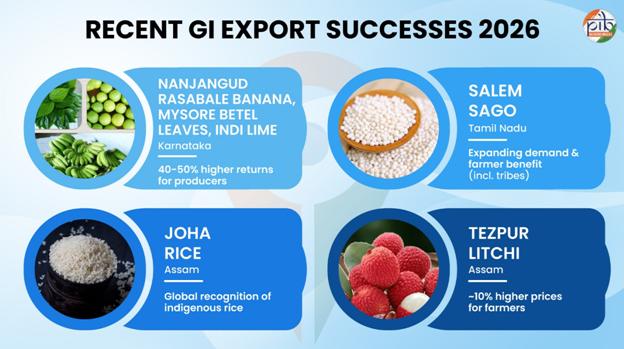
Export promotion agencies are also leveraging GI certification to expand India’s global footprint. The Agricultural and Processed Food Products Export Development Authority (APEDA) has facilitated exports of several GI-tagged products to new international markets. GI fruits from Karnataka have secured 40-50 per cent higher returns in the Maldives, Salem Sago has expanded its presence in Canada, Joha Rice has entered markets in the UK and Italy, while Tezpur Litchi exports to Dubai have fetched nearly 10 per cent higher prices for growers.
GI products are also gaining importance in India’s trade negotiations. They feature in discussions under the proposed India-EU Free Trade Agreement, while New Zealand has agreed to facilitate registration of Indian GI products. Following the India-Oman CEPA, Karnataka’s GI-tagged Indi Lime was exported to Oman, demonstrating the growing commercial value of GI-certified products.
The government has set an ambitious target of achieving 10,000 GI registrations by 2030. As India continues to strengthen legal protection, improve market access, promote exports, and integrate GI products with tourism and trade, the country’s traditional crafts and regional specialties are expected to play an increasingly important role in rural development and the heritage economy.


