







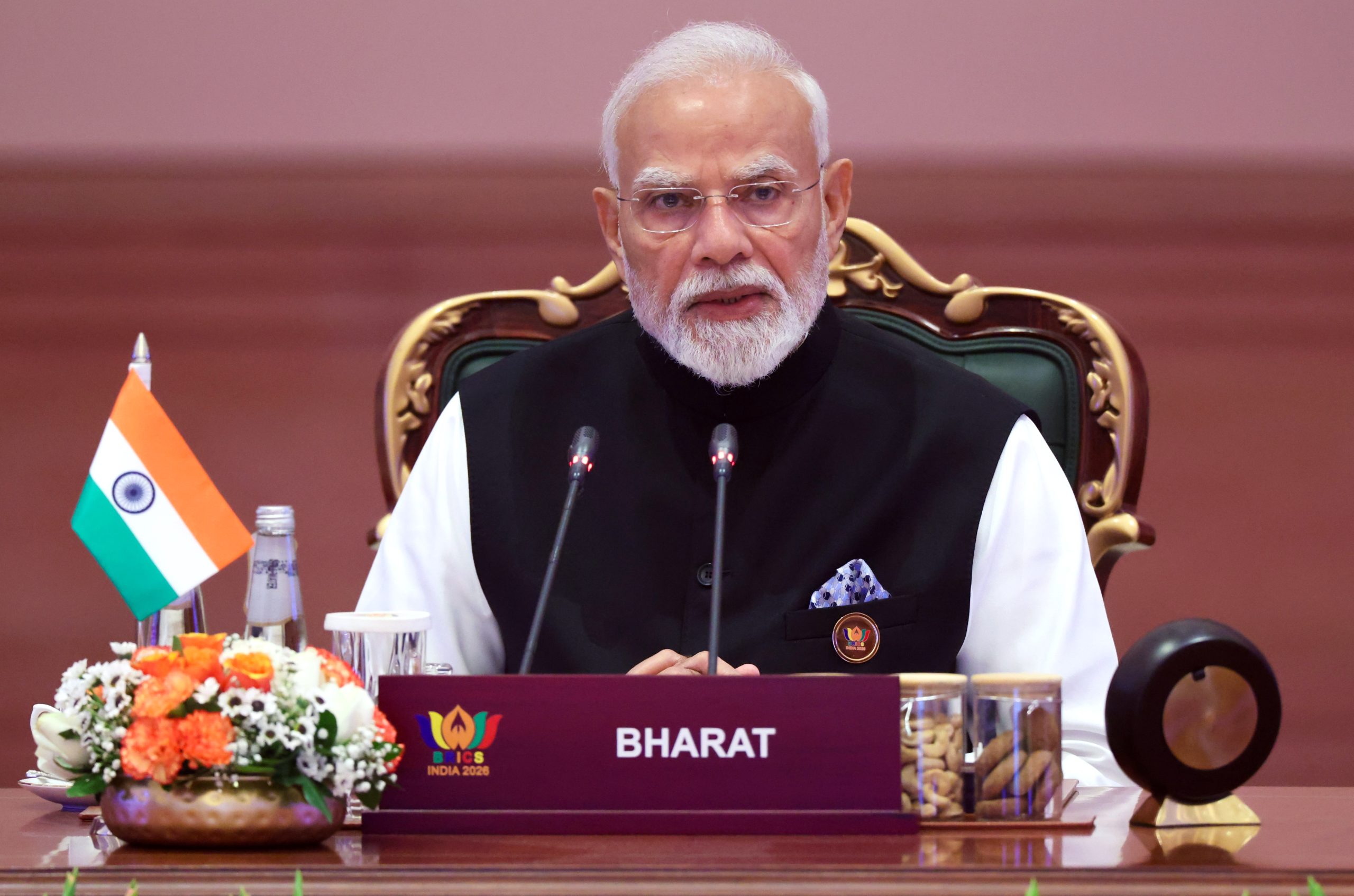
The Global South must become a “rule shaper” and the existing “pyramid of privilege” structure in global governance must give way to a “platform of partnership”, Prime Minister Narendra Modi said on Saturday while opening the two-day annual BRICS summit.
The prime minister also unveiled a 10-point roadmap for global governance reform under the BRICS framework while advocating for a ‘Seafarers’ Emergency Support Network’ to safeguard sailors facing heightened risks from ongoing global and regional crises.
PM Modi made the remarks in the presence of a galaxy of world leaders including Russian President Vladimir Putin, Chinese President Xi Jinping, Iranian President Masoud Pezeshkian, South African President Cyril Ramaphosa, Malaysian Prime Minister Anwar Ibrahim, Indonesian President Prabowo Subianto, Abu Dhabi Crown Prince Mohamed bin Zayed Al Nahyan and Egyptian President Abdel Fattah El-Sisi.
In his remarks, PM Modi hailed BRICS for emerging as a key global body and called for a “new and ambitious agenda” for the grouping for the next 20 years so that it can effectively handle pressing global challenges.
As the BRICS chair, India has placed the Global South at the heart of its agenda by seeking actionable solutions for food, energy, and supply chain security, primarily to insulate developing nations from the economic consequences of conflicts in Ukraine and West Asia.
“The current structure of global governance resembles a pyramid: power and decision-making are concentrated at the top, while the lower tiers consist of nations that are affected by these decisions but unable to shape them,” PM Modi said.
“Today, the Global South stands in the front row of global crises but in the back row of decision-making. We must transform this ‘pyramid of privilege’ into a ‘platform of partnership’ — one where every nation has a voice, every member has a stake, and the development of humanity lies at the heart of every effort,” he said.
To this end, the Prime Minister proposed that the BRICS jointly formulate a 10-point roadmap for global governance reform under the broader framework of the grouping’s reform roadmap. PM Modi said the roadmap should be finalised by the time of the next summit.
“In formulating this roadmap, we must focus on three key aspects: representation, responsiveness, and rule-making,” said PM Modi.
Elaborating on “representation”, PM Modi said the reform of the UN Security Council can no longer be postponed and that the negotiations on it must be brought under a definite timeframe and clear outcomes.
“Similarly, voting power, leadership positions and policy priorities within financial institutions must align with today’s economic realities.
Countries that drive global economic growth should also play an appropriate role in shaping global economic governance,” he said.
Explaining his third point, the Prime Minister said ensuring equal participation in defining future global rules is crucial.
“Domains such as artificial intelligence, cyberspace, outer space, biotechnology, and critical technologies are not only shaping future opportunities but also defining future rules.”
“We must strive to transform the Global South from a ‘rule-follower’ into a ‘rule-shaper’,” he said.
The Prime Minister also highlighted the critical role being played by the seafarers’ community in the flow of global trade and said their safety should be a matter of priority.
“Seafarers make a massive contribution to global trade, yet they often find themselves lacking support during difficult times. I propose that we establish a ‘Seafarers’ Emergency Support Network’,” said PM Modi.
“This would connect the maritime authorities and diplomatic missions of relevant countries, facilitating assistance with distress alerts, medical aid, family notifications, and evacuations,” he said.
The main focus of PM Modi’s address was his call for reform of the global governance structure as well as to find ways to make BRICS much stronger.
“This year’s BRICS summit marks a historic milestone. We are celebrating the 20th anniversary of BRICS. In human life, the age of 20 marks the beginning of a new phase of maturity and responsibility,” he said.
PM Modi said BRICS, too, has reached a moment of “coming of age” and that it has established a distinct identity on the global stage.
“We respect each other’s perspectives and move forward through consensus. We strive to advance not by opposing anyone, but by taking everyone along.
“Now is the time for us to translate our unity and consensus within BRICS into tangible results on the global stage,” said PM Modi.
“We need to work on a new and ambitious agenda for the next 20 years. We must begin this process with our own internal working systems. While the BRICS presidency rotates annually, this should not disrupt our institutional momentum,” he said.
PM Modi also called for establishing a BRICS continuity and implementation mechanism.
-PTI


