







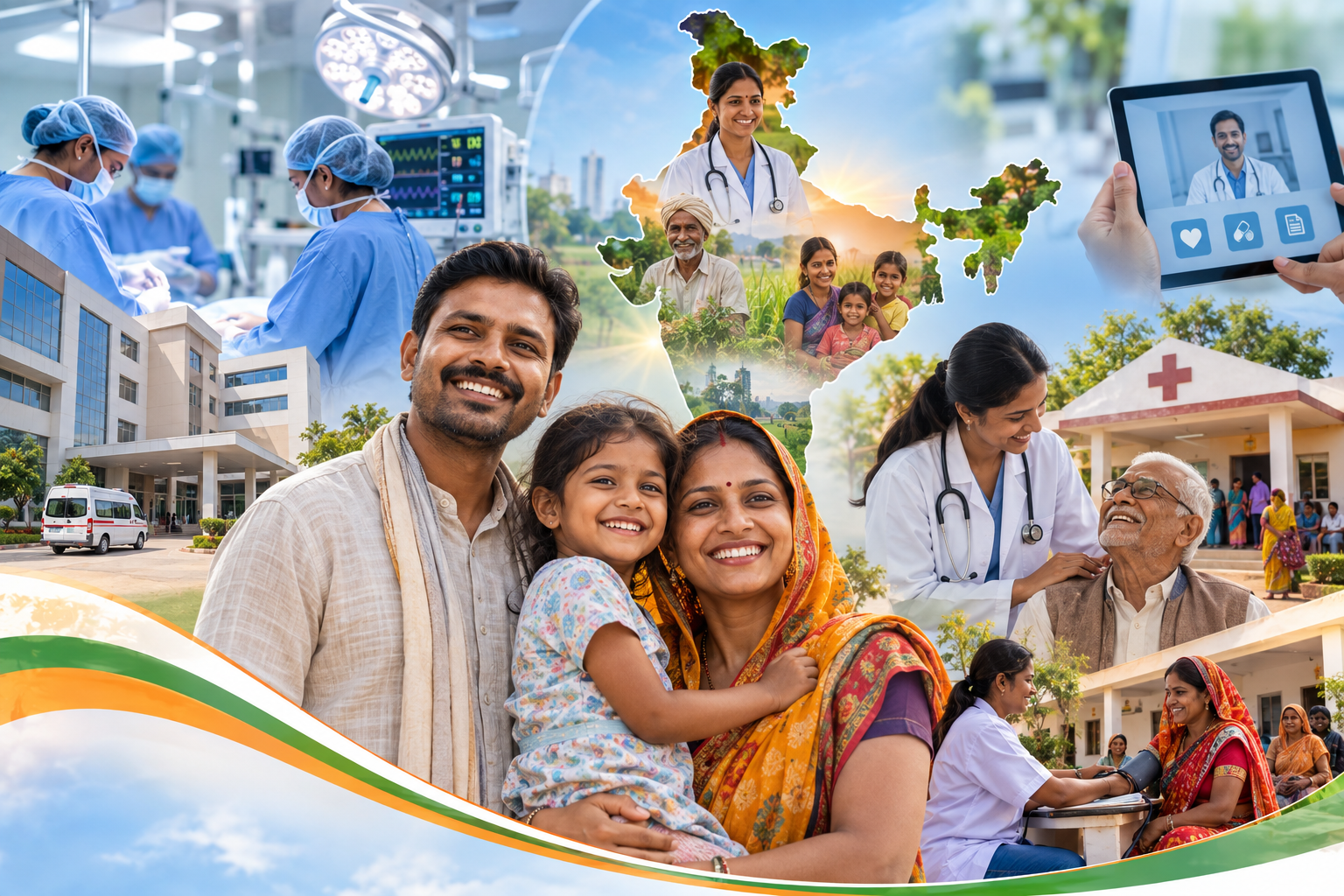
The Ayushman Bharat Pradhan Mantri-Jan Arogya Yojana (AB PM-JAY) has completed eight years, with more than 48.51 crore people holding Ayushman cards and around 13.25 crore hospital admissions funded under the scheme.
Launched on September 23, 2018, AB PM-JAY is a flagship health assurance scheme aimed at providing financial protection to economically vulnerable families and expanding access to secondary and tertiary healthcare.
As of September 21, 2026, about 33 per cent of India’s population had Ayushman cards under the scheme. The programme has provided treatment worth around Rs 2.03 lakh crore through a network of more than 38,000 empanelled public and private hospitals, as of August 31, 2026.
AB PM-JAY provides cashless hospitalisation coverage of up to Rs 5 lakh per family per year and covers 1,961 procedures across 27 medical specialties.
The scheme has also been expanded to cover additional categories of beneficiaries. In March 2024, around 37 lakh families of ASHAs, Anganwadi workers and Anganwadi helpers were included. As of September 21, more than 44.81 lakh Ayushman cards had been created for these beneficiaries.
In September 2024, the government expanded AB PM-JAY to cover all senior citizens aged 70 years and above, covering around six crore people. More than 1.36 crore Ayushman Vay Vandana cards had been created for senior citizens as of September 21, 2026.
The scheme also covers beneficiaries identified through the Socio-Economic Caste Census (SECC) 2011, based on defined deprivation and occupational criteria. Additional categories covered through specific initiatives include construction workers and their dependants, road accident victims covered under PM-RAHAT, transgender persons under the SMILE initiative, eligible children covered under PM CARES for Children, waste pickers and identified sanitation workers under NAMASTE, and Particularly Vulnerable Tribal Groups under PM-JANMAN.
Four pillars of Ayushman Bharat
AB PM-JAY is part of a broader Ayushman Bharat framework that includes Ayushman Arogya Mandirs (AAMs), the Ayushman Bharat Digital Mission (ABDM) and the PM-Ayushman Bharat Health Infrastructure Mission (PM-ABHIM).
Ayushman Arogya Mandirs provide comprehensive primary healthcare closer to communities. They offer screening and management of diseases, oral, eye and ear-nose-throat care, mental health support, first-level emergency and trauma care, along with essential medicines and diagnostics.
The centres also support community health outreach and provide access to telemedicine services through e-Sanjeevani. More than 50 crore teleconsultations had been conducted, including at AAMs, as of September 17, 2026. The centres have recorded cumulative footfall of more than 540 crore.
Digital health infrastructure
The Ayushman Bharat Digital Mission (ABDM), launched in September 2021, seeks to create an integrated digital health ecosystem through digital health identities and interoperable healthcare services.
More than 97.61 crore ABHA IDs were operational as of September 17, 2026, with over 119.95 crore health records linked to the accounts.
The digital health ecosystem also includes the Healthcare Professionals Registry, Health Facility Registry and Unified Health Interface. More than 5.78 lakh verified healthcare facilities and over 11 lakh healthcare professionals are registered on the platform.
Strengthening health infrastructure
The PM-Ayushman Bharat Health Infrastructure Mission (PM-ABHIM) was launched on October 25, 2021, with a budget of Rs 64,180 crore for 2021-26.
The mission focuses on strengthening health infrastructure, disease surveillance and health research. It includes support for 23,224 rural health and wellness centres, 13,736 urban health and wellness centres, 3,389 block public health units, 744 integrated public health laboratories and 631 critical care hospital blocks.
Together, AB PM-JAY, Ayushman Arogya Mandirs, ABDM and PM-ABHIM are aimed at strengthening the continuum of healthcare — from primary care and digital health services to hospital-based treatment and critical health infrastructure — as India advances towards universal health coverage.


