







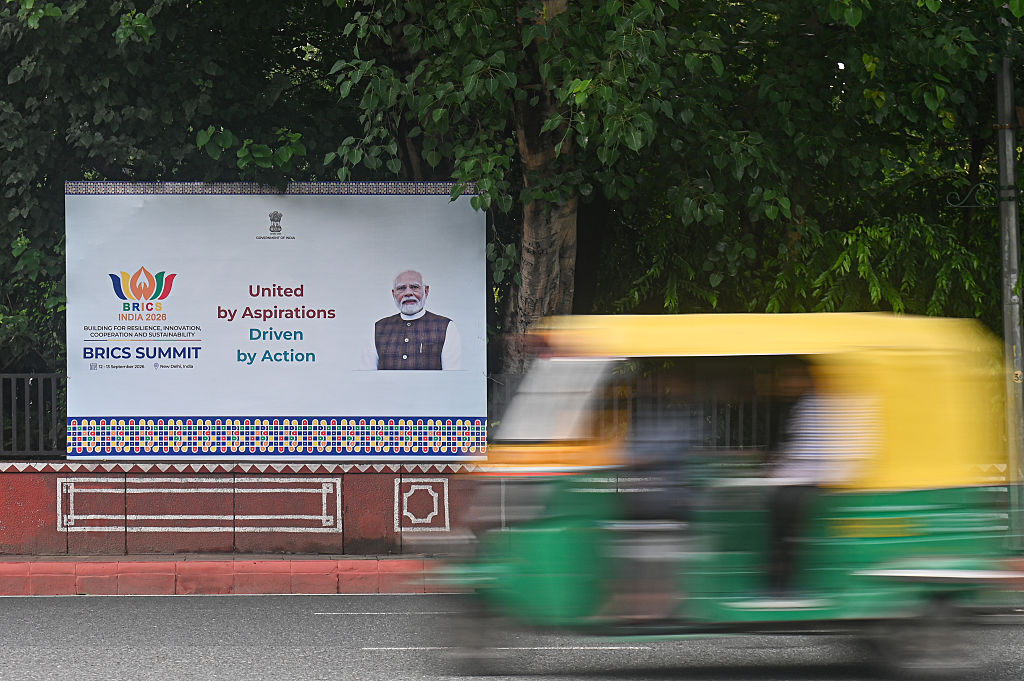
Delhi is set to host the 18th BRICS Leaders’ Summit on September 12-13, as India concludes its 2026 chairship of the expanded grouping of major emerging economies and developing countries.
India’s chairship, which began on January 1, 2026, is guided by the theme “Building for Resilience, Innovation, Cooperation and Sustainability”, with the four pillars reflecting its focus on strengthening resilience, harnessing innovation, deepening cooperation and advancing sustainable development through a people-centric approach.
Four pillars of India’s BRICS Chairship
Resilience: India’s chairship seeks to strengthen economic, social and institutional resilience so that BRICS countries are better equipped to respond to global uncertainties, supply-chain disruptions, health challenges and climate-related risks. The focus is on building systems that are robust, adaptable and capable of supporting inclusive development.
Innovation: The innovation pillar places emphasis on harnessing emerging technologies, including artificial intelligence, digital public infrastructure and fintech, to improve service delivery and promote future-ready growth. It also seeks to encourage knowledge-sharing and technological cooperation among BRICS countries.
Cooperation: India is seeking to deepen cooperation among BRICS members through greater policy coordination, development finance, trade facilitation and engagement on reforms of global governance institutions. The approach also places people-centric partnerships and practical collaboration at the heart of the grouping’s expanding agenda.
Sustainability: The sustainability pillar focuses on strengthening collective action on climate change, green finance, energy transition and sustainable development, while taking into account the national circumstances and development priorities of individual BRICS members. India’s chairship has accordingly placed resilience and sustainability at the centre of discussions across several ministerial and working-level engagements.
BRICS: An expanding platform of the Global South
BRICS has evolved into an important platform for political and diplomatic coordination among major emerging economies and developing countries. It currently comprises 11 full members — Brazil, Russia, India, China, South Africa, Egypt, Ethiopia, Indonesia, Iran, Saudi Arabia and the United Arab Emirates.
The grouping has also introduced a partner-country category, with Belarus, Bolivia, Cuba, Kazakhstan, Malaysia, Nigeria, Thailand, Uganda, Uzbekistan and Vietnam among the partners.
The expanded BRICS grouping accounts for a significant share of the global population and economy, representing around 49.5 per cent of the world’s population, 40 per cent of global GDP and 26 per cent of global trade.
From BRIC to an expanded BRICS
The grouping began as BRIC, comprising Brazil, Russia, India and China. It was formalised at the first meeting of BRIC Foreign Ministers on the sidelines of the United Nations General Assembly in New York in 2006. The first BRIC Leaders’ Summit was subsequently held in Yekaterinburg, Russia, in 2009.
South Africa joined the grouping in 2011, transforming BRIC into BRICS. The grouping subsequently entered a new phase of expansion, with Egypt, Ethiopia, Iran, Saudi Arabia and the UAE becoming full members in January 2024, followed by Indonesia in January 2025.
The expansion was accompanied by the creation of the partner-country category, approved at the 16th BRICS Summit in Kazan in 2024. Nine countries initially joined the category in 2025, while Vietnam subsequently became the tenth BRICS partner country.
Three traditional pillars of BRICS cooperation
While the agenda of BRICS has expanded considerably over the years, its institutional cooperation continues to be broadly organised around three core pillars: Political and Security; Economy and Finance; and Cultural and People-to-People Exchanges.
Under the Political and Security pillar, BRICS countries engage on issues including international peace and security, counter-terrorism, global governance and reform of the multilateral system.
The Economy and Finance pillar covers trade and investment, financial cooperation, development finance, economic coordination, international financial architecture and issues concerning the global economy.
The Cultural and People-to-People pillar seeks to strengthen ties among societies through cooperation in areas such as culture, education, youth, sports, tourism and other people-to-people exchanges.
Over time, this framework has enabled BRICS cooperation to expand into a much wider range of issues, including climate change, food and energy security, agriculture, telecommunications, labour and employment, trade, international financial architecture and cooperation within the World Trade Organization, alongside the fight against terrorism and other shared global challenges.
Building on Brazil’s 2025 chairship
The 17th BRICS Summit was held in Rio de Janeiro, Brazil, on July 6-7, 2025, under Brazil’s chairship. Brazil’s presidency placed emphasis on strengthening Global South cooperation, inclusive and sustainable governance, global health, climate action, artificial intelligence governance, trade and finance, and improving the efficiency of BRICS mechanisms.
The summit also marked the first high-level meeting of the expanded grouping following the recent enlargement of its membership. Brazil’s chairship sought to consolidate the expanded BRICS framework while advancing cooperation on global governance, sustainable development and emerging challenges.
India’s fourth BRICS chairship
The 2026 chairship marks India’s fourth time at the helm of BRICS, following its earlier chairships in 2012, 2016 and 2021. India last held the chair in 2021, when it hosted the 13th BRICS Summit virtually on September 9 under the theme “BRICS@15: Intra-BRICS Cooperation for Continuity, Consolidation and Consensus.”
The 2021 chairship focused on four broad priorities: reforming the multilateral system, strengthening counter-terrorism cooperation, using digital and technological tools to achieve the Sustainable Development Goals, and enhancing people-to-people exchanges. More than 150 meetings and events were organised during India’s 2021 chairship, including ministerial-level engagements across several sectors.
The New Delhi Declaration adopted at the 13th summit underscored the need for reforms in the multilateral system, stronger counter-terrorism cooperation, the use of digital tools for achieving the SDGs and greater people-to-people exchanges.
Against this backdrop, India’s 2026 chairship represents both continuity and an expansion of priorities — carrying forward its emphasis on reform, digital cooperation and people-centric development while placing resilience, innovation and sustainability at the centre of BRICS’ response to a rapidly changing global environment. The 18th Summit in New Delhi will therefore provide the platform for BRICS leaders to assess the grouping’s evolving role and chart the course for deeper cooperation among its expanded membership.


