







As geopolitical tensions, disrupted supply chains and rising logistics costs create fresh pressures for businesses, the government’s Emergency Credit Line Guarantee Scheme (ECLGS) 5.0 is emerging as a key mechanism to keep credit flowing to enterprises and support business continuity.
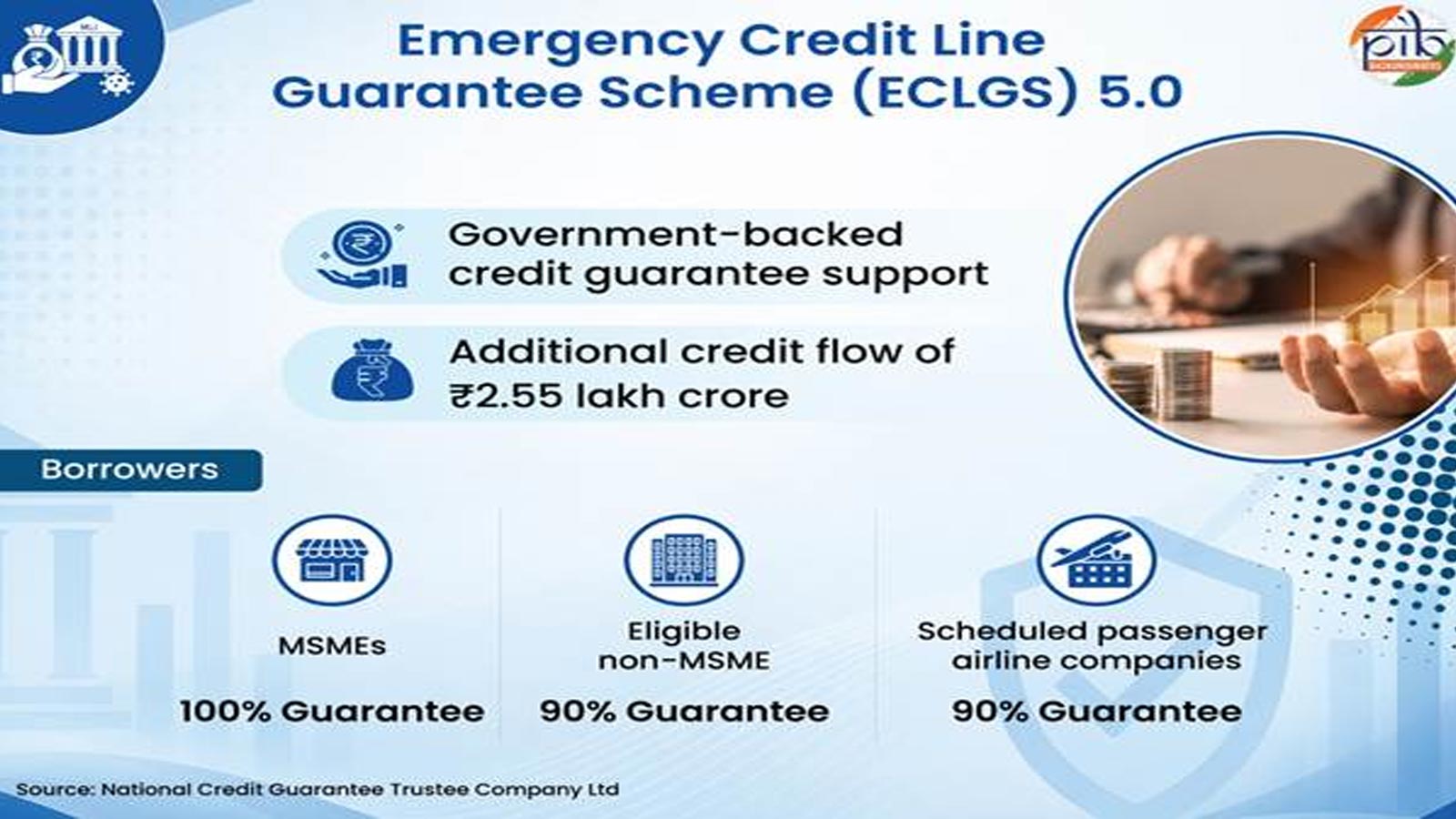
Approved on May 5, 2026, ECLGS 5.0 enables lending institutions to provide additional working capital to eligible businesses backed by government guarantees. Implemented by the National Credit Guarantee Trustee Company (NCGTC), the scheme aims to facilitate additional credit of up to ₹2.55 lakh crore.
The latest phase builds on the ECLGS framework launched in 2020 under the Aatmanirbhar Bharat package to help businesses deal with the economic fallout of the COVID-19 pandemic. While the earlier versions focused on pandemic-related financial stress, ECLGS 5.0 has been designed to strengthen business resilience against external economic disruptions.
Strong uptake by MSMEs
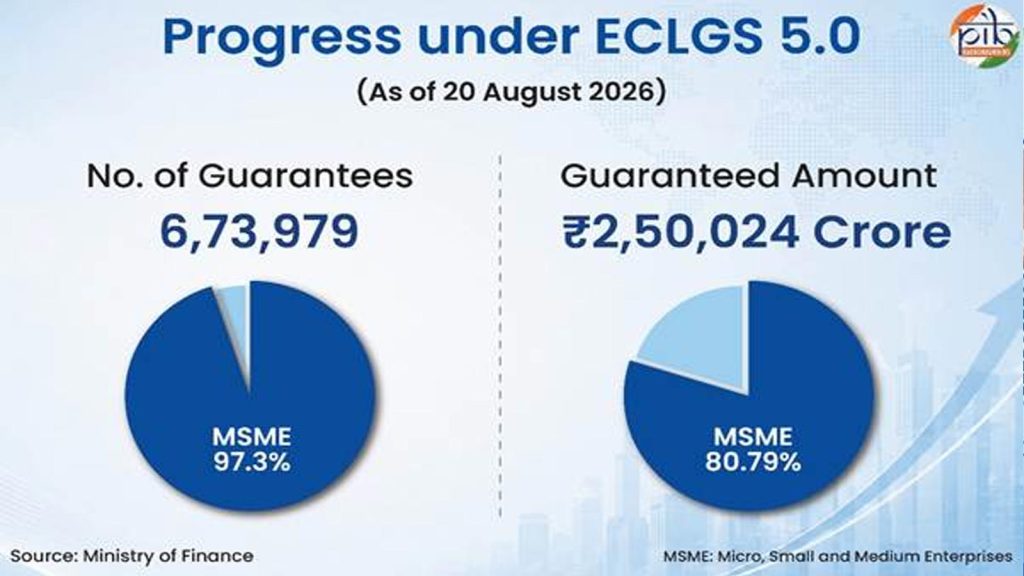
The scale of demand for the latest scheme is reflected in its early implementation. As of August 20, 2026, 6,73,979 guarantees had been issued, covering a guaranteed amount of ₹2,50,024 crore.
Micro, Small and Medium Enterprises (MSMEs) account for 97.3 per cent of the guarantees issued by number and 80.79 per cent of the total guaranteed amount, highlighting the central role of smaller businesses in the scheme.
The government has set March 31, 2027, as the operational deadline for ECLGS 5.0, or until guarantees worth ₹2.55 lakh crore are issued, whichever comes earlier.
For eligible MSMEs, the scheme provides a 100 per cent credit guarantee, while eligible non-MSME businesses and scheduled passenger airlines receive 90 per cent guarantee coverage. Lending institutions are not required to pay a guarantee fee.
What does ECLGS 5.0 offer?
For MSMEs and eligible non-MSME businesses, additional credit of up to 20 per cent of peak fund-based working capital outstanding during the fourth quarter of FY 2025-26 can be availed, subject to a ceiling of ₹100 crore per borrower.
Eligible borrowers must have had existing working capital facilities from member lending institutions as of March 31, 2026, and their loan repayments should not have been overdue by more than 60 days.
The scheme covers MSMEs across sectors. However, certain sectors are excluded from coverage for non-MSME borrowers, including NBFCs, power generation, transmission and distribution, telecom services, sugar and ethanol, IT companies, paper and paper products, educational institutions, beverages other than tea and coffee, and tobacco.
Where a business operates across both eligible and excluded sectors, eligibility is determined by the proportion of turnover generated from eligible activities during FY 2025-26.
The loans carry a five-year tenure, including a one-year moratorium. For MSMEs, interest is linked to the External Benchmark Lending Rate, while eligible non-MSMEs are linked to the Marginal Cost of Funds-based Lending Rate. Lending institutions can charge up to 0.75 percentage points above the applicable benchmark, subject to an overall ceiling of 9 per cent per annum. For loans provided by eligible NBFCs, the interest rate cannot exceed 13 per cent per annum.
Special window for airlines
ECLGS 5.0 also provides a separate support mechanism for scheduled passenger airlines, a sector particularly vulnerable to disruptions in fuel costs, travel demand and global supply chains.
Eligible airlines can receive additional credit of up to 100 per cent of their specified existing credit exposure, subject to a ceiling of ₹1,500 crore per borrower. Any amount above ₹1,000 crore and up to ₹1,500 crore requires a proportionate equity contribution from promoters or owners.
The government guarantee covers 90 per cent of the loan, with no guarantee fee payable by lending institutions. The interest rate will be determined by the lender under its board-approved policy.
Airline loans will have a seven-year tenure, including a two-year moratorium.
From pandemic relief to resilience
The ECLGS framework has evolved considerably since its introduction in 2020.
ECLGS 1.0 initially supported MSMEs, business enterprises, Mudra borrowers and individual business loans affected by the pandemic. ECLGS 2.0 expanded coverage to 26 stressed sectors identified by the Kamath Committee and the healthcare sector, while ECLGS 3.0 extended assistance to hospitality, travel and tourism, leisure, sporting and civil aviation businesses.
ECLGS 4.0 was subsequently introduced to strengthen healthcare infrastructure during the pandemic, supporting hospitals, nursing homes, clinics, medical colleges and manufacturers of liquid oxygen and oxygen cylinders.
Together, the first four phases issued 1.19 crore guarantees amounting to ₹3.68 lakh crore before the schemes concluded on March 31, 2023.
The fifth phase represents a shift from emergency pandemic assistance towards building financial resilience against new external shocks.
Expanding access through Jan Samarth
A major focus of ECLGS 5.0 is ensuring that eligible businesses can access institutional credit without having to navigate a complex process on their own.
Borrowers can access the scheme through participating Scheduled Commercial Banks, Scheduled Urban Cooperative Banks, financial institutions and eligible NBFCs. The government is also using the Jan Samarth Portal to facilitate digital access.
Outreach campaigns have been conducted through State Level Bankers’ Committees, NCGTC, PSB Alliance, banks, industry associations and enterprises. The first phase covered nine locations between May 20 and June 6, while a second phase is being conducted across 10 additional locations.
The broad participation of banks and financial institutions is intended to ensure that the scheme reaches businesses across regions and sectors.
Keeping businesses, jobs and supply chains moving
The broader objective of ECLGS 5.0 extends beyond providing loans. By improving access to working capital, the scheme is designed to help enterprises meet short-term financial obligations, maintain production, preserve employment and prevent disruptions in supply chains.
For MSMEs in particular, timely access to credit can determine whether a business can continue paying workers, purchasing raw materials and fulfilling orders during periods of uncertainty.
With ₹2.50 lakh crore in guarantees already issued by August 20 against the overall ₹2.55 lakh crore target, the strong uptake indicates substantial demand for government-backed credit support.
As external economic risks continue to evolve, ECLGS 5.0 is positioned as a financial buffer aimed at helping Indian businesses withstand disruptions while maintaining the momentum of economic activity and growth.


