







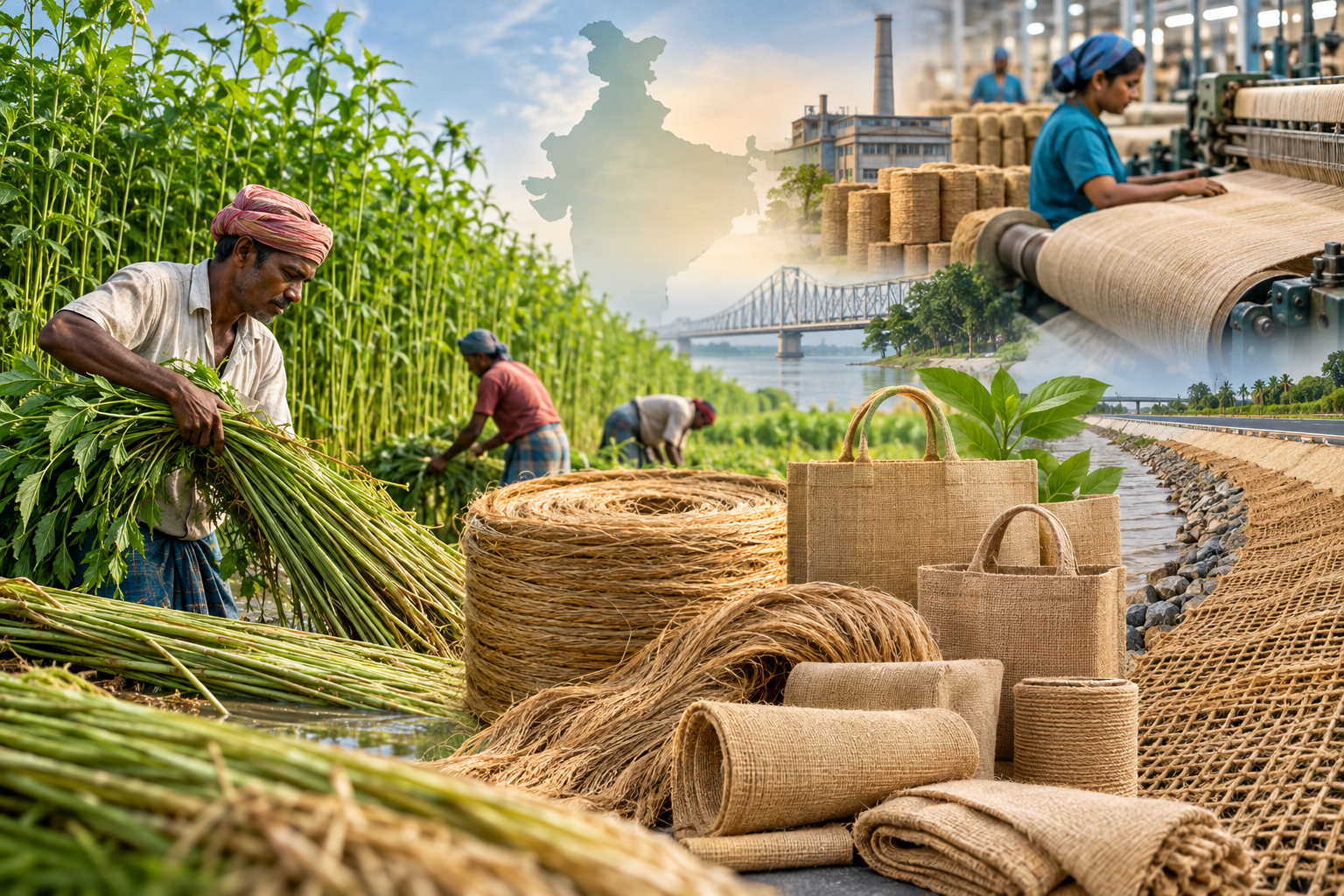
Jute, often described as India’s “Golden Fibre” because of its distinctive golden colour and silky lustre, continues to play an important role in the country’s agricultural economy, manufacturing sector and push towards sustainable materials.
India is the world’s largest producer of raw jute and also accounts for about 75 per cent of estimated global jute goods production. The sector supports nearly 40 lakh farm families involved in jute cultivation and provides direct employment to around 3.70 lakh workers in organised mills and diversified jute units.
What makes jute important?
Jute is a natural fibre that is biodegradable, recyclable, strong, durable and versatile. It is used in packaging, agriculture, construction and industrial textiles. Its ability to absorb moisture, provide thermal and acoustic insulation and generate low static electricity also makes it suitable for a range of value-added products.
Its environmental characteristics have increased its relevance as countries look for alternatives to synthetic and plastic-based materials.
Where is jute produced in India?
West Bengal is the country’s largest jute-producing state, followed by Bihar, Assam, Odisha and Jharkhand.
Jute is generally sown during March and April and harvested within 100 to 110 days. The crop requires hot and humid conditions and is predominantly rainfed. Small and marginal farmers account for a significant share of its cultivation.
India had 120 composite jute mills as of December 2025, with West Bengal accounting for 89 of them.
How large is India’s jute industry?
India produced 76 lakh bales of raw jute and 12.80 lakh metric tonnes of jute goods in 2025-26.
During the same financial year, the country exported 22,700 metric tonnes of raw jute worth Rs 225.11 crore and 1.71 lakh metric tonnes of jute goods valued at Rs 3,155.27 crore.
Domestic consumption of jute goods stood at 12.05 lakh metric tonnes during the year, accounting for 94 per cent of total production.
How has India’s jute sector evolved?
Jute has a long history in India, with its use traced back to the third century BC. It became a major commercial commodity during the British colonial period, when jute mills were established in Bengal.
Partition in 1947 disrupted the integrated jute economy of Bengal. Nearly 80 per cent of the jute-growing areas went to East Pakistan, while most of the jute mills remained in India, creating a shortage of raw material.
To address the problem, the government launched the “Grow More Jute” campaign in September 1949, encouraging farmers to cultivate jute. Production subsequently increased from 6.7 lakh tonnes in 1951-52 to 14.56 lakh tonnes in 1961-62.
The Jute Packaging Act, 1987, further strengthened the sector by creating a stable market for jute packaging in essential commodities.
What is the government doing for jute farmers?
The government has introduced several measures aimed at improving farmer incomes, productivity and market access.
The Minimum Support Price (MSP) for raw jute has been fixed at Rs 5,925 per quintal for 2026-27, representing a 61.8 per cent return over the all-India weighted average cost of production. The MSP has risen from Rs 2,400 per quintal in 2014-15.
The Jute Corporation of India is the nodal agency for implementing the MSP policy. It purchases raw jute directly from farmers when market prices fall below the MSP through its network of Departmental Purchase Centres.
What is the National Jute Development Programme?
The National Jute Development Programme is the umbrella programme for the development and promotion of the jute sector. It was allocated Rs 485.58 crore for the period from 2021-22 to 2025-26.
The programme focuses on improving farm productivity and farmer incomes and promoting diversification through initiatives including JUTE-ICARE and the Jute Diversification Scheme.
JUTE-ICARE, launched in 2015-16, promotes scientific cultivation, mechanisation and improved retting techniques. It also supports small and marginal farmers through subsidised certified seeds and field demonstrations.
Beyond bags: Where else is jute being used?
Jute is increasingly being developed into value-added and technical products.
One such application is jute geotextiles, which can be used for slope protection, soil stabilisation, erosion control, road construction, railway track formation and riverbank protection.
Because jute geotextiles are biodegradable, they can support soil restoration while reducing erosion and helping seed germination and early plant growth. The National Jute Board provides technical assistance for their design, testing, procurement and installation.
Jute is also being explored in textiles and apparel. Jute-viscose-blended apparel was worn by Indian athletes and team members at the 2026 Commonwealth Games, highlighting the potential of biodegradable jute-blended fabrics.
How is technology being used in the jute sector?
Digital technology is increasingly being incorporated into the jute supply chain.
The JUTE-SMART portal, developed by the Office of the Jute Commissioner, digitises the procurement and supply of jute sacking bags. Since 2016, the system has been used to manage these operations, with registration and compliance processes further digitised in 2026.
The government has also introduced the Jute Crop Information System, developed by ISRO’s National Remote Sensing Centre in collaboration with the Jute Corporation of India and National Jute Board. It uses remote sensing and field data to monitor jute cultivation.
Two tools under the system are BHUVAN JUMP, a mobile application for field monitoring, and PATSAN, a web-based platform providing near-real-time jute surveillance and analytics.
What support is available for jute products and entrepreneurs?
The Jute Diversification Scheme supports processing, marketing and sales of diversified jute products.
Measures include a 30 per cent capital subsidy for plant and machinery for jute mills and MSMEs producing jute diversified products, cluster-based Jute Resource-cum-Production Centres, assistance for jute retail outlets and incentives for exports of diversified jute products.
The government has also introduced the Jute Mark India logo to certify compliance with quality standards and verify jute content in blended products, with the aim of improving consumer confidence and brand recognition.
What lies ahead for India’s jute sector?
India’s jute sector is moving beyond its traditional dependence on packaging towards diversified products, technical textiles, sustainable apparel and technology-enabled cultivation and supply chains.
With its large farmer base, established industrial ecosystem and biodegradable characteristics, jute has the potential to contribute to both rural livelihoods and India’s transition towards more sustainable materials.
Continued investment in innovation, product diversification, market development and technology could further strengthen the competitiveness of India’s “Golden Fibre” in domestic and international markets.


