







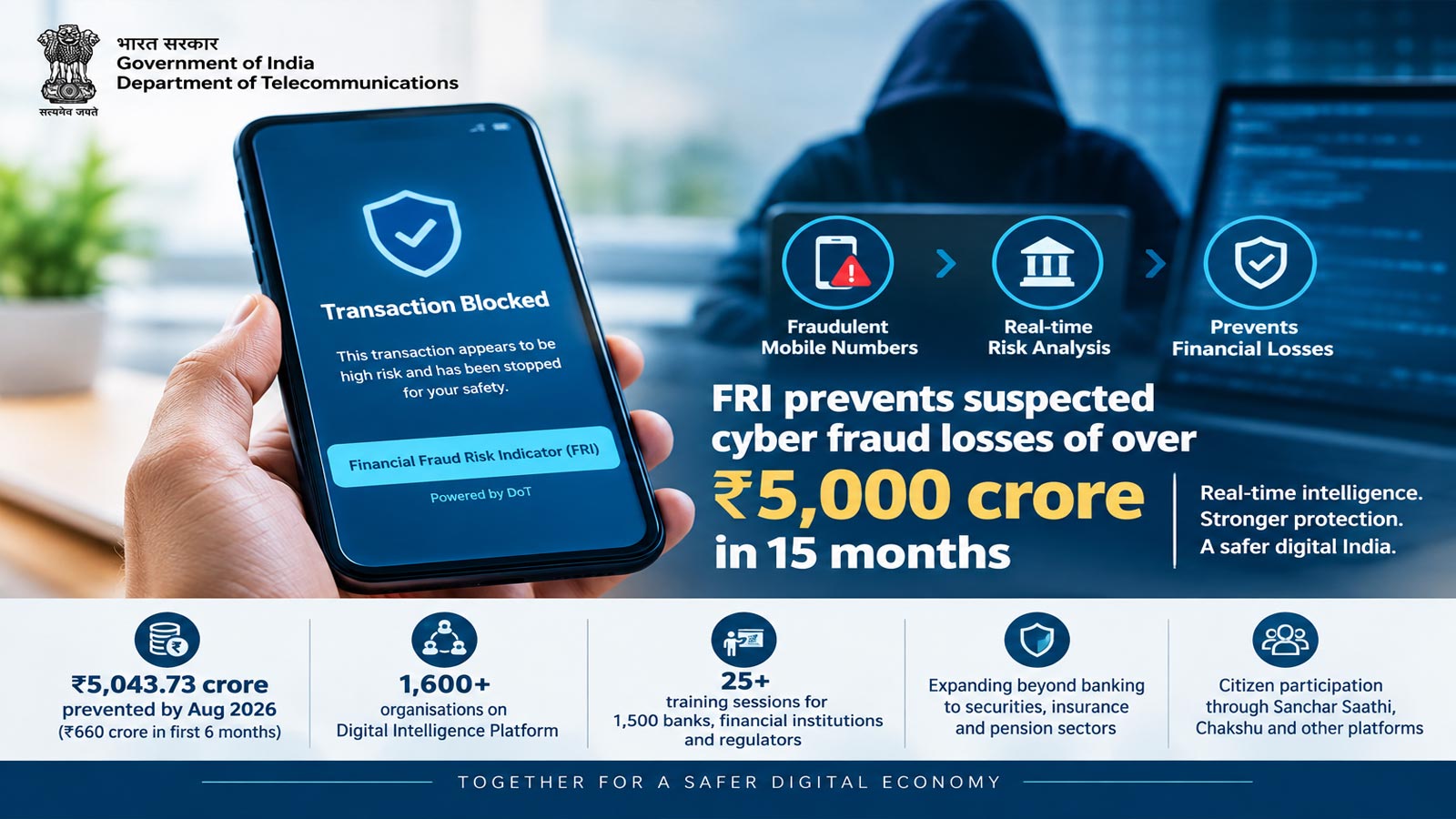
The Department of Telecommunications (DoT) has prevented suspected cyber fraud losses of more than ₹5,000 crore through its Financial Fraud Risk Indicator (FRI) in the 15 months since its launch on May 22, 2025, marking a major expansion in efforts to protect citizens from digital financial fraud.
The milestone marks a decisive scaling-up of an initiative that had prevented ₹660 crore of losses in its first six months of operation. It reflects the growing role of telecom intelligence in shielding citizens from digital financial fraud, and the strength of coordinated action across the telecom, banking, fintech, securities, insurance and law enforcement ecosystems.
The pace of protection has accelerated sharply. Cumulative savings though use of FRI rose from ₹139.16 crore in August 2025 to ₹5,043.73 crore by August 2026 with over ₹2,000 crore prevented in the four months from April 2026 alone, as adoption has deepened across banks and payment platforms.
Real-time fraud prevention
Developed under the DoT’s Digital Intelligence Platform (DIP), FRI provides financial institutions with real-time intelligence on the likelihood of a mobile number being associated with cybercrime or financial fraud.
The system classifies mobile numbers as medium, high or very high risk, using inputs from multiple sources. These include citizen reports through the Sanchar Saathi platform, the Indian Cybercrime Coordination Centre’s National Cybercrime Reporting Portal, telecom operators, banks, financial institutions and other telecom-related parameters.
The risk intelligence is shared securely with banks, payment service providers, insurers, securities intermediaries and pension-sector entities. Institutions can use these signals during customer onboarding, transaction monitoring and fraud detection to identify potentially fraudulent transactions before money leaves a customer’s account.
The DoT said the approach represents a shift from a reactive model, where fraud is investigated after the loss, to a preventive model in which suspicious transactions can be stopped at the point of initiation.
Prevention reduces burden on citizens
The department highlighted that preventing a fraudulent transaction eliminates the need for subsequent recovery efforts, which can involve filing complaints, registering cases, freezing accounts, tracing money and coordinating with multiple institutions.
Fraud proceeds can move rapidly through mule accounts across banks, making recovery difficult once funds have been transferred. In contrast, an FRI-based check can be completed in a fraction of a second when a payment is initiated.
The DoT said the more than ₹5,000 crore prevented therefore represents only the direct financial losses avoided and does not capture the wider benefits of preventing complaints, investigations, account freezes, record requisitions and other follow-up procedures.
Over 1,600 organisations on Digital Intelligence Platform
The Digital Intelligence Platform currently connects more than 1,600 stakeholders, including telecom service providers, banks, financial institutions, law enforcement agencies and government departments.
The DoT has also conducted more than 25 training sessions covering around 1,500 banks, financial institutions and regulators to familiarise them with the FRI methodology, DIP integration and the use of risk signals in their fraud-prevention systems.
The department said collaboration with the Reserve Bank of India (RBI), National Payments Corporation of India (NPCI), Securities and Exchange Board of India (SEBI) and other financial-sector institutions has been central to expanding the system.
FRI expands beyond banking
The government is progressively extending the framework beyond traditional banking and digital payments.
FRI signals are being integrated with securities-market intermediaries to help curb fraud involving trading and demat accounts. The framework is also being extended to insurance entities and pension-sector stakeholders to strengthen fraud checks during policy issuance, claims processing and pension-account transactions.
Citizens remain the first line of defence
The DoT has stressed that citizen participation is an important component of the FRI ecosystem. Reports of suspicious calls and messages submitted through Sanchar Saathi and its Chakshu facility contribute to the intelligence used to identify potentially fraudulent mobile numbers.
The department has urged citizens to independently verify payment details if a banking or UPI application displays a warning about the recipient’s mobile number.
Citizens have also been advised to report suspected fraud calls, SMS or WhatsApp messages through Sanchar Saathi. In cases of financial cyber fraud, they should immediately call 1930 or report the incident through the National Cybercrime Reporting Portal.
The DoT has further advised citizens to check mobile connections issued in their name, report lost or stolen handsets and verify the authenticity of mobile handsets before purchasing them.
The department said initiatives such as Sanchar Saathi, Chakshu, CEIR, ASTR, FRI and DIP form part of a broader effort to build a safer digital ecosystem through proactive detection, intelligence sharing and coordinated action across government, telecom and financial institutions.


