







As India’s agricultural production rises and its food security requirements expand, the government is increasingly turning to decentralised storage infrastructure to ensure that foodgrains can be stored closer to where they are produced.
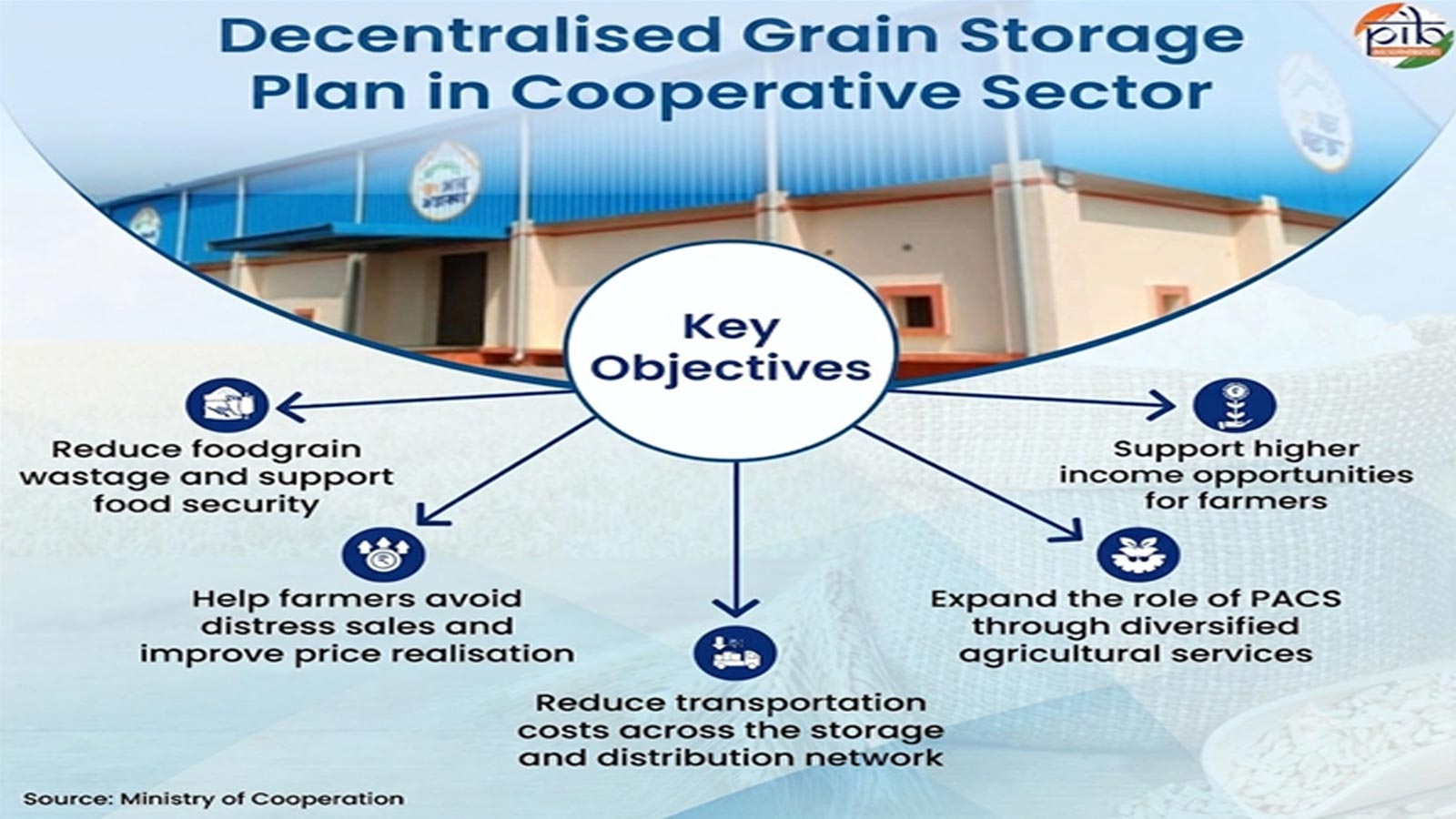
At the centre of this effort is the Decentralised Grain Storage Plan in the Cooperative Sector, launched as a pilot in May 2023 to build storage facilities through Primary Agricultural Credit Societies (PACS). The initiative seeks to bring storage, procurement, processing and distribution closer to farmers while reducing transportation costs and post-harvest losses.
The scale of the challenge is significant. According to the Third Advance Estimates for 2025-26, India’s foodgrain production is estimated at 376.563 million tonnes, up 5.3 per cent from 357.732 million tonnes a year earlier. At the same time, the National Food Security Act, 2013 covers around 80 crore people, making an efficient grain storage and distribution network critical to food security.
While large warehouses and centralised facilities operated by the Food Corporation of India and state agencies remain an important part of the system, decentralised storage can reduce the distance between farms, procurement centres, warehouses and Fair Price Shops.
From pilot projects to a national network
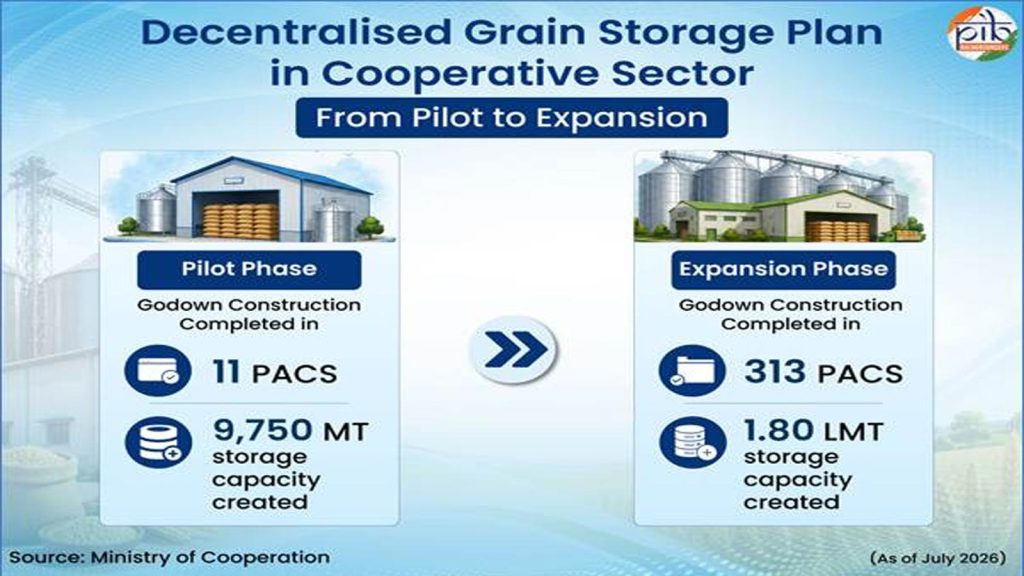
The cooperative storage initiative began with pilot projects in 11 PACS across 11 states, creating 9,750 metric tonnes (MT) of storage capacity. The pilot states included Maharashtra, Uttar Pradesh, Gujarat, Rajasthan, Madhya Pradesh, Uttarakhand, Tamil Nadu, Telangana, Assam, Karnataka and Tripura.
The programme has since moved beyond the pilot stage. As of July 2026, 1,012 PACS and cooperative societies had been identified under the plan, while godown construction had been completed in 313 PACS, creating more than 1.80 lakh tonnes (1.80 LMT) of storage capacity.
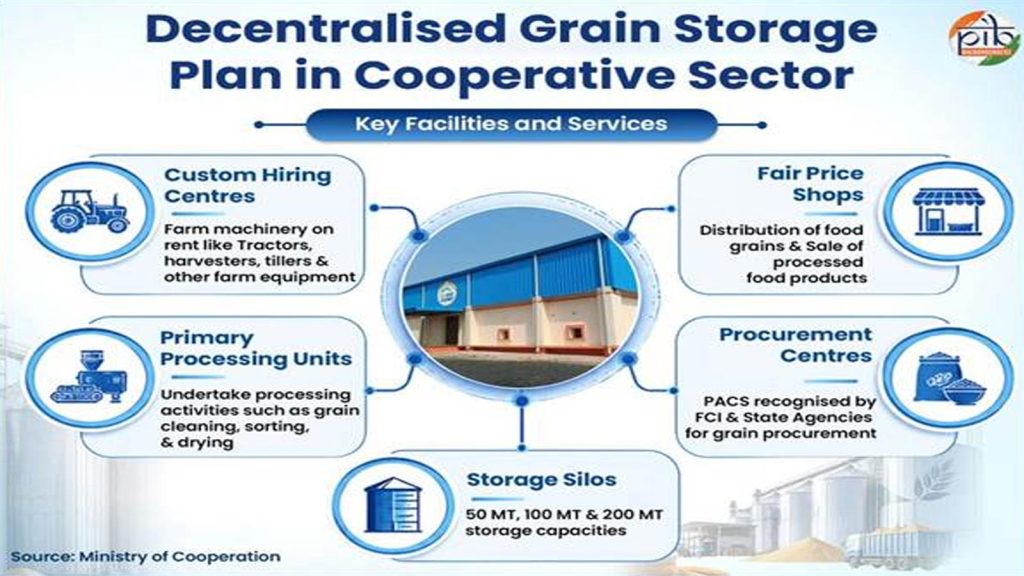
The expansion reflects an effort to create a network in which village-level cooperatives become more than credit institutions. Under the model, PACS can develop storage facilities alongside procurement centres, primary processing units, Fair Price Shops and Custom Hiring Centres for agricultural machinery.
The objective is to give farmers greater flexibility in deciding when to sell their produce, potentially helping them avoid distress sales and secure better price realisation. Local storage can also reduce transportation requirements and help preserve grain quality.
A convergence-driven model
Rather than creating an entirely new financial architecture, the plan brings together existing government schemes to support infrastructure at the PACS level.
The Agriculture Infrastructure Fund (AIF) provides financing and interest subvention for post-harvest infrastructure, while the Agricultural Marketing Infrastructure (AMI) scheme supports storage construction through capital subsidy. The Sub-Mission on Agricultural Mechanization (SMAM) supports agricultural machinery and Custom Hiring Centres, while the Pradhan Mantri Formalisation of Micro Food Processing Enterprises (PMFME) scheme supports micro food-processing activities.
This convergence is designed to turn PACS into integrated rural service hubs, linking farmers not only to credit but also to storage, processing, procurement and local markets.
The model allows for silo-based storage facilities with capacities of 50 MT, 100 MT and 200 MT, alongside conventional godowns.
Making village-level storage financially viable
A major focus of the programme has been ensuring that cooperatives can operate the infrastructure sustainably.
To improve project viability, the subsidy available under the AMI scheme has been enhanced from 25 per cent to 33.33 per cent, while the margin money requirement has been reduced from 20 per cent to 10 per cent. Cost norms for godown construction have also been revised.
PACS can access credit through State Cooperative Banks and District Central Cooperative Banks, with NABARD serving as the subsidy-channelising agency for eligible AMI projects. NABARD’s special refinance facility, combined with the 3 per cent interest subvention under AIF, can bring the effective loan interest rate for PACS down to 1 per cent under the plan.
The Food Corporation of India has also been authorised to provide assured hiring of eligible godowns created under the programme, subject to prescribed conditions. This provides an additional potential revenue stream for cooperatives and strengthens the financial case for building local storage capacity.
Nerpingalai shows how the model can work
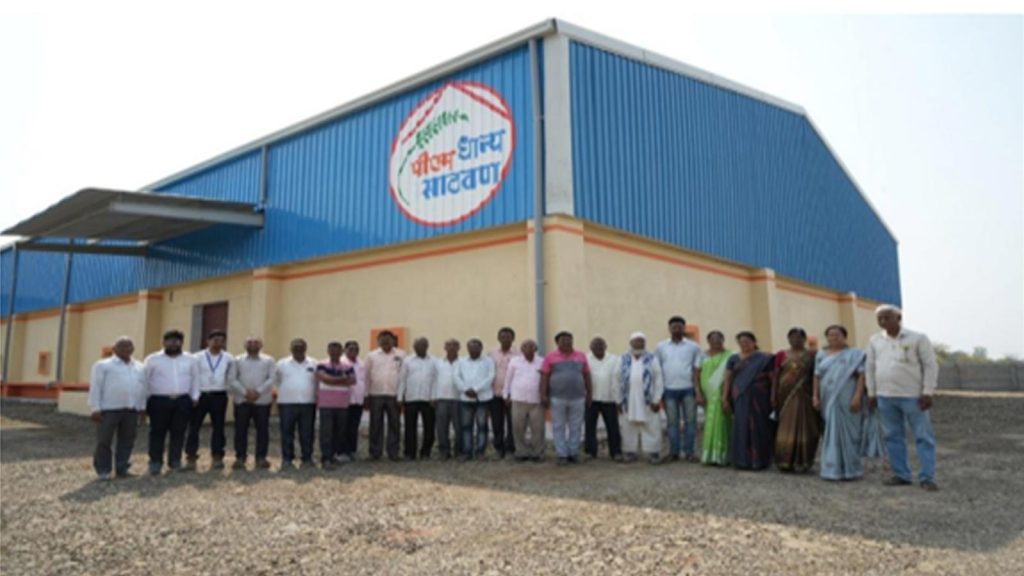
The experience of Nerpingalai PACS in Amravati, Maharashtra, illustrates how decentralised storage can translate into direct benefits for farmers.
The cooperative has constructed a 3,000-MT warehouse with support under the AMI and AIF schemes. With NABARD refinance support, the effective interest rate for the project was reduced to 1 per cent.
Around 300 farmers are using the warehouse to store nearly 32,000 bags of soybeans. The cooperative has also provided advances of about Rs 4.50 crore against stored produce, giving farmers access to liquidity without requiring them to sell immediately.
The warehouse is expected to generate around Rs 7.68 lakh annually in rental income and nearly Rs 54 lakh in annual interest income for the cooperative. Besides improving storage access, the project has strengthened the financial base of the PACS and generated local employment opportunities.
The example illustrates the broader proposition behind the scheme: storage infrastructure can simultaneously serve as a farmer-support mechanism and a source of sustainable income for rural cooperative institutions.
Building trust through standards and transparency
For decentralised storage to be effective, capacity expansion needs to be accompanied by quality assurance.
Storage facilities under the plan are required to follow prescribed standards, including Warehousing Development and Regulatory Authority (WDRA) norms and specifications suited to local environmental conditions. Construction guidelines call for durable and corrosion-resistant materials, adequate ventilation and measures to protect grain from spoilage.
Regular inspections and quality audits are part of the framework. PACS members are expected to monitor implementation, while Project Management Consultants provide updates on construction and expenditure.
The plan also provides uniform branding guidelines for storage infrastructure, including the approved grain storage logo and prescribed colour scheme, aimed at creating a recognisable identity for the initiative.
A cooperative approach to food security
The institutional structure mirrors the decentralised character of the programme. The National Cooperative Development Corporation (NCDC) is the implementing agency, with an Inter-Ministerial Committee overseeing implementation at the national level. National, state and district-level coordination mechanisms support execution and address local requirements.
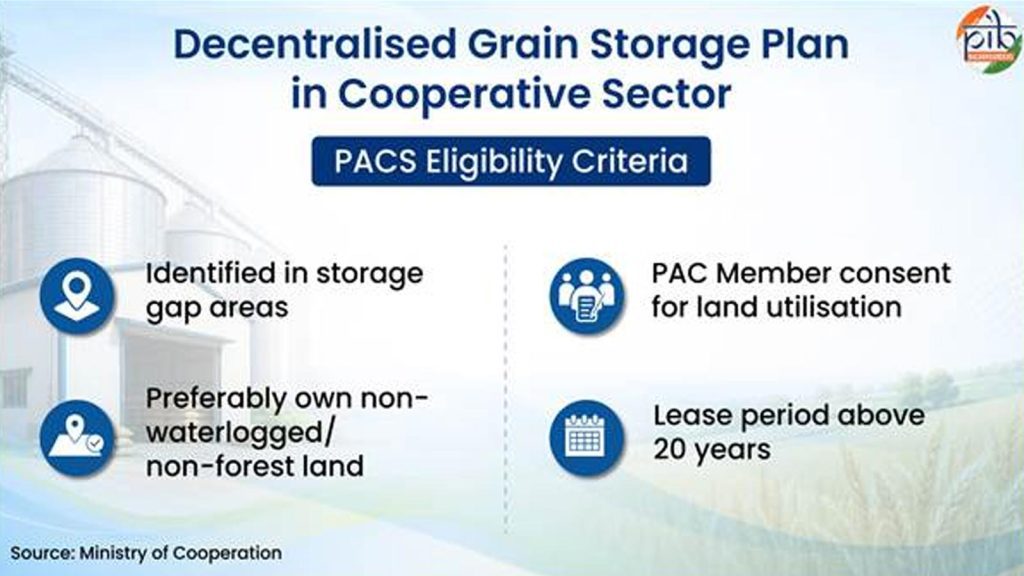
PACS are selected by District Cooperative Development Committees in areas where storage demand exists. The framework also specifies conditions relating to land ownership, suitability and member consent to ensure that infrastructure projects are viable and locally supported.
Ultimately, the Decentralised Grain Storage Plan is aimed at changing where and how India stores its foodgrains. Instead of relying predominantly on large, centralised facilities, the model seeks to build a network of storage points closer to farms and rural markets.
With foodgrain production crossing an estimated 376 million tonnes and the country’s food security system serving hundreds of millions of people, the expansion of such local infrastructure could play an important role in reducing wastage, cutting logistics costs and improving farmers’ ability to hold produce until market conditions are favourable.
By combining government financing, cooperative institutions and local infrastructure, the initiative seeks to make the village-level PACS a more versatile part of India’s agricultural supply chain-linking the farmer not only to credit, but also to storage, processing, procurement and markets.


