







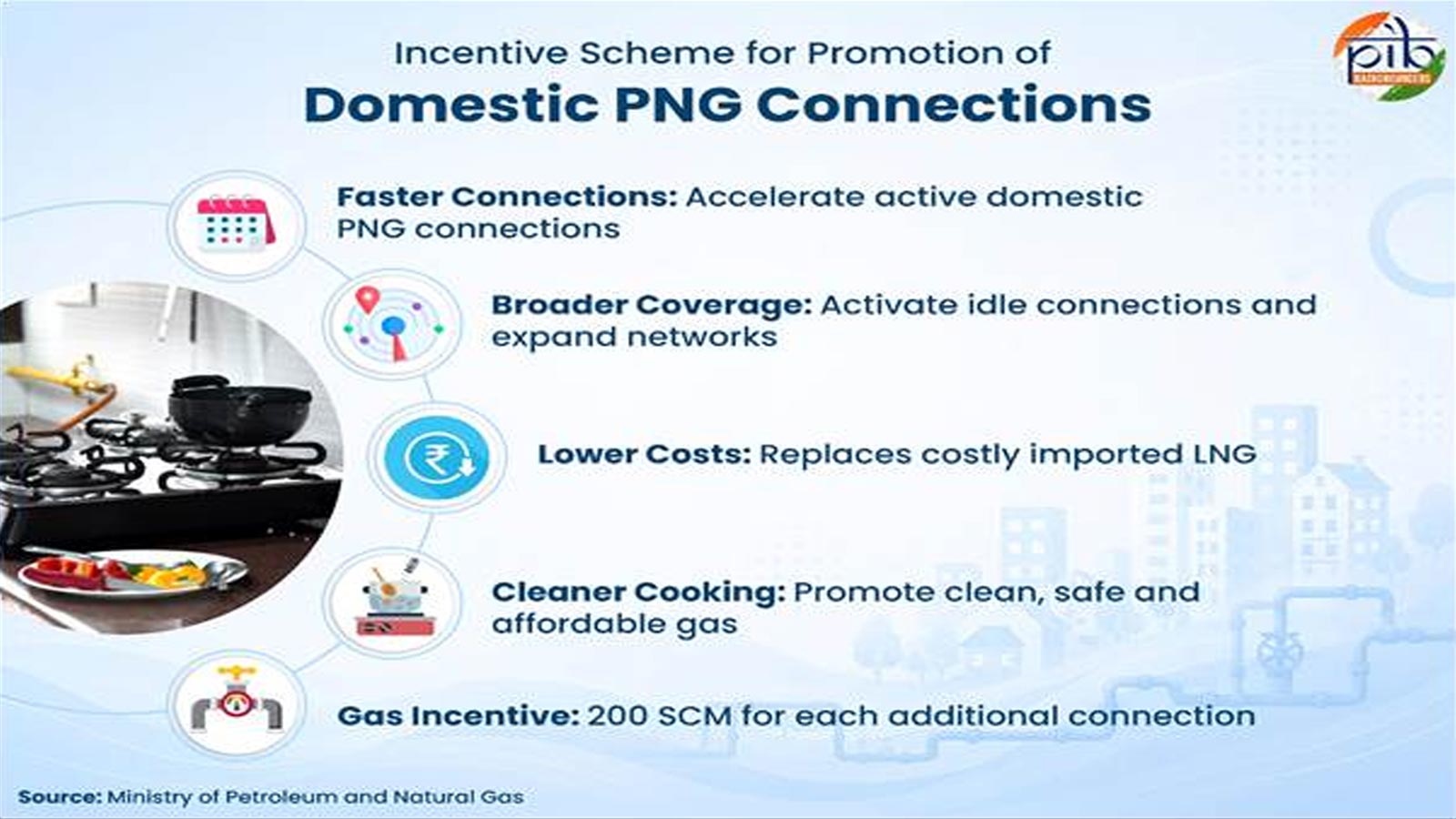
India has stepped up efforts to expand access to clean and affordable cooking fuel with the launch of the Incentive Scheme for Promotion of Domestic PNG Connections, aimed at accelerating the growth of active domestic Piped Natural Gas (PNG) connections across the country.
Launched on August 18, 2026, the scheme came into effect from September 1 and seeks to encourage City Gas Distribution (CGD) entities to connect more households to piped natural gas, while making better use of existing infrastructure and expanding networks into new areas.
With PNG emerging as an important component of India’s transition towards cleaner household energy and greater energy security, the initiative seeks to make piped cooking gas more accessible, convenient and affordable for households.
1.74 crore domestic PNG connections already in place
The supply of PNG to households forms part of the wider City Gas Distribution network, comprising pipelines and allied infrastructure serving domestic, commercial and industrial consumers.
CGD networks are developed by entities authorised by the Petroleum and Natural Gas Regulatory Board (PNGRB). The regulator has authorised entities in 309 Geographical Areas (GAs), covering the entire mainland of the country.
As of August 18, 2026, India had 1.74 crore domestic PNG connections, providing a substantial base for further expansion.
The new incentive scheme is specifically designed to increase the number of active, billed domestic PNG connections by encouraging CGD entities to convert unbilled connections into active connections and extend PNG networks to new areas.
How the incentive scheme works
The scheme will be implemented in two tranches over a six-month period. A minimum number of domestic connections has been fixed for every Geographical Area, with eligible CGD entities required to add billed domestic connections above the prescribed threshold during the performance period.
For every incremental connection achieved beyond this threshold, the CGD entity will receive an additional allocation of 200 Standard Cubic Metres (SCM) of domestically produced Administered Price Mechanism (APM) gas, which is priced lower than costlier Liquefied Natural Gas (LNG).
The additional APM gas allocation is intended to replace LNG that CGD entities currently procure for their Compressed Natural Gas (Transport) segment. By substituting relatively expensive LNG with cheaper domestic APM gas, the scheme is expected to reduce the overall cost of gas sourcing for CGD companies.
This, in turn, is expected to significantly improve the commercial viability of household PNG connections.
As per the scheme, the payback period on capital invested in a domestic PNG connection is expected to fall from around 10 years to nearly three years. The shorter payback period provides CGD companies with a strong commercial incentive to connect households at a faster pace.
What PNG means for households
For consumers, the expansion of PNG promises more than just an alternative to conventional cooking fuel. It is intended to bring greater convenience, safety, affordability and continuity of supply to kitchens.
Unlike LPG cylinders, PNG is delivered directly to homes through underground pipelines, eliminating the need to book, transport, store or replace cylinders.
PNG pipelines operate at low pressure, and natural gas is lighter than air. In the unlikely event of a leakage, it rises and disperses quickly, adding to the safety advantages of piped supply.
The metered billing system also means households pay according to the quantity of gas they actually consume, similar to electricity or water billing.
On a per-unit energy basis, PNG generally costs less than LPG, potentially reducing household cooking-fuel expenditure over time. Continuous pipeline supply also eliminates dependence on cylinder delivery logistics, making PNG particularly convenient for households in high-rise buildings and densely populated urban colonies.
The fuel also offers environmental benefits. PNG burns more cleanly than conventional cooking fuels, producing fewer pollutants and helping improve indoor air quality while reducing carbon emissions.
Measures to make PNG expansion easier
The government is simultaneously working to remove regulatory and infrastructure-related barriers to faster PNG expansion.
An Accelerated Approval Framework has been issued under the Natural Gas and Petroleum Products Distribution (Through Laying, Building, Operation and Expansion of Pipelines and Other Facilities) Order, 2026. The framework is intended to speed up approvals required for laying and expanding gas pipelines.
The Order also introduces uniform charges for pipeline Right-of-Way (RoW), covering permissions required to use land or public areas for laying PNG pipelines. Applications are to be processed on priority and within defined timelines.
Tax rationalisation is another component of the broader effort. States have been encouraged to reduce Value Added Tax (VAT) on natural gas to 5 per cent. Several states have already taken this step, helping reduce the cost of piped gas for consumers.
Digital push for new connections
The government’s National PNG Drive 2.0, conducted from January 1 to June 30, 2026, focused on accelerating domestic PNG connections across Geographical Areas.
A unified PNG registration portal is also being developed as a single-window digital platform for consumers. The portal is expected to simplify the process of applying for new connections and allow households to track their applications more easily.
Together, these regulatory, fiscal and digital measures are intended to make the transition to PNG faster and more accessible.
Towards cleaner and connected kitchens
The expansion of PNG is ultimately aimed at aligning India’s energy transition with the everyday needs of households. By combining commercial incentives for CGD companies with measures to simplify consumer access, the new scheme seeks to accelerate the movement from conventional cylinder-based cooking towards piped gas.
As networks expand into new areas and more existing connections become active, the initiative is expected to reduce dependence on cylinders while providing households with a cleaner, safer, affordable and continuous cooking-fuel supply.
The government sees piped cooking gas as an increasingly important part of India’s cleaner-energy future, bringing the benefits of modern energy infrastructure directly into homes and making clean cooking fuel a more natural part of everyday life.


