







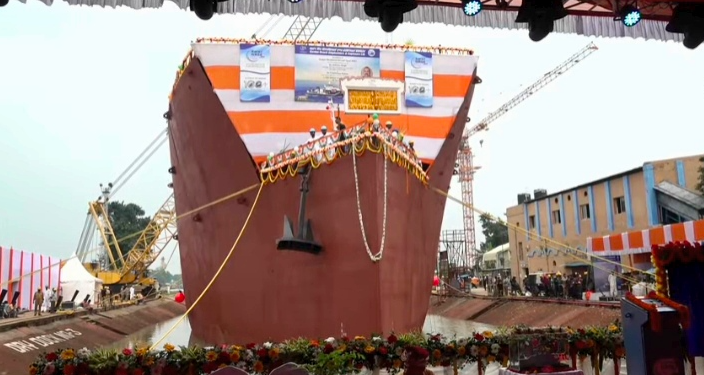
Union Minister for Earth Sciences Dr Jitendra Singh on Wednesday launched India’s advanced Ocean Research Vessel (ORV) ‘Sagar Manthan’ at Rishi Bankim Shipyard in Kolkata, marking a significant step towards strengthening the country’s indigenous oceanographic research and maritime capabilities.
The vessel, Yard 3041, has been designed, engineered and constructed by defence public sector undertaking Garden Reach Shipbuilders and Engineers (GRSE) for the National Centre for Polar and Ocean Research (NCPOR) under the Ministry of Earth Sciences.
Dr Jitendra Singh launched the vessel virtually in the presence of Ministry of Earth Sciences Secretary Dr T Srinivasa Kumar and other senior officials. The vessel was named by the Minister’s spouse, Manju Singh, in keeping with the traditional naming ceremony.
Describing the occasion as a “red letter day” for NCPOR, the Ministry of Earth Sciences and the country, Dr Jitendra Singh said the launch demonstrated India’s growing capabilities in building advanced ocean research platforms domestically.
“This fine ship is India’s first advanced Ocean Research Vessel built by GRSE, displaying the required thrust towards Atmanirbharta and self-reliance,” he said.
The Minister said ocean research was strategically important as the world’s understanding of the oceans remained limited despite their critical role in climate and environmental systems.
He said data collected through vessels such as ‘Sagar Manthan’ would help India contribute to disaster prevention, environmental protection and global ocean geopolitics.
Dr Jitendra Singh also noted that the vessel would gradually replace the 43-year-old ORV ‘Sagar Kanya’, which was procured from Germany in 1983. He said the Ministry of Earth Sciences was planning to acquire additional oceanographic vessels, including a Polar Research Vessel, in the future.
The new vessel is being constructed under Vertical-4, Deep Ocean Survey and Exploration, of the government’s Deep Ocean Mission at an estimated cost of around Rs 840 crore.
An all-weather, multidisciplinary research platform, ‘Sagar Manthan’ has been designed to operate in challenging oceanic environments, including the Southern Ocean, and is expected to have a service life of around 30 years.
The vessel is equipped with advanced systems for oceanographic and geophysical research, including dynamic positioning, multibeam bathymetry, multichannel seismic systems, sub-bottom profiling, weather radar and drop keels.
It will also have facilities for deploying Remotely Operated Vehicles (ROVs) and Autonomous Underwater Vehicles (AUVs).
The vessel will support multidisciplinary research along the Indian Ocean mid-ocean ridges, including surveys for multi-metal hydrothermal sulphide mineralisation, environmental baseline studies, upper-air observations and Conductivity, Temperature and Depth (CTD) profiling.
Speaking at the launch, Dr T Srinivasa Kumar said the vessel represented India’s transition from procuring ocean research platforms from abroad to designing and building them domestically.
“As an oceanographer, I have witnessed first-hand the immense value of ocean research. It is the foundation for understanding climate challenges, predicting tsunamis, and strengthening maritime capabilities,” he said.
He said the vessel’s capabilities would include underway swath multibeam surveys, geophysical profiling, atmospheric observations and water-column sampling.
Dr Srinivasa Kumar said GRSE had successfully taken on the complex challenge of building the vessel, demonstrating India’s ability to design and construct sophisticated ocean research platforms.
The vessel has been built in compliance with international regulatory standards and carries dual-class certification from the Indian Register of Shipping (IRS) and the American Bureau of Shipping (ABS).
The project has progressed through several key milestones since the contract was signed in July 2024. The first steel cutting was carried out on November 29, 2024, followed by keel laying on April 8, 2026.
Following its launch, the vessel will undergo superstructure erection, system integration and extensive sea trials before being delivered to NCPOR and the Ministry of Earth Sciences for commissioning. The vessel is scheduled for delivery in 2028.


