







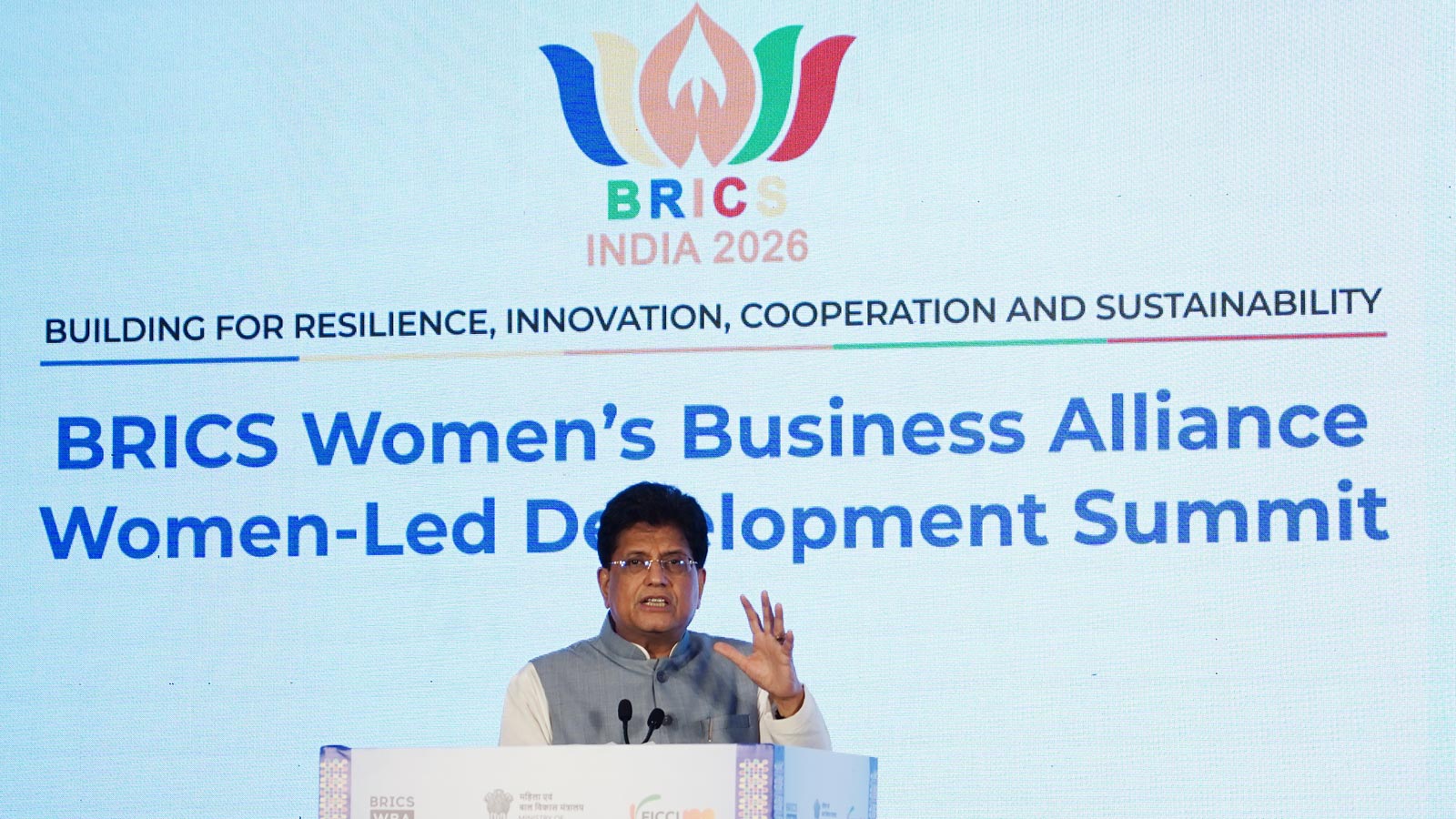
India will work with BRICS member and partner countries to expand opportunities for women-led enterprises in international trade, Union Commerce and Industry Minister Piyush Goyal said on Wednesday, calling for easier access to credit and markets, predictable business rules and greater participation of women entrepreneurs in global trade platforms.
Addressing the BRICS Women’s Business Alliance (WBA) Women-Led Development Conference in New Delhi, Goyal said entrepreneurs seeking to enter international markets face three major challenges – access to finance, access to buyers and markets, and predictable rules that facilitate business and trade.
He said India was ready to share its experience in empowering women entrepreneurs with the BRICS Women’s Business Alliance and the wider BRICS business community.
India’s financial inclusion push for women
Highlighting India’s progress in women’s financial inclusion, Goyal said the country had opened nearly 300 million bank accounts for women over the past 12 years and provided collateral-free loans to women seeking to establish businesses or livelihoods, including those without established credit histories.
Around 100 million rural women are now part of nearly nine million self-help groups, cooperatives and other women’s collectives, he said. The number of women earning more than ₹1 lakh in personal annual income has crossed 30 million, with these women being referred to as Lakhpati Didis.
Goyal said India has extended around 560 million loans to small entrepreneurs, with more than 68 per cent going to women entrepreneurs. The objective, he said, is to promote women’s economic independence and enable them to become active contributors to the country’s growth.
The minister also expressed confidence that India’s female workforce participation would rise substantially as education, skills and income levels improve. Greater participation of women in the formal workforce, he said, could provide a significant boost to India’s economic growth.
He stressed that women should not be viewed merely as beneficiaries of development programmes but as “architects of New India”, underlining the government’s focus on women-led development.
Common BRICS trade platform proposed
Goyal referred to the recent meeting of BRICS Commerce and Industry Ministers in Jaipur, where member countries agreed on voluntary principles for assessing small exporters.
He said assessment of small entrepreneurs should take into account not only invoices and payment records but also their capabilities and progress over time.
He also highlighted the Jaipur Consensus, under which BRICS countries agreed to explore the creation of a common platform for international trade. Such a platform, he said, could help connect businesses with buyers across BRICS countries and make product requirements and trade opportunities more visible.
Financial institutions and intermediaries could also participate on such a platform to support women entrepreneurs and small businesses as trade among BRICS countries expands.
More women-led trade delegations sought
The minister called for greater participation of women-owned enterprises in international exhibitions, conferences, seminars, business forums and buyer-seller meets.
He proposed that BRICS countries organise more sector-specific women-led business delegations, including delegations focused entirely on sectors such as textiles. Such initiatives, he said, could help women entrepreneurs build international networks, integrate into global value chains and explore markets beyond the BRICS grouping.
Goyal also called for the proposed Women’s Advancement Fund, highlighted in the Jaipur Consensus, to be converted into a concrete initiative.
On access to finance, he urged the BRICS Women’s Business Alliance and BRICS Business Council to ensure that ongoing work on an invoice-discounting platform reflects the actual requirements of women exporters. He also called on governments, banks and export-import banks to consider trade invoices when making lending decisions.
Push for digital trade and predictable rules
Goyal stressed that predictable rules and simpler procedures are essential for expanding international business.
He called for greater adoption of electronic trade documents, e-invoices, electronic bills of lading and e-customs declarations across BRICS countries. He also highlighted voluntary principles aimed at facilitating the online delivery of services across borders while respecting the laws of individual countries.
He said BRICS members have committed to protecting and strengthening the multilateral trading system under World Trade Organization rules, which he described as important for developing and less-developed economies.
The minister also urged entrepreneurs to identify documents, certificates and procedures that create barriers to business and communicate not only the problems but also practical solutions. Such feedback, he said, would help governments simplify processes and make international trade easier.
Services trade offers major opportunity
Goyal said services trade among BRICS countries has not received adequate attention despite the global services market being worth nearly $10 trillion.
He highlighted opportunities in mobility, digital services and other areas where women entrepreneurs and micro, small and medium enterprises can play a greater role. Greater cooperation among BRICS countries, he said, could help improve service delivery and open new opportunities in the digital economy.
He also pointed to India’s One District, One Product (ODOP) initiative, under which products from districts are being identified and promoted with the objective of creating global markets and developing districts as export hubs.
Goyal said the initiative is increasingly expanding into services and local cuisines, creating opportunities for entrepreneurs to take distinctive regional products and services to international markets.
He cited growing demand for Indian fruits and vegetables, particularly in Gulf markets with large Indian communities, as an opportunity for small farmers and women entrepreneurs involved in packaging, processing and food product development.
India’s exports grow despite global headwinds
Calling on entrepreneurs to turn global challenges into opportunities, Goyal said India’s merchandise exports grew by more than 15 per cent between April and August, despite prevailing global trade uncertainties.
He also highlighted India’s 7.8 per cent economic growth in the April-June quarter, describing it as the highest growth rate among major economies.
Goyal said India was increasingly engaging with the global economy from a position of confidence and strength and was seeking to expand international trade despite geopolitical and economic uncertainties.
He said India aims to transform itself from a roughly $4 trillion economy into a $30 trillion economy by 2047, when the country marks 100 years of Independence, and stressed that women-led development would be central to achieving this ambition.
Quoting Prime Minister Narendra Modi, Goyal said, “When women prosper, the world prospers,” and expressed confidence that women entrepreneurs would play an increasingly important role in shaping India’s economic growth and its engagement with global markets.


