







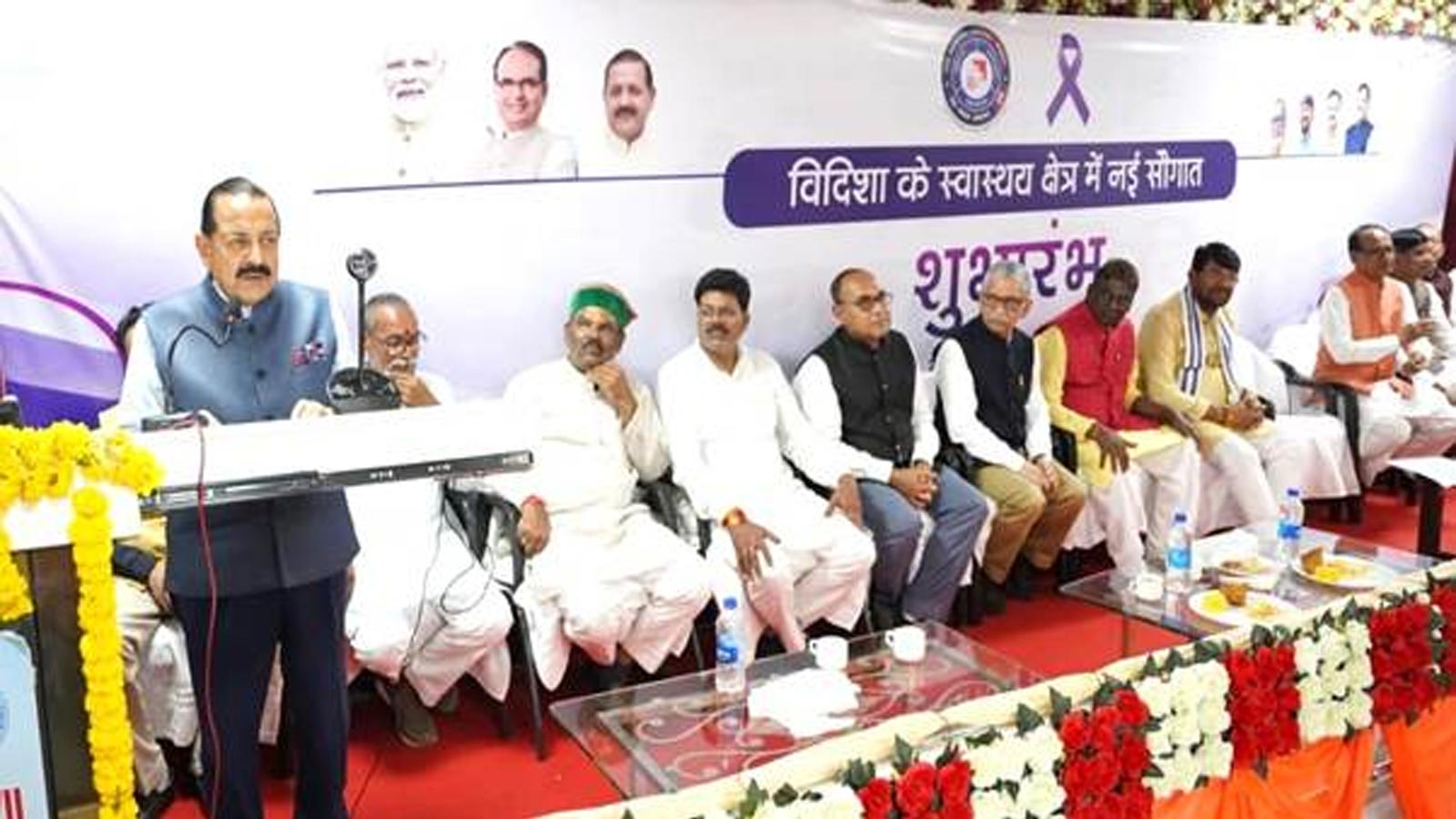
Union Minister of State (Independent Charge) for Science & Technology and Earth Sciences and MoS PMO, Personnel, Public Grievances, Pensions, Atomic Energy and Space, Dr. Jitendra Singh, on Tuesday inaugurated a Day-Care Cancer Facility at Atal Bihari Vajpayee Government Medical College in Vidisha, Madhya Pradesh, and stressed the need to expand cancer-care services beyond major metropolitan centres.
Speaking at the event, Singh said the rising cancer burden in the country calls for sustained expansion of cancer-care facilities at different levels so that patients can access quality treatment closer to their homes.
He said the Department of Atomic Energy (DAE), through the Tata Memorial Centre (TMC), is working to expand cancer-care capabilities across the country, covering treatment and radiation as well as prevention, early detection, diagnosis and training of medical professionals.
Singh also called for greater cooperation from citizens and society to curb malpractices such as food adulteration that may contribute to the country’s cancer burden.
Union Agriculture and Farmers Welfare Minister Shivraj Singh Chouhan and Madhya Pradesh Deputy Chief Minister and Health Minister Rajendra Shukla were among those present at the inauguration.
The Vidisha facility is being developed with technical support from TMC as part of a phased programme to strengthen cancer-care services at the medical college.
Phased expansion of cancer care at Vidisha
Singh said the Vidisha facility should be viewed as part of a wider national initiative under which TMC is helping medical institutions develop cancer-care capabilities according to local requirements.
“Somewhere it is cancer care, somewhere it is radiation, and we are also training State-level doctors in cancer management,” he said, emphasising the need to take specialised cancer-care services beyond major metropolitan centres.
The Vidisha programme began with a Cancer Gap Care Analysis conducted by a multidisciplinary team of senior TMC specialists from June 5 to 7, 2026. The team included experts in surgical, medical and radiation oncology, pathology and preventive care.
A large-scale cancer screening and awareness camp was also organised during the period. According to the ministry, 586 cancer patients and 254 suspected cases were identified during the two-day screening programme, with arrangements made for further treatment and referral.
The day-care facility is the first step in a phased expansion of cancer-care services at Vidisha Medical College. TMC has provided an action plan covering equipment and drug procurement, medical and surgical oncology, radiotherapy, pathology, community outreach, cancer registries and palliative care.
Focus on training and advanced treatment
As part of the manpower development programme, two doctors from the Medicine Department and seven nursing officers from Vidisha have completed specialised oncology training at the Advanced Centre for Treatment, Research and Education in Cancer (ACTREC), Mumbai.
Training for surgeons and surgical staff from Vidisha at ACTREC, Kharghar, is scheduled to begin shortly, with the aim of enabling the medical college to manage common surgical cancers locally.
Radiotherapy will also form a key component of the cancer-care programme. The Madhya Pradesh government has announced the construction of a radiotherapy facility at Government Medical College, Vidisha, including a Linear Accelerator (LINAC). The facility is expected to be commissioned within the next two to three years.
The proposed facility is expected to provide patients from Vidisha and neighbouring districts access to advanced radiation treatment closer to home.
The programme also envisages strengthening pathology and cancer diagnostics. TMC has provided a list of Immunohistochemistry (IHC) and molecular markers required for accurate cancer diagnosis and sub-typing. Pathology personnel from Vidisha will undergo specialised training at TMC, Mumbai, in oncopathology, IHC techniques and molecular diagnostics.
Prevention, early detection and cancer registries
Singh said cancer care should not be limited to treatment after diagnosis and must place greater emphasis on prevention and early detection.
TMC will work with Vidisha Medical College to establish a centre of excellence for cancer prevention and early detection through education and research. Healthcare workers will also be trained in evidence-based strategies to reduce the cancer burden, with TMC providing support for implementation and periodic monitoring.
The programme also includes the establishment of a Population-Based Cancer Registry (PBCR) and a Hospital-Based Cancer Registry (HBCR). These registries will provide local data on cancer incidence, stage at diagnosis and treatment outcomes, helping authorities plan future services and allocate resources.
Dedicated palliative-care services are also being developed, with doctors and nursing personnel to receive structured training in palliative medicine.
India could see around 20 lakh new cancer cases annually by 2030
Putting the Vidisha initiative in a broader national context, Singh said the scale of India’s cancer challenge makes it necessary to expand access to treatment beyond a limited number of major centres.
He referred to projections that India could see around 20 lakh new cancer cases annually by 2030, underscoring the need to expand prevention, early detection, diagnosis and treatment capacity.
TMC has established 11 hospital and institutional units across seven states, including centres in Mumbai, Kharghar-New Mumbai, Punjab, Varanasi, Visakhapatnam, Muzaffarpur and Guwahati.
The National Cancer Grid (NCG) complements this institutional network and has grown into a collaborative network of more than 380 cancer centres, research organisations, patient groups and professional bodies. It supports quality improvement, standardisation, manpower training and cancer research.
Singh said the objective is to ensure that expertise from established cancer centres can progressively support institutions across different parts of the country.
He also referred to Government Medical College, Kathua, where cancer-care capacity is being strengthened through collaboration with TMC. The broader approach, he said, is to enable medical institutions outside major metropolitan centres to develop capabilities suited to the needs of their respective regions.
The minister said the DAE-TMC cancer-care initiative is not limited to establishing standalone treatment facilities but encompasses medical and surgical oncology, radiation oncology, advanced pathology, prevention and early detection, cancer surveillance, palliative care and training of medical and nursing personnel.
The Vidisha initiative reflects this integrated approach, with the day-care facility serving as the first step towards a broader cancer-care framework combining treatment, diagnostics, radiotherapy, trained manpower, prevention, early detection, cancer registries and palliative care.
Singh said the larger objective is to ensure that patients can access specialised cancer care closer to where they live, reducing the need for them and their families to travel long distances for diagnosis and treatment.


