







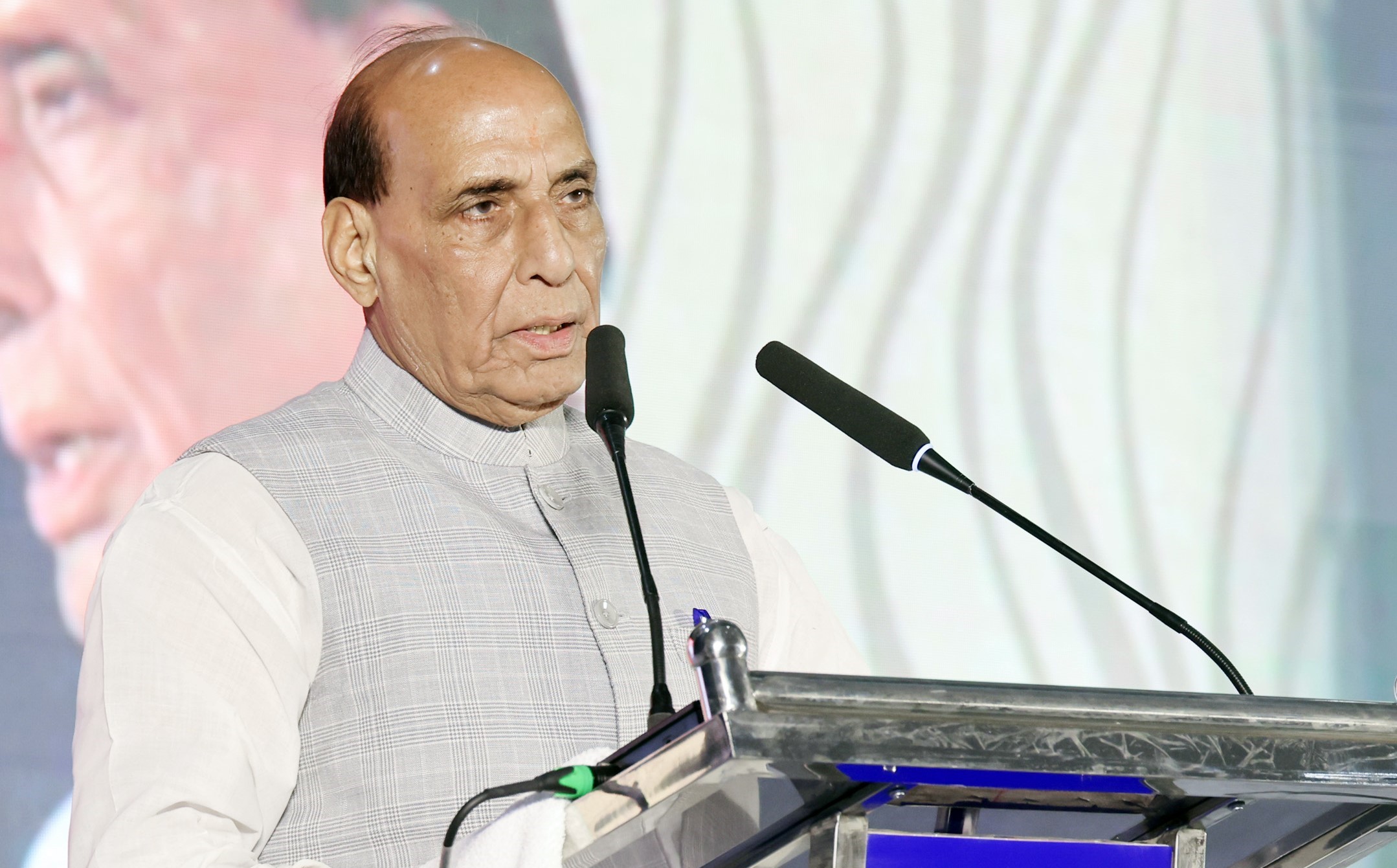
National security cannot be viewed solely in terms of safeguarding geographical boundaries and requires a holistic approach to address emerging threats, Defence Minister Rajnath Singh said on Thursday.
Addressing a defence conclave in New Delhi, Singh said modern security challenges include drones and unmanned aerial vehicles, cyberattacks, lone-wolf attacks and disinformation campaigns, apart from conventional arms and artillery. He said national security is also linked to economic and energy security, with hostile actors potentially seeking to disrupt the economy or energy supply chains.
“We’ve adopted a holistic approach to tackle these highly fluid threats,” Singh said.
The Defence Minister said the concepts of strength and peace, which were not viewed as contradictory in Indian tradition, came to be seen as mutually exclusive alternatives by some leaders after Independence. Several wars imposed on India, he said, demonstrated that security policy cannot be based on wishful thinking and must take into account ground realities and national interests.
“We’ve made it clear that the nation possesses both ‘power of argument’ and ‘argument of power’, and we will communicate through whichever language the other party understands best,” Singh said.
He said India was pursuing global peace through diplomacy while simultaneously strengthening its defence and strategic capabilities. Referring to the surgical strikes, Balakot air strike and Operation Sindoor, Singh said these demonstrated India’s capability and resolve to safeguard its national interests.
“India is a peace-loving nation that has never advocated for war. Yet, we must always remain prepared to safeguard our integrity and sovereignty, and protect our citizens,” he said.
Singh said military preparedness without diplomacy could lead to confrontation and a security dilemma, while diplomacy without adequate capabilities could be perceived as a sign of weakness. A balance between the two, he said, was essential.
He outlined the government’s efforts to strengthen strategic autonomy and national security while advancing self-reliance in defence. Through the QUAD, India is working towards a free, open and rules-based Indo-Pacific, while the I2U2 grouping of India, Israel, the UAE and the US has expanded cooperation in new areas, he said.
India’s participation in multilateral groupings such as BIMSTEC, BRICS and the Shanghai Cooperation Organisation (SCO) has also increased, Singh said, adding that the country had strengthened strategic partnerships, created new platforms for cooperation and expanded its diplomatic outreach.
Referring to Operation Sindoor, Singh said the government had made clear that India would not tolerate “nuclear blackmail”. He said terrorism and talks could not go hand in hand and that terrorism and trade could not coexist.
“We’ve also conveyed the message that no border can prevent us from dismantling terrorist infrastructure. No distinction will be made between terrorists and their sponsors. By suspending the Indus Waters Treaty, we’ve made it clear that blood and water cannot flow together,” he said.
Singh said India’s approach had evolved beyond “strategic containment” and “deterrence by denial” towards “deterrence by punishment”.
He said India had articulated its new policy against terrorism through Operation Sindoor, adding, “Any terror attack originating from Pakistani soil will be considered an ‘Act of War’ against India. Those contemplating any form of misadventure will be met with a response they deserve.”
The Defence Minister said the physical power of any state rested on two pillars — a robust economy and a strong military. A strong economy provides greater resources for national security and defence preparedness, while security creates favourable conditions for development, he said.
“National security and national development complement each other,” Singh said.
Highlighting India’s economic and defence growth, Singh said the economy was growing at 7.8 per cent and the country was among the world’s top five economies. He said the defence budget had nearly tripled from around Rs 2.50 lakh crore in 2013-14 to a record Rs 7.85 lakh crore in 2026-27.
Defence production, he said, had reached an all-time high of around Rs 1.80 lakh crore. He also highlighted the ongoing modernisation of the armed forces, transformation of ordnance factories and profitability of defence public sector undertakings.
Describing “Terrain, Technology and Thinking” as the three Ts crucial to warfare, Singh said the government was focusing on technological development as new domains of warfare emerged.
Capabilities were being developed in areas including drones, artificial intelligence, cybersecurity, electronic warfare, space and quantum technology, he said.
“We’ve developed indigenous unmanned aerial vehicles (UAVs) like Rustom, Ghatak and Nagastra. Our drone warfare capabilities were demonstrated during Op Sindoor,” Singh said.
He also referred to the indigenous BrahMos missile system and the development of the “Sudarshan Chakra” system, saying these initiatives were aimed at addressing future combat challenges.
Singh said national security becomes stronger with self-reliance and that work was underway with the vision of “Design in India”, “Develop in India” and “Manufacture in India”.
He said defence research and development allocation had increased by more than 112 per cent over the last 12 years, from around Rs 13,700 crore in 2014-15 to more than Rs 29,000 crore currently. Twenty-five per cent of the defence R&D budget has been opened to industry, startups and academia to encourage their participation in defence innovation, he added.
The minister said licensing rules in defence production had been simplified, while priority was being given to indigenous systems under the Defence Acquisition Procedure. More than 5,500 items have been included across over 10 Positive Indigenisation Lists, he said.
He also highlighted the transfer of technology for conventional missile systems developed by the Defence Research and Development Organisation (DRDO) to Indian industry and the establishment of 15 Industry-Academia Centres of Excellence.
Singh said India had successfully tested Multiple Independently Targetable Re-entry Vehicle (MIRV) technology with the Agni-5 missile, a capability possessed by only a limited number of countries.
To strengthen the domestic defence supply chain, he said Defence Industrial Corridors had been established in different parts of the country. Startups and micro, small and medium enterprises (MSMEs), he added, were being integrated into defence innovation alongside large manufacturers.
“Indian defence manufacturers, MSMEs, and vendors are being brought together through the Srijan Defence Equipment Empowerment Platform. So far, over 41,000 vendors and more than 2.7 lakh products have been listed on this platform,” Singh said.
The Defence Minister also highlighted measures taken for the welfare of serving personnel, veterans and their families.
“Special attention has been paid to the welfare of veterans and their families. ECHS facilities have been expanded. The SPARSH platform was launched with the objective of ensuring ‘Right Pension, Right Pensioner, Right Time’. The ‘One Rank One Pension’ policy, which had been pending for years, has also been implemented,” he said.
Singh said the service and sacrifice of soldiers should be honoured not only through words but also by ensuring their welfare and comfort. Earlier this month, he said, lifetime free train travel was granted to all soldiers awarded the Sena Medal and selected members of their families.


