







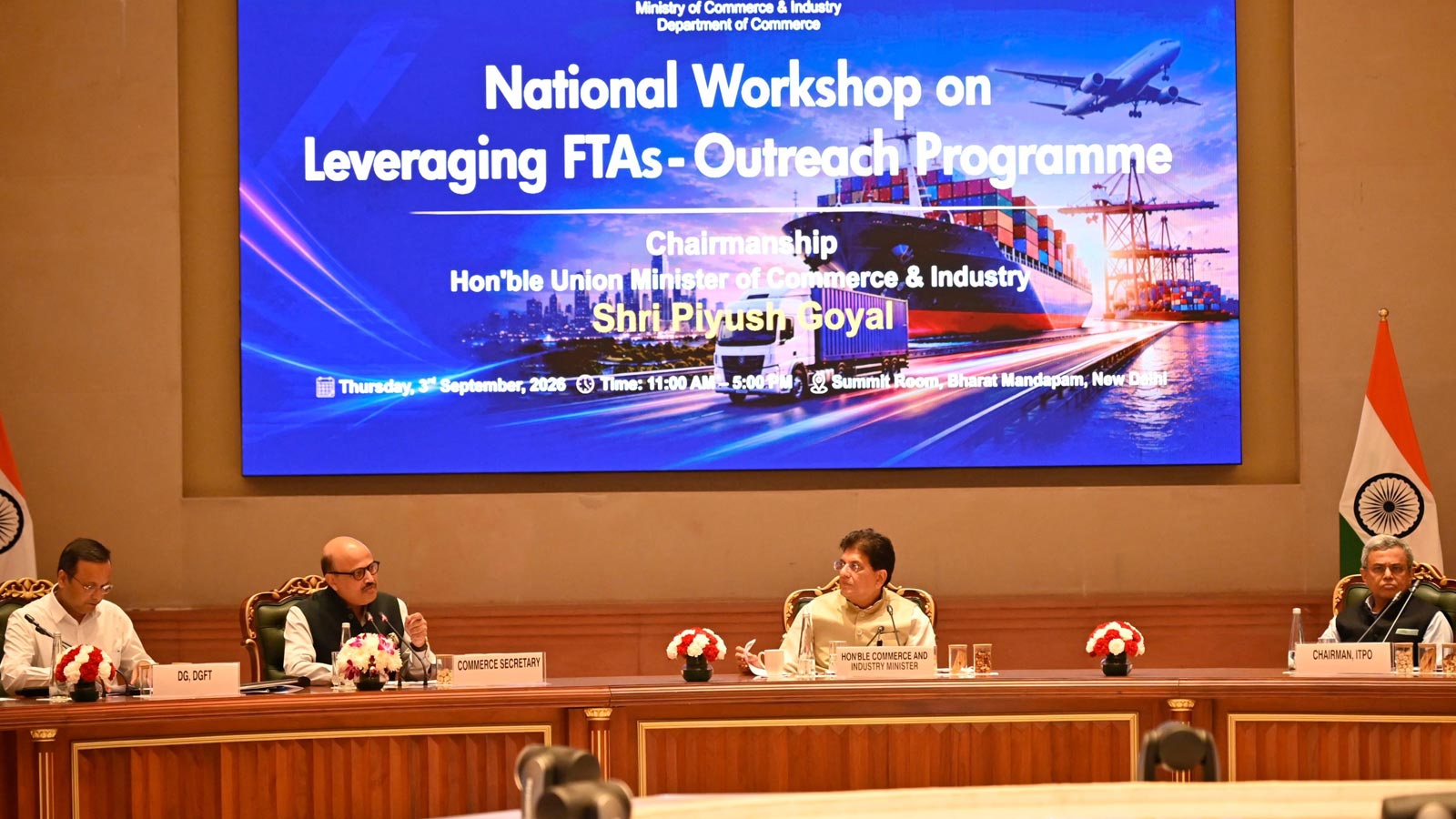
Union Commerce and Industry Minister Piyush Goyal on Thursday called for a nationwide drive to maximise the utilisation of India’s Free Trade Agreements (FTAs), urging states, industry bodies and exporters to ensure that preferential market access reaches businesses in every district.
Addressing a national workshop on “Leveraging FTAs: An Outreach Programme” in New Delhi, Goyal said India’s network of nine FTAs currently spans economies accounting for around $60 trillion in GDP and provides preferential access to nearly two-thirds of global trade.
He said upcoming trade agreements and efforts to secure greater market access could potentially give Indian exporters access to around 75 per cent of global trade at tariff rates lower than those faced by competitors.
The Minister called for the FTA outreach programme to reach all 780 districts and cover MSMEs, traders, entrepreneurs, start-ups and women entrepreneurs. He stressed the need to translate trade agreements into concrete export opportunities, particularly for first-time exporters and smaller businesses.
India targets $1 trillion exports
Goyal said India has set an export target of $1 trillion for the current year, representing growth of around 16 per cent.
India’s exports during April-July reached approximately $317 billion, compared with about $280 billion during the corresponding period last year, an increase of around $36-37 billion, he said.
Referring to the country’s 7.8 per cent GDP growth in the first quarter, Goyal said India had maintained strong economic momentum despite global uncertainty. He urged businesses to remain focused on expanding India’s presence in international markets.
The Minister said the government would continue efforts to expand India’s product basket, encourage new exporters and help smaller exporters scale up.
More markets through FTAs
Goyal said FTAs with Mauritius, Oman, the UAE, Australia and the UK are already operational, while agreements with other partners are expected to come into force progressively.
He said India was also pursuing or working towards greater market access with countries and blocs including Canada, Mexico, Chile, Mercosur, the Southern African Customs Union (SACU), the Gulf Cooperation Council (GCC) and Israel, besides reviewing arrangements with ASEAN, South Korea and Japan.
Goyal said the objective of an FTA is not simply to secure a low tariff but to ensure that Indian exporters receive a competitive advantage over businesses from competing countries.
Citing the textile sector, he said Indian exporters had previously faced disadvantages against competitors such as Bangladesh and Vietnam, which benefited from preferential market access. With India now securing more competitive tariff rates in several developed markets, he said exporters needed to focus on scale, quality, timely delivery and customer trust.
“The ball is now entirely in our court,” Goyal said.
Focus on MSMEs and first-time exporters
The Minister called for greater coordination between the Department of Commerce, DPIIT, other ministries, Export Promotion Councils (EPCs), industry associations and state governments.
He urged EPCs and industry associations to expand their outreach to the grassroots and disseminate information on FTA benefits in local languages and easy-to-understand formats.
Goyal also highlighted e-commerce as an important avenue for MSMEs and first-time exporters to enter global markets, saying recent measures were aimed at encouraging large-scale exports through digital platforms.
He called for more sector-specific and cluster-level workshops and greater participation of businesses from different parts of the country in international trade delegations.
Support for exporters
Goyal sought innovative suggestions under the Export Promotion Mission, particularly in areas such as regulatory approvals, sanitary and phytosanitary (SPS) requirements, technical barriers to trade and freight support for exporters in geographically challenging regions, including the Northeast, Jammu and Kashmir, Uttarakhand and Himachal Pradesh.
He also called for stronger support for small exporters facing disruptions in shipping routes and higher logistics costs.
The Minister said exporters would receive priority support in the proposed 100 BHAVYA parks, including concessions for those committing to higher export levels and access to plug-and-play facilities. Existing clusters and industrial parks would also be supported through the Export Promotion Mission.
Push for $2 trillion exports by 2030
Goyal said India should continue to aim for the long-term target of $2 trillion in exports by 2030, despite challenges posed by the COVID-19 pandemic, geopolitical conflicts and global disruptions.
He said that setting lower targets would not be sufficient to generate the jobs, foreign exchange earnings and entrepreneurial opportunities required for India’s economic transformation.
The Minister said India should aspire to become a trusted global partner while ensuring that exported products meet and exceed international quality standards.
He also stressed the importance of technical and sanitary standards and said India should ensure that its products carry genuine value and that country-of-origin certification remains credible.
Goyal said a sustained nationwide effort could help create millions of jobs, increase foreign exchange earnings and encourage a new generation of entrepreneurs to enter the export sector, supporting India’s transition towards a developed economy by 2047.
Centre-state coordination
The workshop brought together officials from the Central government, states and Union Territories, Export Promotion Councils and industry associations to identify sector- and cluster-specific opportunities arising from India’s trade agreements.
Commerce Secretary Rajesh Agrawal said the workshop was aimed at bringing stakeholders together and disseminating information on specific opportunities emerging from FTAs for industries across states.
The sessions focused on identifying export clusters and products, understanding practical challenges in using FTA benefits and determining follow-up support required from the Central government.
The Department of Commerce said the initiative is part of its continuing effort to strengthen Centre-State coordination and ensure that the benefits of India’s FTAs reach manufacturers and exporters at the district and cluster level.


