







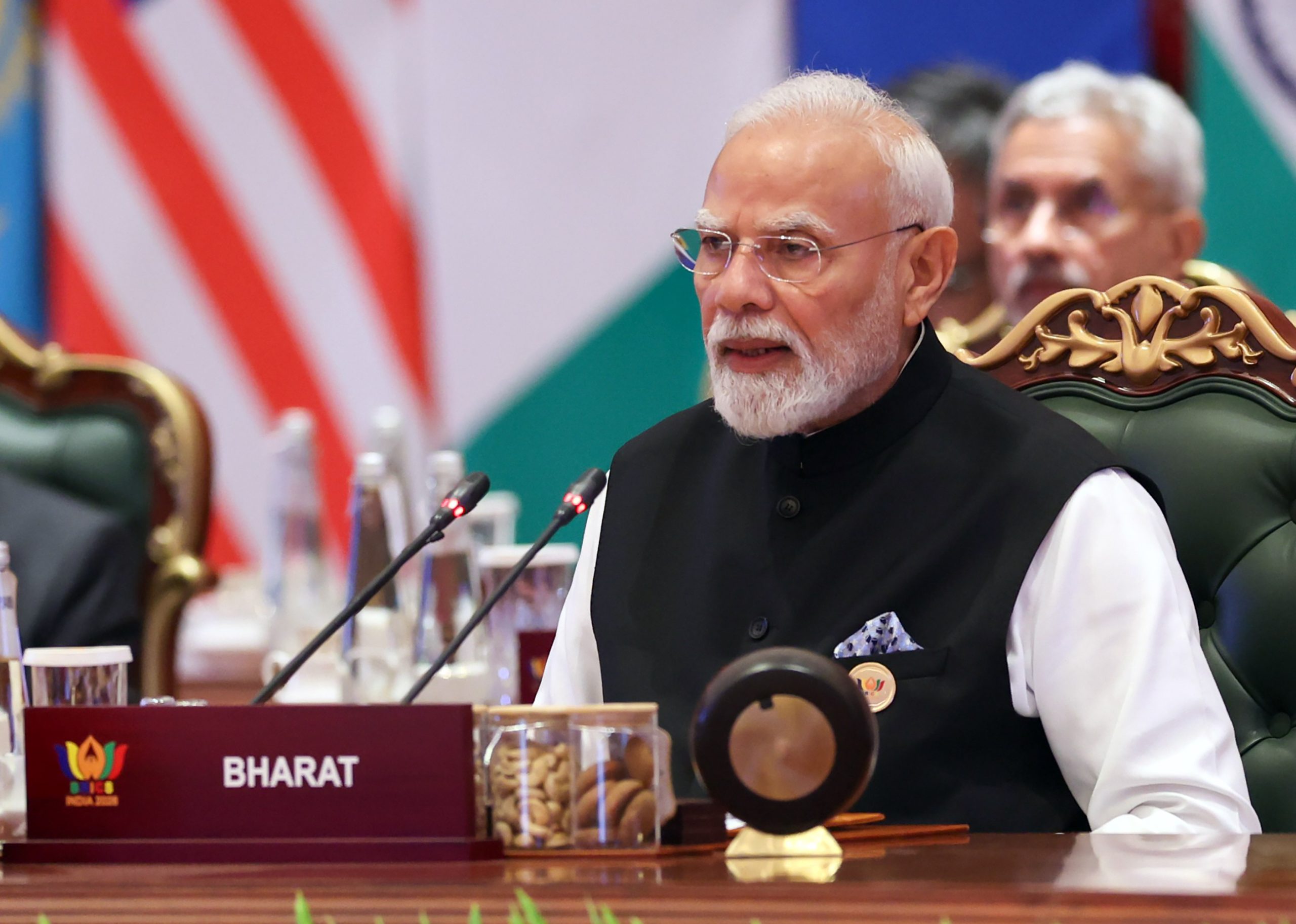
Prime Minister Narendra Modi on Saturday called for a “new and ambitious agenda” for BRICS for the next 20 years, urging the grouping to translate its unity and consensus into concrete outcomes while giving the Global South a greater role in shaping global governance.
Addressing the 18th BRICS Summit Session: “Inclusive Global Governance and Strengthening” at Bharat Mandapam in New Delhi, PM Modi said India’s BRICS Chairship had placed people and the Global South at the centre of its agenda, with a focus on practical and actionable solutions in areas including food, energy and supply chain security.
The Prime Minister also underlined the need to strengthen BRICS’ institutional mechanisms, reform global governance structures and ensure that countries of the Global South move from being “rule-takers” to “rule-shapers” in determining the rules that will govern emerging areas such as artificial intelligence, cyberspace, outer space and biotechnology.
Humanity First: Making BRICS More People-Centric
India’s BRICS Chairship has been guided by a people-centric and “Humanity First” approach, with resilience, innovation, cooperation and sustainability forming the core priorities of its agenda.
Highlighting the scale of India’s engagement during its Chairship, PM Modi said the year-long programme sought to bring BRICS cooperation closer to people and address issues of direct relevance to developing countries.
“With this vision in mind, more than 350 meetings were organised. We had the opportunity to welcome your teams in nearly 30 cities across India. I sincerely thank each one of you for your active contribution and support in making India’s BRICS Chairship a success,” PM Modi said.
The approach, he said, was aimed at making BRICS cooperation more people-oriented while developing collective responses to challenges confronting the developing world.
BRICS at a ‘Coming of Age’ Moment
Reflecting on the 20th anniversary of BRICS, PM Modi described the occasion as a historic milestone, saying the grouping had entered a new phase marked by greater maturity, responsibility and ambition.
“This year’s BRICS Summit marks a historic milestone. We are celebrating the 20th anniversary of BRICS. In human life, the age of twenty marks the beginning of a new phase of maturity and responsibility. It is a stage when dreams are accompanied by responsibilities, and capabilities are channelled in new directions,” said PM Narendra Modi.
He said the evolution of BRICS over the past two decades had established the grouping as a distinct voice on the global stage, while its consensus-based approach allowed members with diverse perspectives to work together.
“Today, BRICS too stands at a ‘coming of age’ moment. Over the past twenty years, BRICS has established a distinct identity for itself on the global stage. We respect each other’s perspectives and move forward through consensus. We strive to move ahead with an approach that is not against anyone but instead seeks to take everyone along,” said PM Modi.
From Consensus to Concrete Outcomes
Calling for a shift from consensus-building to measurable implementation, PM Modi said BRICS must now ensure that its decisions translate into tangible outcomes on the global stage.
He said the grouping must also strengthen its internal working mechanisms so that the annual rotation of the Chairship does not disrupt institutional continuity or slow the implementation of decisions.
PM said that it is now time for us to translate our unity and consensus within BRICS into concrete outcomes on the global stage. “For the next twenty years, we must work on a new and ambitious agenda. We must begin by strengthening our own working systems,” he said.
BRICS Continuity and Implementation Mechanism
Proposing a mechanism to ensure continuity between successive Chairships, PM Modi said:
“The BRICS Chairship changes every year, but this should not interrupt our institutional momentum. I propose the establishment of a BRICS Continuity and Implementation Mechanism. Through the Troika, this mechanism will ensure systematic follow-up on all initiatives and outcomes.
We can create a secure digital repository in which, for every decision, the nodal point, timeline, and implementation status can be recorded,” PM Modi said.
Transforming the ‘Pyramid of Privilege’ into a ‘Platform of Partnership’
Turning to the broader question of global governance, PM Modi called for a fundamental transformation of the existing international system to give the Global South a stronger and more meaningful voice in global decision-making.
He said BRICS must not limit itself to strengthening cooperation among its members but should also contribute to reshaping global institutions so that representation better reflects present-day realities.
“The Global South is today in the front row of global crises, but in the back row of decision-making. We must transform this “pyramid of privilege” into a “platform of partnership”, where every country has a voice, every member has a stake, and the advancement of humanity remains at the heart of every endeavour,” PM Modi said.
Calling for a structured approach to global governance reform, he proposed the preparation of a roadmap that could guide BRICS’ collective efforts in the coming years.
“With this objective, I propose that we work together to formulate ten proposals for global governance reform, which we could seek to develop into a BRICS Reform Roadmap by the next Summit,” he added.
Representation, Responsiveness and Rule-Making
PM Modi said the proposed reform roadmap should focus on three critical areas — representation, responsiveness and rule-making — to make global institutions more inclusive, effective and representative of contemporary realities.
On representation, he called for reforms in key global institutions, including the United Nations Security Council, and stressed the need for negotiations to move towards clearly defined timelines and concrete outcomes.
He also said that global financial institutions must reflect the changing balance of the world economy.
“Similarly, in financial institutions, voting power, leadership positions, and policy priorities should reflect today’s economic realities. Countries that drive global economic growth should also have an appropriate role in shaping global economic governance,” he said.
On responsiveness, PM Modi stressed that global institutions must be capable of delivering timely and effective solutions to emerging challenges, particularly when crises have a direct impact on people.
“Second, Responsiveness. Global institutions will earn the trust of humanity only when they are able to provide effective solutions to global challenges. We must focus on the speed, scale, and last-mile impact of our collective response,” PM Modi said.
PM Modi Proposes ‘Seafarers Emergency Support Network’
Highlighting the vital contribution of seafarers to global trade and supply chains, the Prime Minister proposed the creation of a dedicated emergency support mechanism to assist them during crises.
He noted that seafarers often operate far from their home countries and can face difficulties accessing timely assistance during emergencies.
“I propose whether we can establish a Seafarers Emergency Support Network? This network could connect the Maritime authorities and missions of the countries concerned. It could facilitate distress alerts, medical assistance, communication with families, and support for evacuation,” said PM Modi.
The proposed network, he said, could strengthen coordination among maritime authorities and diplomatic missions while providing practical assistance to seafarers and their families during emergencies.
From ‘Rule-Takers’ to ‘Rule-Shapers’
On the third pillar of the proposed reform agenda — rule-making — PM Modi emphasised the importance of ensuring equal participation by developing countries in shaping the rules governing emerging technologies and strategic domains.
He pointed out that rapid advances in artificial intelligence, cyberspace, outer space, biotechnology and other critical technologies would not only create new opportunities but also determine the frameworks that govern the future.
“And third, I would like to speak about rule-making. Ensuring equal participation in shaping the global rules of the future is of utmost importance.
AI, cyberspace, outer space, biotechnology, and critical technologies are shaping not only the opportunities of the future, but also the rules that will govern the future.
We must work to transform the Global South from rule-takers into rule-shapers. Through BRICS, we can provide young diplomats and policymakers from the countries of the Global South with negotiation skills, practical training, and legal expertise,” PM said.
Linking this agenda with the broader objective of South-South cooperation, PM Modi said India was prepared to take the lead in building the institutional and human capacity of Global South countries to participate more effectively in global rule-making.
“By a happy coincidence, today is the United Nations Day for South-South Cooperation. It is especially significant that such a decision is being taken on a day dedicated to the Global South. India is ready to take the lead on this issue.”
‘If Our Future Is Shared, the Right to Shape That Future Must Also Be Shared’
Concluding his remarks, PM Modi said India’s message at the BRICS Summit was centred on the principle that shared global challenges must be matched by shared participation in shaping the future.
He called for a BRICS that moves from giving countries a voice to ensuring that their participation has a meaningful impact on global decision-making.
“The message of the BRICS Summit being hosted by India should be loud and clear: If our future is shared, then the right to shape that future must also be shared. From voice to impact. From privilege to partnership. This should be the resolve of BRICS at 20,” said PM Modi.
PM Modi made the remarks in the presence of a galaxy of world leaders, including Russian President Vladimir Putin, Chinese President Xi Jinping, Iranian President Masoud Pezeshkian, South African President Cyril Ramaphosa, Malaysian Prime Minister Anwar Ibrahim, Indonesian President Prabowo Subianto, Abu Dhabi Crown Prince Mohamed bin Zayed Al Nahyan and Egyptian President Abdel Fattah El-Sisi.
India is hosting the 18th BRICS Summit at Bharat Mandapam in New Delhi on September 12–13, bringing together leaders from BRICS member and partner countries as well as outreach invitees.
India’s BRICS Chairship is guided by the theme, “Building for Resilience, Innovation, Cooperation and Sustainability”, reflecting PM Modi’s vision of a people-centric approach rooted in the spirit of “Humanity First”, according to the Ministry of External Affairs.
-PIB Inputs


