







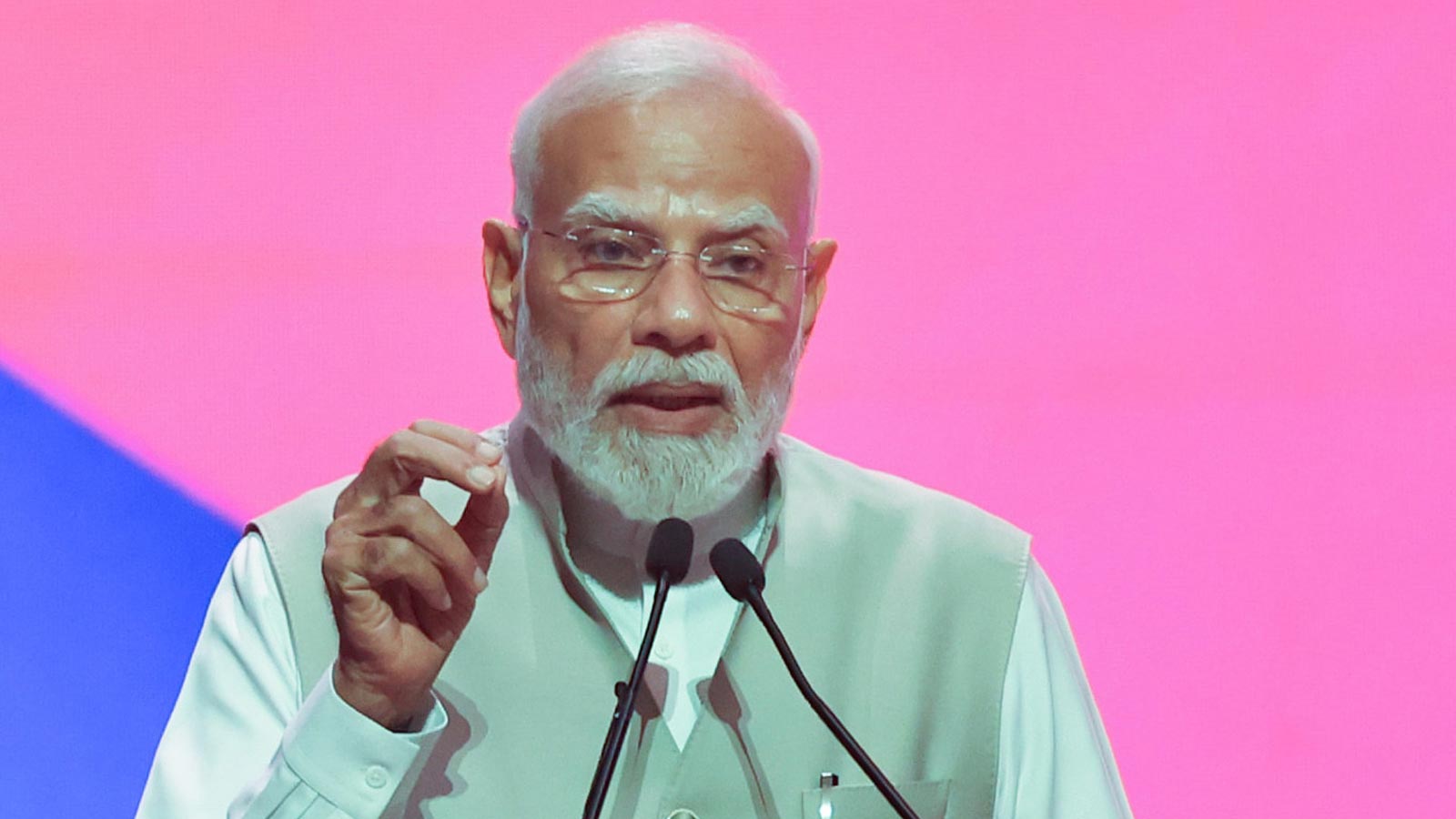
Prime Minister Narendra Modi on Tuesday inaugurated the Global Fintech Fest 2026 in Mumbai, describing India’s fintech journey as a major driver of financial inclusion and technological transformation and calling on the sector to focus on next-generation innovation, cybersecurity and consumer protection.
Addressing fintech innovators, industry leaders and investors from India and abroad, PM Modi said India’s growing fintech ecosystem, powered by innovation, youth participation and risk-taking, was strengthening his confidence in the country’s journey towards a Viksit Bharat.
Highlighting India’s economic resilience amid global uncertainty, the Prime Minister pointed to conflicts, trade tensions and pressures on energy and commodity supply chains, contrasting these challenges with India’s 7.8 per cent economic growth in the April-June quarter. He said India’s growth was giving the world renewed confidence.
PM Modi also highlighted what he described as a major validation of India’s economic trajectory – the recent upgrade of India’s sovereign rating to the A- category by a Japanese credit rating agency, after three decades. He attributed the improvement to structural reforms and macroeconomic stability and said India’s reform process would continue at a faster pace.
UPI at the centre of India’s fintech transformation
The Prime Minister placed the Unified Payments Interface (UPI) at the centre of India’s fintech success story, saying the country’s digital finance journey could not be discussed without acknowledging its impact.
Recalling UPI’s 10th anniversary on August 25, PM Modi said the platform had transformed the way millions of Indians accessed financial services. People who had remained outside the formal banking system for generations, he said, had now become major drivers of India’s fintech growth.
The Prime Minister said UPI processed more than 24 billion transactions in August alone. He cited French President Emmanuel Macron’s observation that UPI was not merely a technology story but a wider civilisational transformation.
UPI is currently operational in 11 countries, PM Modi said, stressing that the next phase should focus on integrating India’s digital payment system with domestic payment networks in more countries.
He called for stronger payment linkages with countries where large Indian communities live or where India has significant trade, with the aim of reducing remittance costs and ensuring that money reaches Indian families more quickly.
The Prime Minister also urged the Indian fintech industry to develop its own global standards and protocols instead of relying primarily on foreign-designed payment standards. He said India’s capabilities had reached a stage where the country could create its own rules and connect them with the global financial system.
Fintech must move beyond payments
PM Modi said India’s fintech sector must now expand beyond digital payments and increase access to credit, insurance, savings, investments and pension products.
He highlighted the potential of fintech to serve sections of society and small businesses that remain underserved by conventional financial institutions. Citing the PM SVANidhi scheme, he said millions of street vendors had been brought into the formal credit system, contributing to an increase of more than 20 per cent in their average annual income.
The government has extended the PM SVANidhi scheme until 2030, he said, underlining the importance of formal credit access for small entrepreneurs.
The Prime Minister said the experience of PM SVANidhi demonstrated how fintech could stimulate economic activity at the grassroots level. He called on the industry to use digital transaction histories and other data to assess the financial needs of small businesses that may not qualify for conventional bank loans despite having viable enterprises.
PM Modi gave the example of small shopkeepers whose digital transactions can demonstrate the health of their businesses but whose modest capital requirements may remain outside traditional lending models.
“Businesses of this kind” can be analysed and served by fintech, PM Modi said, adding that addressing this micro-credit gap could shape the next chapter of India’s fintech growth.
Making insurance, pensions as easy as digital payments
The Prime Minister also called for greater financial inclusion among independent workers, including delivery partners and people dependent on short-term or gig-based work.
He urged fintech companies to make access to savings, pensions and insurance as simple and convenient as making a digital payment through a QR code.
PM Modi said comprehensive financial services should become accessible to workers regardless of whether they have conventional employment structures.
Agentic AI, tokenisation and quantum technology
Looking ahead, the Prime Minister identified Agentic AI, tokenisation and quantum computing as technologies that could open new possibilities for the financial sector.
However, he stressed that technological possibilities would have to be converted into tangible benefits for society. The challenge for the fintech ecosystem, he said, was to translate emerging technologies into real-world impact while maintaining trust and security.
PM Modi laid out a four-point agenda for the sector, calling for a focus on world-class cybersecurity, ethical data protection standards, a strong regulator-industry innovation ecosystem and a Fintech Consumer Protection Index.
He said these areas should become collective tasks for the industry and argued that India’s fintech sector could become a gateway to global opportunities if it consistently tested itself against these standards.
Focus on trust, scale and next-generation innovation
Concluding his address, PM Modi called on the fintech industry to build on the principles that have driven India’s Digital India journey – scale, scope, secure systems, democratisation and public trust – while shifting decisively towards next-generation innovation.
He said India’s fintech ecosystem had already demonstrated its ability to deliver technology at population scale, and the next phase should focus on using that capability to deepen financial inclusion, strengthen global connectivity and create new solutions for individuals and businesses.


