







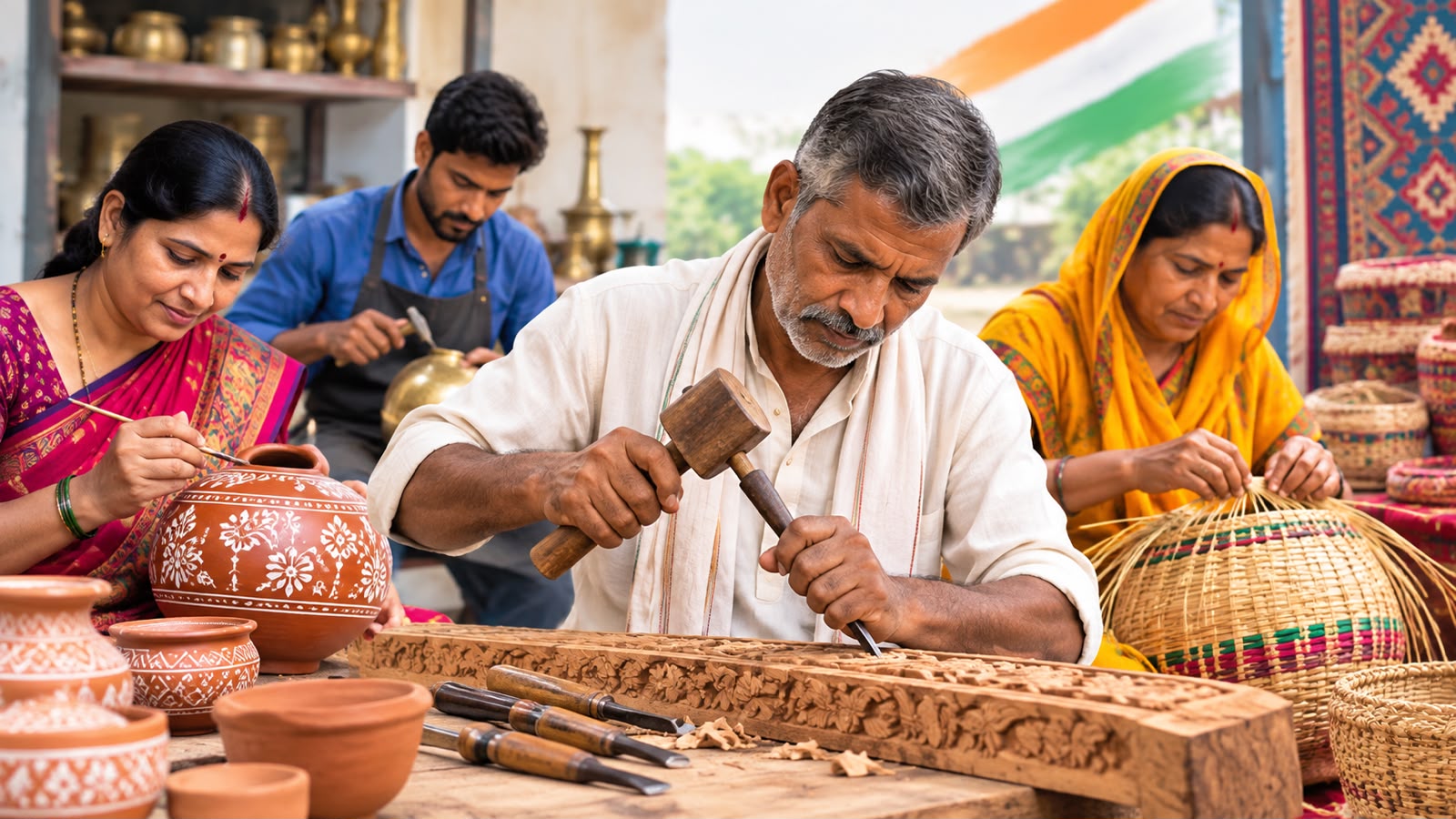
The PM Vishwakarma scheme, launched on September 17, 2023, to provide end-to-end support to traditional artisans and craftspeople, has achieved its target of registering 30 lakh beneficiaries as it approaches three years of implementation.
The Central Sector Scheme, with an outlay of Rs 13,000 crore for 2023-24 to 2027-28, covers 18 traditional trades and provides support through recognition, skill training, modern toolkits, collateral-free credit, digital transaction incentives and marketing assistance.
The scheme is built around the three pillars of Samman, Samarthya and Samriddhi, and seeks to strengthen the Guru-Shishya parampara and family-based practice of traditional skills.
As of September 15, 2026, more than 24.37 lakh artisans had received basic skill training, while over 18.16 lakh had received toolkits.
Under the scheme, beneficiaries receive a PM Vishwakarma scheme Certificate and ID Card after completing the registration and verification process. Basic training is conducted for five to seven days and advanced training for 15 days or more. Trainees receive a stipend of Rs 500 per day.
Eligible beneficiaries can also receive modern toolkits worth up to Rs 15,000.
The scheme provides collateral-free Enterprise Development Loans of up to Rs 3 lakh in two tranches. The first tranche of up to Rs 1 lakh has an 18-month tenure, while the second tranche of up to Rs 2 lakh has a 30-month tenure.
The loans carry a concessional interest rate of 5 per cent, with the government providing interest subvention of up to 8 per cent. Eligibility for the second tranche is linked to repayment of the first tranche and adoption of digital transactions or completion of advanced training.
More than 6.19 lakh loans worth around Rs 5,316 crore have been sanctioned under the scheme. The credit support is intended to help beneficiaries purchase raw materials, upgrade tools, expand operations and strengthen their enterprises.
The scheme also provides incentives for digital transactions. Beneficiaries receive Rs 1 for each eligible digital transaction involving a bank account, subject to a maximum of 100 transactions per month. More than 8.11 lakh beneficiaries have received digital incentives, with over Rs 42 crore disbursed.
More than 12,000 artisans have also been trained in the use of artificial intelligence tools for branding, product design, packaging and marketing.
PM Vishwakarma covers 18 traditional trades, including carpenters, boat makers, armourers, metalsmiths, hammer and toolkit makers, locksmiths, goldsmiths, potters, sculptors and stone breakers, cobblers and footwear artisans, masons, basket and mat makers, coir weavers, doll and toy makers, barbers, garland makers, washermen, tailors and fishing-net makers.
The scheme is open to artisans and craftspeople aged 18 years or above who work with their hands and tools in one of the notified trades and operate in the unorganised sector on a self-employed basis. Registration and benefits are restricted to one member of a family comprising the husband, wife and unmarried children.
Applicants who have availed loans under similar credit-based government schemes for self-employment or business development during the preceding five years are generally not eligible. Government employees and their family members are also excluded. Beneficiaries of MUDRA and PM SVANidhi who have fully repaid their loans are eligible under PM Vishwakarma scheme.
Applications can be submitted through Common Service Centres (CSCs), followed by a three-tier verification process involving the Gram Panchayat or Urban Local Body, District Implementation Committee and Screening Committee.
Beneficiaries are also onboarded on the Udyam Assist Platform, which facilitates the formalisation of informal micro enterprises and provides an Udyam Registration Number and certificate.
The scheme has also expanded market access through trade fairs, exhibitions, branding initiatives and e-commerce platforms. More than 1,500 awareness programmes and camps, over 50 workshops, 82 trade fairs, 37 state-level exhibitions and more than 50 flash mobs have been organised across the country.
The first PM Vishwakarma scheme National Exhibition-cum-Trade Fair was held at Dilli Haat from January 17 to 31, 2026. More than 117 artisans participated in the event, recording sales of over Rs 2 crore. The exhibition attracted more than 60,000 visitors, including foreign diplomats and senior government officials.
More than 30,000 Vishwakarma scheme beneficiaries have been onboarded on e-commerce platforms, including the Government e-Marketplace (GeM), ONDC, Meesho, Amazon, Fabindia and Sulekha. The Ministry of MSME has also signed an MoU with Amazon to facilitate the onboarding of eligible artisans on its marketplace.
Under the One Station One Product initiative, dedicated retail outlets at selected railway stations have been used to provide market access to Divyangjan Vishwakarma artisans. More than 42 beneficiaries from different trades have been facilitated with stalls across 14 states and Union Territories.
PM Vishwakarma scheme stalls have also been set up at airports, including Bhopal and Chandigarh, in collaboration with the Ministry of Civil Aviation’s AVSAR scheme. Workshops have been organised in six cities with the Indian Institute of Packaging to train 1,500 artisans in packaging and branding.
The Ministry of MSME, in collaboration with TRIFED, has also organised Tribal Artisan Melas to connect tribal PM Vishwakarma beneficiaries with platforms such as Tribes India. Stalls have additionally been set up at hotels and resorts in states including Bihar, Gujarat, Goa, Himachal Pradesh, Odisha and Puducherry.
The scheme has also produced individual beneficiary outcomes. Villi, a basket maker from Zunheboto in Nagaland, completed skill training and availed a Rs 1 lakh collateral-free loan, which she used to purchase raw materials and expand her enterprise. Her monthly income subsequently increased by around 40 per cent to nearly Rs 15,000.
Darshan Lal, a woodcarver from Chamoli in Uttarakhand who has practised the craft for more than three decades, received skill training, a toolkit and access to affordable credit under the scheme. His family tradition is associated with artisans involved in the construction of the Badrinath temple. In 2026, he participated in the PM Vishwakarma Haat in Delhi, his first exhibition in the national capital.
A concurrent evaluation of PM Vishwakarma scheme by IIM Mumbai covered 11,591 beneficiaries across all states and Union Territories and included feedback from banks, Common Service Centres, India Post personnel and training centres.
According to the evaluation, 93 per cent of the beneficiaries surveyed reported a moderate to significant increase in income following training.
The scheme seeks to provide support across different stages of artisans’ work while retaining the local and family-based character of traditional occupations. It also aims to support the continuity of traditional skills and the Guru-Shishya tradition while helping artisans and craftspeople access formal credit, technology and wider markets.


