







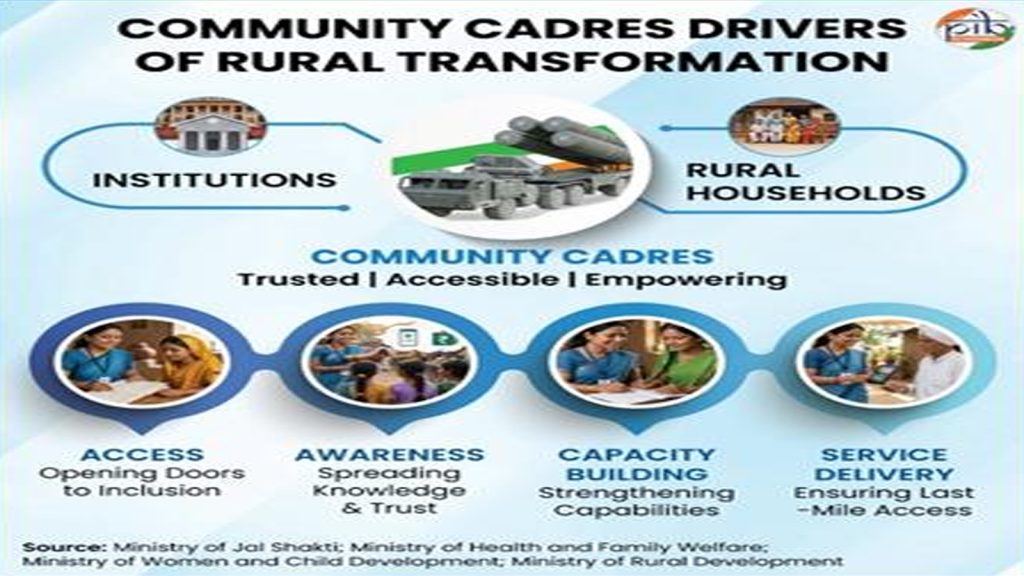
Across India’s villages, a vast network of trained community workers is helping bridge the distance between government institutions and rural households. Working at the grassroots, these workers support the implementation of government programmes, mobilise communities, facilitate access to services and provide assistance at the doorstep.
At the heart of this decentralised system are more than 9 lakh Community Resource Persons (CRPs) working across areas ranging from agriculture and allied activities to banking, insurance, financial literacy, gender awareness and community development.
Nearly 4.08 lakh of these CRPs are engaged in livelihoods, supporting agriculture, livestock, fisheries, forest produce and rural enterprises. They work alongside other specialised community cadres such as Krishi Sakhis, Pashu Sakhis, Matsya Sakhis, Van Sakhis, Bank Sakhis, Business Correspondent Sakhis, Financial Literacy CRPs and Gender Champions.
The larger frontline workforce also includes more than 10.40 lakh Accredited Social Health Activists (ASHAs) and 10.58 lakh trained Anganwadi Workers (AWWs), who form an important part of the health, nutrition and early childhood service delivery network.
Together with Swachhagrahis, Awaas Mitras, Village Water and Sanitation Committees and other local functionaries, these community cadres are helping bring government programmes closer to rural families.
A decentralised workforce for last-mile delivery
Over the past decades, the Government has invested in rural development across a wide range of areas, including livelihoods, healthcare, nutrition, sanitation, drinking water, housing, financial inclusion and employment.
The effectiveness of these programmes at the village level depends not only on schemes and institutions but also on the people who connect those systems with communities.
This is where the community cadre approach comes in.
The model relies on trained people from rural communities who understand local circumstances and can work directly with households. Their responsibilities extend from awareness generation and capacity building to service support and helping people access government programmes.
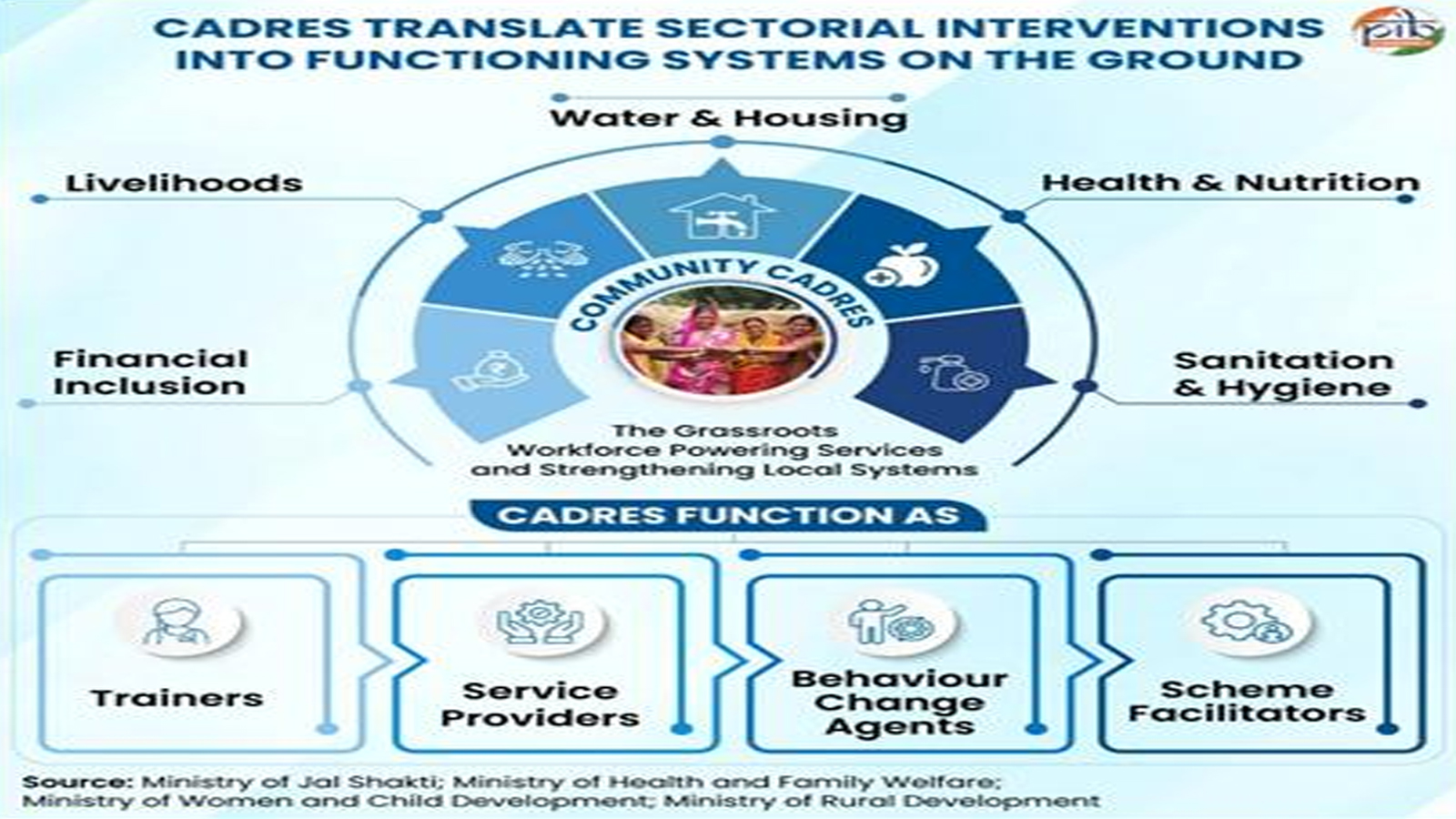
Community cadres serve in several interconnected roles. As trainers, they share skills and knowledge through peer learning. As service providers, they help rural households access livelihood and financial services. As behaviour change agents, they promote improved practices in health, sanitation and social inclusion. As scheme facilitators, they assist people with documentation, linkages and convergence between government programmes.
Frontline rural cadres receive compensation under the respective scheme guidelines, generally through activity-based payments and incentives linked to service delivery, task fulfilment and community mobilisation.
From livelihoods to enterprise: a network built around rural households
For many rural households, livelihood opportunities can be limited by gaps in access to knowledge, services, credit and markets.
The Government has sought to address these gaps by strengthening community-led institutions that enable people to access livelihood opportunities, financial services, social development interventions and government programmes closer to their homes.
A central platform in this approach is the Deendayal Antyodaya Yojana-National Rural Livelihoods Mission (DAY-NRLM).
DAY-NRLM has mobilised more than 10 crore rural households into around 92 lakh Self-Help Groups (SHGs) across the country. These SHGs, along with Village Organisations and Cluster Level Federations, form a large network of women-led community institutions.
Supporting this institutional architecture is a network of more than 9 lakh community cadres working in agriculture, livestock, fisheries, enterprise promotion, banking, financial literacy, insurance and social development.
Because these cadres are drawn from the communities they serve, they combine formal training with local knowledge. They receive field-based handholding and continuous capacity building in their respective areas of work.
The approach is also changing the role of rural women within development programmes. Community cadres such as Krishi Sakhis, Pashu Sakhis, Matsya Sakhis and CRP-EPs are enabling women to move beyond being participants in development programmes to becoming trained service providers, community leaders and local change agents.
Farm livelihoods: taking knowledge and services to farmers
Livelihood CRPs operate across both farm and non-farm sectors.
Farm livelihood CRPs support SHG members and rural households in adopting improved agricultural practices, strengthening livestock management, improving productivity and accessing livelihood services.
As of June 2025, more than 4.62 crore Mahila Kisans had been covered under farm livelihood interventions, supported by more than 3 lakh trained livelihood CRPs.
Among these cadres, Krishi Sakhis have emerged as an important grassroots agricultural extension network. They work directly with farmers and promote sustainable agriculture as well as the marketing of agricultural products.
More than 1.91 lakh Krishi Sakhis have been mobilised, according to the Annual Report 2025-26.
In forest-based regions, Van Sakhis support the collection, cultivation and value addition of non-timber forest products. Around 2,993 Van Sakhis are providing field-level support and disseminating knowledge.
The network also extends to allied agricultural activities.
Around 1.70 lakh Pashu Sakhis have been mobilised to support livestock-rearing households. Their work includes helping improve animal health, reducing input costs and enhancing productivity.
Similarly, more than 2,012 Matsya Sakhis provide assistance to strengthen fisheries-based livelihoods and improve market access.
Rural entrepreneurship gets a grassroots push
The community cadre model is not confined to agriculture and allied activities. It increasingly extends into non-farm livelihoods and rural entrepreneurship.
Community Resource Persons for Enterprise Promotion (CRP-EPs) and Udyog Sakhis assist households in identifying viable business opportunities, preparing enterprise plans, accessing credit and developing market linkages.
Nearly 48,785 Udyog Sakhis are supporting non-farm livelihoods, while CRP-EPs provide specialised support under the Start-up Village Entrepreneurship Programme (SVEP).
The scale of enterprise development under the programme has continued to grow. As of June 2026, 4.32 lakh enterprises had been supported under SVEP.
Enterprise promotion initiatives are operating across hundreds of blocks in multiple States and Union Territories. Building on this network, the Government is also implementing the National Campaign on Entrepreneurship, which aims to train 50,000 CRPs on enterprise promotion and provide enterprise development training to 50 lakh SHG members.
Taking banking services to the doorstep
For rural households, physical access to banking services can be as important as access to credit and financial products.
This is where Business Correspondent (BC) Sakhis and Bank Sakhis are playing a grassroots financial intermediary role under DAY-NRLM.
More than 1.48 lakh BC Sakhis provide digital and doorstep banking services in villages. Their services include account opening, deposits, withdrawals, fund transfers and balance enquiries.
More than 50,548 branch-level Bank Sakhis facilitate credit linkages.
The network has also helped expand access to formal credit for SHGs. Since 2013-14, Bank Sakhis have helped SHGs access ₹13.41 lakh crore in bank credit.
Supporting this system are 56,727 Financial Literacy CRPs, who conduct village-level awareness campaigns and work with bank-led Financial Literacy Centres to promote informed financial decision-making.
During 2025-26, more than 3.81 crore women SHG members received financial literacy training covering financial planning, savings, credit, insurance, pension, enterprise financing and business correspondence.
Debashree Gogoi Bora: combining banking with enterprise
The community cadre approach is also reflected in individual journeys such as that of Debashree Gogoi Bora from Nagaon, Assam.
Introduced to the programme by a neighbour, Debashree began by handling basic banking transactions. She later obtained a Common Service Centre ID and established a Customer Service Point.
For more than five years, she has helped villagers access financial services locally, including benefits under schemes such as PM Kisan and Arunodoi.
She serves around 30-35 customers a day and processed more than 2,500 transactions between April and August, earning a monthly commission of between ₹10,000 and ₹17,000.
Her work has extended beyond banking. She also runs a Desktop Publishing, photocopying and photo-printing service, while using her home-baking skills to support local celebrations.
With her husband’s support, she manages these multiple activities and plans to shift her CSP to a dedicated shop to expand her services.
Her experience illustrates how a community banking role can develop into a broader rural livelihood opportunity.
Community cadres extend into social development
The DAY-NRLM community institution network also supports social development interventions.
Community cadres work in areas including gender, nutrition, health, sanitation, social inclusion and access to government services.
The mission has also strengthened convergence between community institutions and frontline systems associated with other government programmes. Anganwadi Workers, Auxiliary Nurse Midwives and ASHAs work alongside community institutions to strengthen engagement with rural households.
The objective is to ensure that rural development does not remain confined to individual schemes but reaches households through coordinated interventions.
ASHAs: the first link to healthcare
Healthcare delivery at the grassroots depends significantly on community-level engagement.
As of December 31, 2025, more than 10.40 lakh ASHAs were serving as the first point of contact in India’s healthcare system.
ASHAs act as a bridge between communities and essential health services. As community-based volunteers, they work flexibly beyond fixed hours, respond to local needs and receive performance-based incentives under national health programmes.
Their presence allows health-related information and services to reach households at the community level.
Anganwadi Workers strengthen nutrition and early childhood services
Alongside ASHAs, Anganwadi Workers form the frontline network for nutrition and early childhood care under the Integrated Child Development Services (ICDS) and Poshan 2.0.
Their responsibilities include identifying children with Severe Acute Malnutrition (SAM) and Moderate Acute Malnutrition (MAM), providing supplementary nutrition and promoting behavioural change related to child feeding, breastfeeding, hygiene and sanitation.
The Poshan Bhi Padhai Bhi initiative focuses on improving Early Childhood Care and Education through the Anganwadi system.
The initiative seeks to strengthen Anganwadi Centres through improved infrastructure, play-based learning materials and better-trained workers.
By March 2026, more than 10.58 lakh Anganwadi Workers had been trained, strengthening the quality and reach of early childhood services at the grassroots level.
Swachhagrahis bring sanitation into community action
The Swachh Bharat Mission (Grameen) places community participation and behaviour change at the centre of rural sanitation.
Swachhagrahis serve as grassroots motivators, encouraging communities to adopt and sustain improved sanitation and hygiene practices.
Ideally, each village has at least one Swachhagrahi, with preference given to women. The cadre can include people from diverse backgrounds, including ASHAs, ANMs, Anganwadi Workers, water linemen, pump operators and other members of the village community.
According to the SBM(G) Capacity Building Dashboard, more than 10.36 lakh functionaries and 36,342 master trainers have been trained.
Swachhata Didis turn waste management into livelihoods
The community approach to sanitation is also creating livelihood opportunities.
In Bastar, women from Self-Help Groups stepped forward as Swachhata Didis to address waste management in villages.
The initiative expanded across 114 villages and 71 Gram Panchayats, with Solid Liquid Resource Management (SLRM) centres established to create an organised system for waste collection, segregation, transportation, processing and recycling.
The SLRM centres generated more than ₹12.22 lakh in revenue in a single year, compared with a total of ₹15.20 lakh earned over the previous five years from 2017 to 2022.
Women from SHGs in rural areas earned an additional ₹2.50 lakh, comprising ₹1.52 lakh from Panchayats and ₹97,553 from material recovery facilities.
The initiative combines sanitation and waste management with livelihood generation through community participation.
Village institutions support water security
The Jal Jeevan Mission uses village-level institutions to promote planning, community participation and local management of drinking water systems.
In line with the 73rd Constitutional Amendment, Gram Panchayats and their sub-committees, including Village Water and Sanitation Committees (VWSCs) or Pani Samitis, are empowered to plan, implement, operate and maintain in-village water supply systems.
Members of VWSCs are selected through the Gram Sabha. The committees ensure at least 50 per cent representation of women and include Panchayat members, representatives from SC/ST communities and underprivileged households.
They also liaise with ASHA workers to monitor water quality and health indicators.
Their responsibilities include managing funds, maintaining bank accounts, setting user charges, preparing budgets and ensuring the proper use and upkeep of water systems.
According to the Jal Jeevan Mission dashboard, more than 5.33 lakh VWSCs/Pani Samitis are operational across the country.
The Nal Jal Mitra Programme complements this institutional network by training community members in technical skills such as plumbing, electrical work and pump operation. The training enables them to manage water systems and undertake minor repairs.
Awaas Mitras guide families towards pucca homes
The community-based approach also extends to rural housing.
Awaas Mitras serve as field-level facilitators under the Pradhan Mantri Awaas Yojana-Gramin (PMAY-G), supporting implementation, monitoring and beneficiary assistance.
Each sanctioned house is linked to a village-level functionary such as a Gram Rozgar Sahayak, Awaas Sahayak, Awaas Mitra or SHG member.
These functionaries provide continuous support and follow-up until the house is completed.
Under PMAY-G, the Government aims to construct 4.95 crore houses by March 2029.
Sumati Debbarma’s journey from a kuccha house to a pucca home
The role of Awaas Mitras is illustrated by the experience of Smt. Sumati Debbarma from Rangacherra Gram Panchayat in Mohanpur Block of West Tripura.
Sumati lived with her daughter in a dilapidated kuccha house with a weak roof, mud floor and fragile walls, leaving the family vulnerable, particularly during the monsoon.
With the assistance of an Awaas Mitra, she received financial support under PMAY-G and completed construction of her new house in 2022.
She received ₹1.30 lakh in three instalments through Direct Benefit Transfer, with payments linked to construction progress and geo-tagging.
The Awaas Mitra helped her with documentation, monitored construction and coordinated with the Block Administration. Community participation through shramdaan also contributed to the completion of the house.
The new pucca home provided Sumati and her daughter with a safer and more secure living environment.
Convergence takes development beyond individual schemes
The community cadre model is increasingly centred on the idea of household-level convergence.
Instead of treating livelihoods, health, sanitation and financial inclusion as isolated areas, the approach seeks to connect rural households with multiple dimensions of development.
Frontline workers can identify eligible beneficiaries, assist with documentation and verification, facilitate bank linkages, spread awareness about government programmes and digital platforms, and provide continuous handholding.
Their trusted presence in communities also supports behavioural change and greater uptake of services.
Capacity building in areas such as financial literacy, livelihoods and enterprise development can strengthen household capabilities and promote self-reliance.
Gender and social inclusion at the grassroots
Community cadres also have a role in addressing social issues beyond economic development.
ASHAs, while primarily responsible for maternal and child health, are also trained in sanitation, nutrition awareness and responding to violence against women.
Similarly, Gender CRPs under NRLM work on issues including gender-based violence, exclusion and inequality.
The objective is to strengthen social inclusion and ensure that development interventions respond to the needs of different sections of rural communities.
A joint advisory of the Ministry of Rural Development, Ministry of Women & Child Development, and Ministry of Health & Family Welfare has highlighted the role of frontline cadres as last-mile enablers of convergence.
Aarti’s journey into grassroots leadership
The transformation taking place through community institutions is also reflected in the journey of Aarti, a 32-year-old woman from Thanwa Mudiyari Gram Panchayat in Basti district, Uttar Pradesh.
Aarti grew up in a financially vulnerable household, could not complete her education and was married at a young age. Her family lived in a kuccha house and depended on her husband’s migrant income.
In 2016, she joined a Self-Help Group, an experience that increased her confidence and participation in community activities.
She subsequently became an office-bearer in the SHG, the Village Organisation and later the Cluster Level Federation.
Her role expanded further when she became a Convergence Community Resource Person (CCRP) under the Panchayati Raj Institutions-Community-Based Organizations (PRI-CBO) Convergence Project.
Aarti helped mobilise villagers, supported the establishment of a weekly market and strengthened connections between the Panchayat, frontline workers and rural households. Her work also contributed to her family’s income.
Her experience demonstrates how participation in community institutions can evolve into grassroots leadership and a direct role in local development.
Continuous training strengthens the cadre network
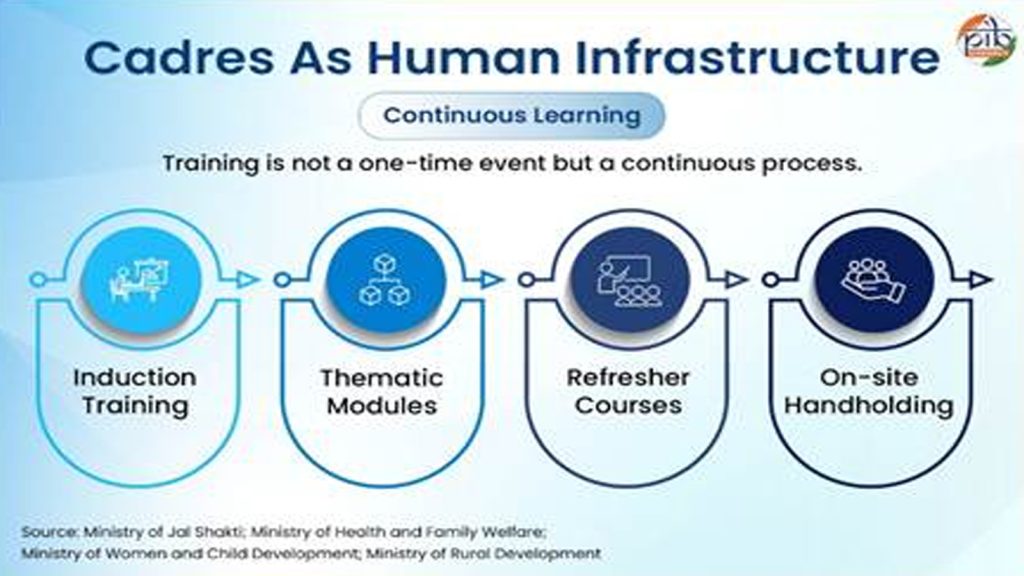
The community cadre model depends on continuous learning rather than one-time training.
Capacity building now combines induction training, thematic modules, refresher courses, field mentoring and on-site handholding.
The National Rural Livelihoods Mission has institutionalised this approach through a diverse cadre ecosystem comprising Krishi Sakhis, Pashu Sakhis, Matsya Sakhis and CRP-EPs.
Training combines classroom instruction with field immersion in agriculture, allied sectors and community mobilisation.
The same principle is reflected across other sectors.
In health and nutrition, ASHAs undergo phased training spread across the year, covering 23 days, supported by field-based tools and regular skill reinforcement.
In sanitation, Swachhagrahis receive training focused on behaviour change and sustained sanitation practices.
In water security, VWSC members and Jal Sakhis are trained in village water planning, water quality monitoring and operation and maintenance of water systems.
In housing, Awaas Mitras receive training to support beneficiary identification, construction monitoring and convergence with other schemes.
Across these sectors, the common institutional framework rests on three elements: continuous capacity building, decentralised knowledge transfer and sustained community presence.
The human network behind last-mile delivery
The expanding community cadre system represents a grassroots layer through which government programmes connect with rural households.
More than 9 lakh CRPs, over 10.40 lakh ASHAs, more than 10.58 lakh trained Anganwadi Workers, Swachhagrahis, Awaas Mitras, water committees and other frontline functionaries collectively operate across different aspects of rural development.
Their roles vary by sector, but the underlying approach remains similar: identify needs, create awareness, build capacity, facilitate access and connect households with institutions.
In livelihoods, they take agricultural and enterprise knowledge to rural households. In finance, they bring banking and financial literacy closer to villages. In healthcare and nutrition, they connect families with frontline services. In sanitation, they promote behaviour change and community waste management. In drinking water, they support local planning and maintenance. In housing, they guide beneficiaries through the construction process.
The community cadre approach therefore places people from rural communities at the centre of last-mile implementation, creating a network that links government programmes with households while strengthening local institutions.
As rural development interventions increasingly converge around the needs of individual households, these frontline workers are positioned at the point where schemes, institutions and communities meet – turning policy and programmes into services, support and opportunities at the village level.


