







India’s rural employment framework has entered a new phase with the rollout of the Viksit Bharat – Guarantee for Rozgar and Ajeevika Mission (Gramin), or VB-G RAM G, which seeks to combine guaranteed wage employment with integrated village development.
The VB-G RAM G Act, 2025, came into force on July 1, 2026, and has since been rolled out across all rural areas of the country. The transition from Mahatma Gandhi NREGA to the new framework has been described as seamless and disruption-free, with digital systems for implementation operational from the beginning.
At the heart of the new framework is a statutory guarantee of 125 days of wage employment in every financial year for every rural household whose adult members volunteer to undertake unskilled manual work.
Unlike an employment framework focused only on generating wage employment, VB-G RAM G links employment with the creation of durable rural assets and broader development priorities. Its four thematic areas are water security, core rural infrastructure, livelihood-related infrastructure, and mitigation of extreme weather events.
From employment to integrated rural development
The framework is aligned with the vision of Viksit Bharat @2047 and adopts a Whole-of-Government approach based on convergence and saturation.
A central feature of this approach is the preparation of Viksit Gram Panchayat Plans (VGPPs). These plans are designed to bring local development needs, existing assets and infrastructure gaps into a single planning framework.
The emphasis is on ensuring that rural development begins at the grassroots level, with Gram Panchayats identifying their requirements and prioritising works according to local needs.
The Gram Sabha and Gram Panchayat play a central role in this process. The Gram Sabha provides recommendations and approval for the plans, enabling villages to determine their development priorities through participatory planning.
How VGPPs are prepared
The VGPP process begins with participatory planning, under which Gram Panchayats identify and prioritise works with the involvement of the Gram Sabha.
This is followed by comprehensive asset mapping. Existing assets, infrastructure and gaps in service delivery within a Gram Panchayat are inventoried. The exercise also takes into account assets created through various Central and State Government schemes and programmes.
Technology is used to strengthen this planning process. GIS, Yuktdhara, PM Gati Shakti and other digital tools provide geospatial and non-spatial information to support evidence-based planning.
The information helps identify infrastructure deficits and development priorities while reducing the possibility of duplication of assets or interventions.
The plans are also designed to promote convergence across government, bringing together resources and interventions from different schemes, departments and stakeholders for integrated village development.
Once prepared at the grassroots level, VGPPs are consolidated at the Block, District, State and National levels. These consolidated plans contribute to the Viksit Bharat National Rural Infrastructure Stack.
The VGPP Framework identifies 318 types of permissible works across the four thematic areas.
Through this process, employment generation is directly connected with asset creation, infrastructure development and the convergence of public interventions.
Significant progress in the first months
The new framework has recorded substantial activity since its implementation on July 1.
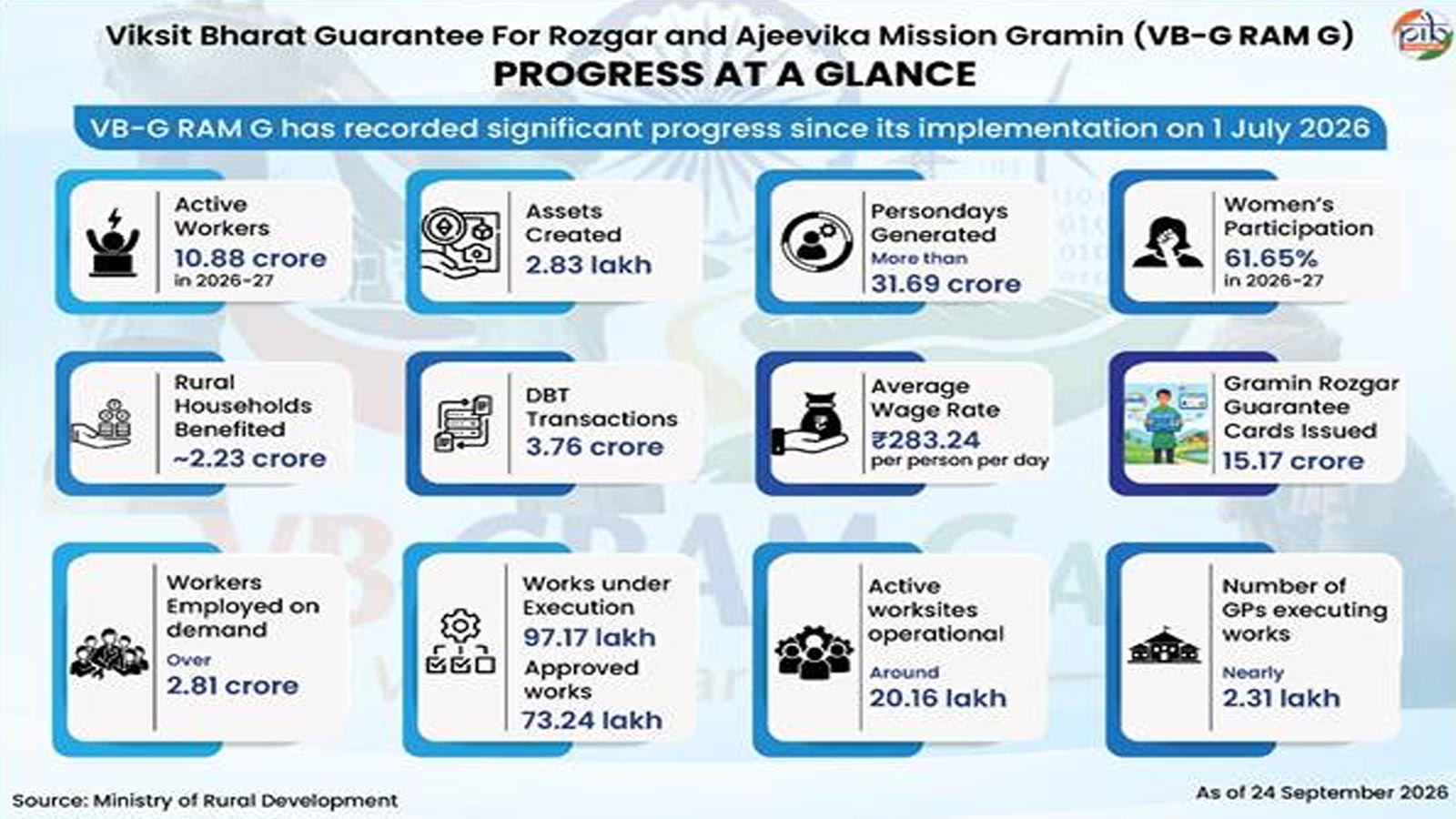
As of September 24, 2026, the number of active workers under VB-G RAM G stood at 10.88 crore in 2026-27. More than 31.69 crore person-days had been generated, while 2.83 lakh assets had been created.
Women accounted for 61.65 per cent of participation during 2026-27, indicating a significant role for women in the rural employment programme.
Employment had been provided on demand to more than 2.81 crore workers belonging to about 2.23 crore rural households.
The scale of ongoing activity is reflected in the number of works under execution, which stood at 97.17 lakh. Another 73.24 lakh approved works were readily available to meet future employment demand.
Around 20.16 lakh worksites were operational, while nearly 2.31 lakh Gram Panchayats were executing works across the country.
The framework had also recorded 3.76 crore Direct Benefit Transfer (DBT) transactions in 2026-27. The average wage rate stood at ₹283.24 per day per person, while 15.17 crore Gramin Rozgar Guarantee Cards had been issued.
₹93,841 crore interim allocation
The financial framework has also been put in place for implementation during the current financial year.
A total of ₹93,841 crore has been allocated to States and Union Territories as an interim allocation for FY 2026-27.
Of this, a Mother Sanction of ₹25,880 crore has been issued as the first instalment to States and UTs.
The financial support forms part of the broader framework for ensuring that employment demand can be met while rural development works are implemented through the new system.
Technology at the centre of transparency
Digital technology forms a major part of VB-G RAM G’s implementation architecture, covering worker verification, attendance, monitoring, payments and transparency.
e-KYC, along with Face Authentication and biometric authentication, is being used for worker verification and attendance. These systems are intended to strengthen transparency, accountability and authenticity.
At the worksite level, geo-tagging, digital measurement, electronic Measurement Books (e-MB) and mobile-based monitoring are being used to track implementation at different stages.
Payments are supported through Direct Benefit Transfer, while spatial technology-enabled planning, real-time dashboards and AI-enabled analytics provide tools for monitoring, reporting and corrective action.
Dedicated digital platforms, citizen engagement platforms and large-scale capacity-building initiatives further support implementation of the framework.
Linking jobs with durable village assets
VB-G RAM G represents an approach in which rural employment, local participation and village development are planned as interconnected components.
Through VGPPs, Gram Panchayats identify local needs, map existing assets and prioritise works. Digital tools provide data for planning, while convergence brings together interventions from different government schemes and departments.
The framework therefore links the statutory employment guarantee with the creation of rural infrastructure and assets. By combining employment, participatory planning, technology and convergence, VB-G RAM G seeks to support resilient livelihoods and integrated rural development from the village level upward.


