







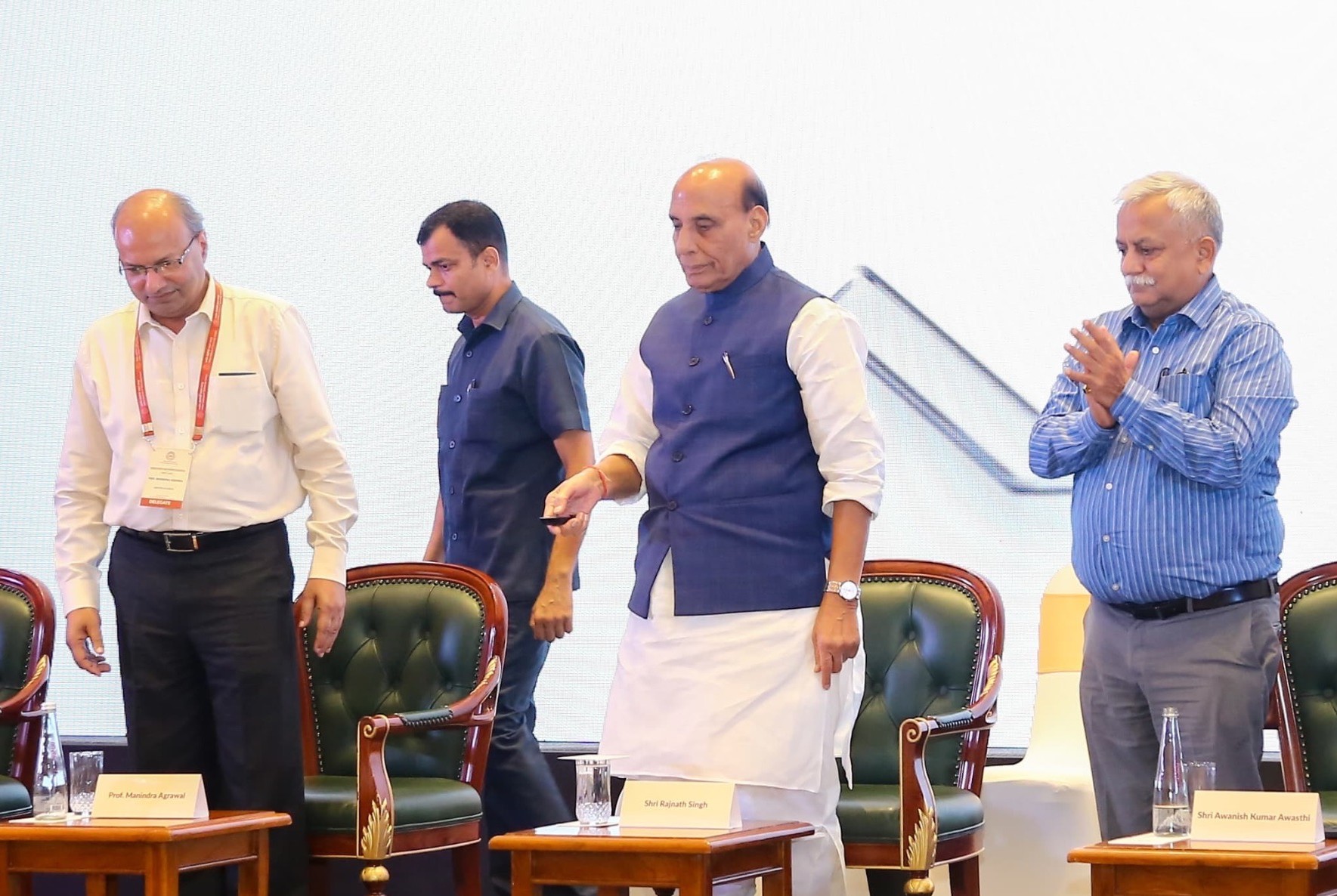
Defence Minister Rajnath Singh on Wednesday said that the proposal to establish a National Military Drone Technology Hub at IIT Kanpur, in collaboration with the Ministry of Defence, has made significant progress, with the approval process nearing completion. The proposed hub aims to fast-track indigenisation and innovation to give India a combat edge.
Speaking at the launch of IIT Kanpur’s ‘Greater Than Us’ fundraising campaign in New Delhi, the Defence Minister emphasised that strengthening indigenous technological capabilities is strategically crucial as artificial intelligence, autonomous systems, unmanned platforms, advanced sensors, cybersecurity and space-based technologies reshape military dynamics, according to a press release by the Ministry of Defence.
Rajnath Singh called for close collaboration among the Defence Forces, the Defence Research and Development Organisation (DRDO), academic institutions, defence public sector undertakings (DPSUs) and private industry, including start-ups, to accelerate the development, adoption and continuous upgradation of indigenous technologies amid the rapidly evolving nature of warfare.
IITs Can Align Research with Operational Requirements of Defence Forces
Rajnath Singh underscored the growing interlinkage between national security and technological capabilities, stressing that IITs can make a significant contribution by aligning academic research with the operational requirements of the Defence Forces and the needs of industry.
“Prime Minister Shri Narendra Modi-led Government’s ‘Aatmanirbhar Bharat’ commitment lies at the centre of its ‘Viksit Bharat’ vision as it aims to create a technologically capable, economically competitive, innovative and confident nation, which is not just a consumer of knowledge & technology but an active contributor to their creation,” he said.
Highlighting the role of higher education and research institutions in realising this vision, Singh noted that the Government has made sustained efforts to strengthen the innovation ecosystem. The growing contribution of this ecosystem to innovation and entrepreneurship is reflected in the IIT network’s support for more than 6,000 start-ups, 56 unicorns and nearly 5,000 patents.
“These achievements demonstrate that IITs are not merely institutions that impart knowledge, but are increasingly becoming engines of innovation, enterprise and technological capability. Institutions such as IIT Kanpur play a significant role in advancing India’s development by expanding scientific capabilities, strengthening the innovation ecosystem and creating solutions that benefit society,” Rajnath Singh said.
IIT Kanpur’s Defence Technology Initiatives
Acknowledging the initiatives undertaken to strengthen indigenous defence capabilities, the Defence Minister highlighted IIT Kanpur’s DRDO-Industry-Academia Centre of Excellence and welcomed the proposal to establish a School of Defence Technologies at the institute.
He expressed confidence that such partnerships would bring scientific talent, institutional expertise and the operational experience of the Defence Forces together to develop indigenous technologies of strategic importance. Credible academic institutions, he said, can play a crucial role in translating research into practical defence applications and addressing the military’s evolving technological requirements.
Research and Innovation to Drive Industrial Growth
Highlighting IIT Kanpur’s role in strengthening Uttar Pradesh’s industrial ecosystem, Singh said the institute could serve as a bridge between scientific research and industrial applications, emerging technologies and enterprise.
He noted that Kanpur’s rich industrial legacy, combined with IIT Kanpur’s technological expertise, could create new opportunities for entrepreneurship, employment, investment and economic growth, contributing to Uttar Pradesh’s vision of becoming a one-trillion-dollar economy.
The Defence Minister also referred to the C3i Cybersecurity Technology Innovation Hub and the institute’s medical school, describing them as significant initiatives in cybersecurity, healthcare and medical technology innovation.
He emphasised that research in emerging fields such as advanced materials, semiconductors, quantum technology and environmental sustainability would be critical to addressing national priorities and developing future technologies.
Rs 1 Lakh Crore RDI Scheme to Boost Private Investment
Stressing the need for sustained investment in research and innovation, Singh referred to the Government’s approval of the Rs 1 lakh crore Research, Development and Innovation (RDI) Scheme to catalyse private-sector investment in research and advanced technologies.
“While public policy can create an enabling environment, institutions must nurture talent and generate ideas, and industry must help translate innovations into practical applications and scale them up,” he said.
‘Greater Than Us’ Campaign Targets $1 Billion by March 2029
Through its ‘Greater Than Us’ campaign, IIT Kanpur aims to raise US$1 billion by March 2029, making it the largest fundraising campaign undertaken by any IIT. Contributions and commitments amounting to Rs 4,155 crore, nearly half of the target, have already been secured from alumni, donors, corporate partners and the Government.
The campaign aims to strengthen the institute’s research infrastructure, nurture talent and accelerate the development and commercialisation of indigenous technologies and innovations in support of India’s vision of becoming a developed nation by 2047.
Rajnath Singh expressed confidence that the campaign would strengthen research capabilities, support advanced facilities, expand opportunities for talented students and help develop solutions to national and global challenges. He called upon the institute’s alumni, industry representatives, philanthropic supporters and institutional partners to contribute through financial support, mentorship, research partnerships and professional networks.
Prof. Manindra Agrawal, Director of IIT Kanpur; Awanish Kumar Awasthi, Advisor to the Chief Minister of Uttar Pradesh; and faculty members, students and alumni of the institute were present on the occasion.
-PIB Inputs


