






In Brief
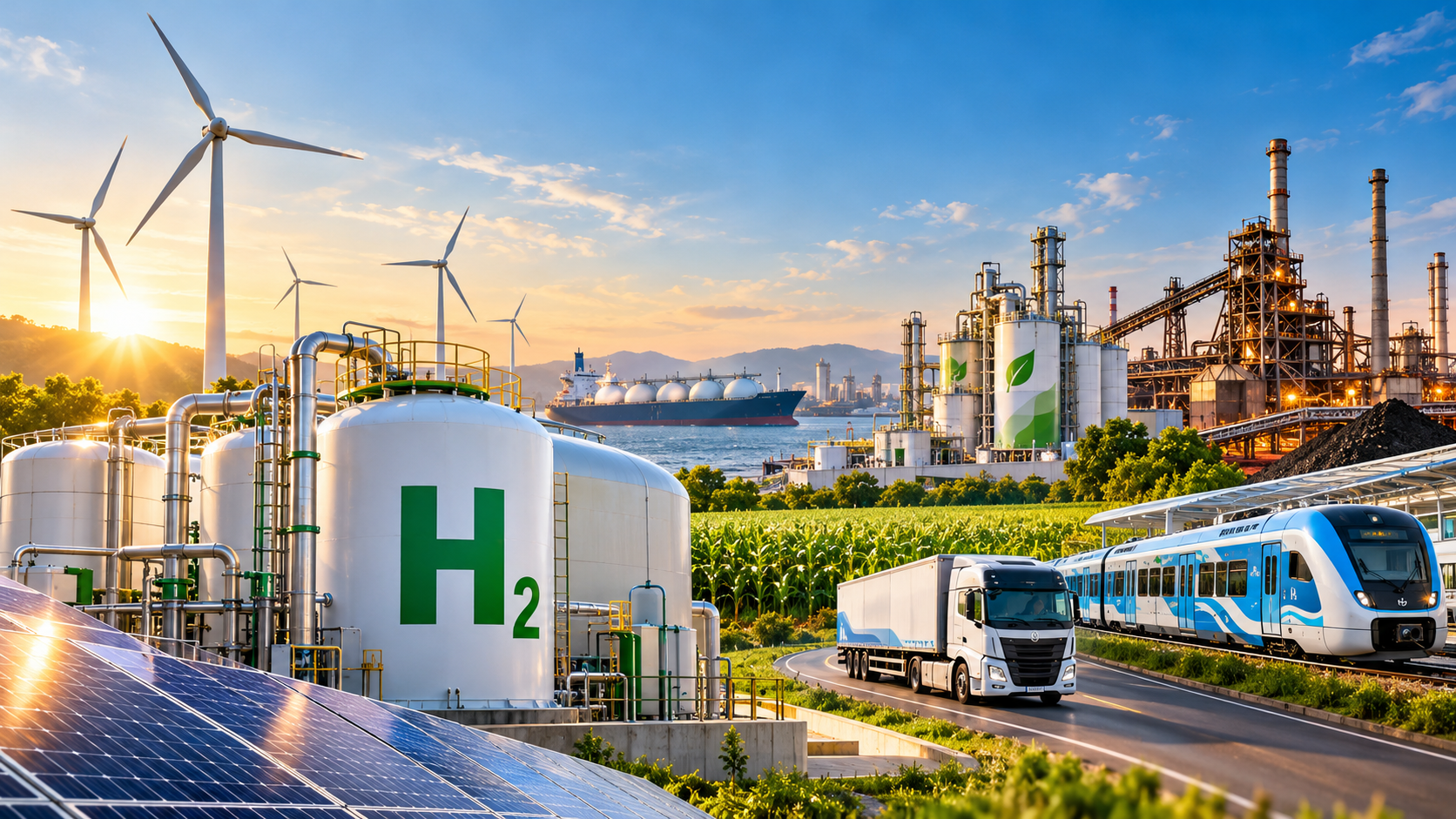
- What is Green Hydrogen? Hydrogen produced by splitting water using renewable electricity, offering a low-emission alternative for industries such as steel, fertilisers, and petroleum refining.
- What is India’s Target? The National Green Hydrogen Mission aims to achieve at least 5 million metric tonnes of annual green hydrogen production capacity by 2030.
- Why Does It Matter? Green hydrogen can strengthen energy security, reduce dependence on fossil fuel imports, create jobs, and support India’s net-zero target by 2070.
Green Hydrogen: A Key Pillar of India’s Clean Energy Transition

India is advancing green hydrogen as an emerging source of clean energy to reduce industrial emissions, strengthen energy security and support its long-term climate goals.
The National Green Hydrogen Mission (NGHM), approved by the Union Cabinet in January 2023 with an outlay of Rs 19,744 crore, seeks to establish India as a global hub for green hydrogen and its derivatives, including green ammonia and green methanol.
The mission aims to develop domestic manufacturing capabilities, expand production, create demand and establish standards that can support the growth of the sector.
What Is Green Hydrogen?
Hydrogen is an energy carrier that can store and deliver energy for various applications. However, its environmental impact depends on the method used to produce it.
Hydrogen produced using fossil fuels can generate significant carbon emissions. Green hydrogen, on the other hand, is produced by splitting water into hydrogen and oxygen using renewable electricity.
When hydrogen is used in a fuel cell, it reacts with oxygen to generate electricity, with water and heat as by-products. Its production using renewable power can substantially reduce emissions compared with conventional fossil-fuel-based methods.
India’s abundant solar and wind resources offer opportunities to produce green hydrogen domestically, reduce reliance on imported fossil fuels and support the country’s goal of achieving net-zero emissions by 2070.
How Is Green Hydrogen Produced?
 Green hydrogen is primarily produced through a process called water electrolysis.
An electrolyser uses electricity to split water into hydrogen and oxygen. When renewable electricity passes through the system, hydrogen is produced at the cathode and oxygen at the anode. The gases are collected separately for further use.
Water must be purified before electrolysis to protect the equipment and maintain its efficiency. According to the Ministry of New and Renewable Energy (MNRE), approximately nine litres of demineralised water are required to produce one kilogram of hydrogen.
The hydrogen is subsequently dried, purified and compressed before being used in industrial processes, transport or other applications.
What Makes Hydrogen “Green”?

Hydrogen itself does not release carbon dioxide when used in a fuel cell, but the emissions associated with its production vary according to the energy source and production process.
In August 2023, India notified its Green Hydrogen Standard. Under the standard, hydrogen qualifies as green if its emissions do not exceed two kilograms of carbon dioxide equivalent per kilogram of hydrogen, measured on a well-to-gate basis and averaged over 12 months.
The standard provides a common benchmark for assessing green hydrogen production. India has also introduced standards for green ammonia and green methanol and launched the Green Hydrogen Certification Scheme of India to support monitoring, verification and certification.
Where Can Green Hydrogen Be Used?
Green hydrogen has significant potential in sectors where reducing emissions is difficult because of high-temperature heat requirements, chemical processes or limited alternatives to fossil fuels.
- Fertilisers: Hydrogen is used to produce ammonia, a key input for nitrogen-based fertilisers. Replacing hydrogen derived from natural gas with green hydrogen can reduce emissions from fertiliser production.
- Petroleum refineries: Refineries use hydrogen to remove sulphur from fuels and upgrade heavier oil into products such as diesel, aviation turbine fuel and naphtha. Green hydrogen can help reduce emissions from these operations.
- Steel manufacturing: Hydrogen can replace coal in certain direct reduced iron processes, offering a lower-emission route to iron production.
- Road and rail transport: Hydrogen fuel cells can power buses, trucks and trains, particularly in applications requiring long operating ranges and quick refuelling.
- Shipping: Green hydrogen can be converted into green ammonia and green methanol, which can serve as alternative marine fuels, subject to safety, infrastructure and engine requirements.
- City gas networks: Hydrogen can be blended with natural gas in limited proportions, subject to safety standards and infrastructure compatibility.
- Exports: India can explore supplying green hydrogen and its derivatives to countries seeking lower-emission fuels, creating opportunities for domestic producers and exporters.


What Is India’s National Green Hydrogen Mission?
The National Green Hydrogen Mission is the government’s central initiative to develop an integrated green hydrogen ecosystem, covering production, manufacturing, infrastructure, research and end-use applications.
The mission targets annual green hydrogen production capacity of at least five million metric tonnes by 2030. With export demand, production could potentially reach 10 million metric tonnes annually.
A key component is the Strategic Interventions for Green Hydrogen Transition (SIGHT) Programme, which has an outlay of Rs 17,490 crore up to 2029–30. It provides incentives for domestic electrolyser manufacturing and green hydrogen production.
According to an official release, incentives have been awarded to 15 companies for electrolyser manufacturing capacity of 3,000 megawatts per annum. Around 8,000 tonnes per annum of green hydrogen production capacity had been commissioned by February 2026, while incentives had been awarded for 8.62 lakh tonnes per annum of production capacity.
What Progress Has Been Made in Pilot Projects?
The mission supports pilot projects to test the use of green hydrogen in sectors such as steel, heavy-duty mobility and shipping before wider commercial deployment.
Five pilot projects have been sanctioned in the steel sector, including support for testing 100 per cent hydrogen injection.
In mobility, 12 projects are set to deploy 70 hydrogen-powered vehicles, comprising 27 buses and 43 trucks. The projects also cover 16 hydrogen refuelling stations across 21 routes.
At V.O. Chidambaranar Port Authority, a pilot project has been awarded to develop bunkering and refuelling facilities for green methanol.
These initiatives are intended to test technologies, identify infrastructure and regulatory gaps, and support the transition from pilot-scale projects to commercial applications.
What Are Green Hydrogen Hubs?
Hydrogen can be difficult to transport, making it important to locate production facilities close to industries and supporting infrastructure.
The mission promotes green hydrogen hubs and Hydrogen Valley Innovation Clusters to bring production, consumption, storage and other infrastructure together.
MNRE has recognised three ports as green hydrogen hubs: Deendayal Port at Kandla in Gujarat, V.O. Chidambaranar Port at Tuticorin in Tamil Nadu, and Paradip Port in Odisha.
An indigenous one-megawatt green hydrogen plant was commissioned at Kandla Port in July 2025. Four Hydrogen Valley Innovation Clusters have also been awarded in Jodhpur, Odisha, Pune and Kerala.
The cluster-based approach is intended to improve project viability, encourage investment and strengthen links between producers and consumers.
How Is the Government Supporting the Sector?
The government has adopted a coordinated approach involving central ministries, state governments, public institutions and industry.
Policy measures include incentives for domestic manufacturing, facilitation of renewable electricity access, improved grid connectivity and exemptions from certain transmission charges for eligible projects.
Green hydrogen and green ammonia plants commissioned by December 31, 2030, are exempt from inter-state transmission system charges for 25 years, according to the release.
The mission also supports research and development, certification, international cooperation and skill development. Its Strategic Hydrogen Innovation Partnership provides a framework for public-private research, with Rs 400 crore allocated for research and development.
As of June 2026, an initial research roadmap worth Rs 113 crore was supporting approved projects in hydrogen production, storage and safety technologies.
What Does Green Hydrogen Mean for India?
Green hydrogen could help India reduce its dependence on imported fossil fuels, strengthen domestic manufacturing and develop new industrial capabilities.
The mission aims to generate more than six lakh jobs across the value chain by 2030. According to the release, 8,149 candidates had been trained and 7,248 certified in hydrogen-related qualifications across 14 States and Union Territories.
The government estimates that the mission could mobilise more than Rs 8 lakh crore in investment and help reduce cumulative fossil fuel imports by approximately Rs 1 lakh crore by 2030. Green hydrogen production and use at the targeted scale could also help avoid nearly 50 million metric tonnes of carbon dioxide emissions annually.
However, wider adoption will depend on making production more affordable, expanding renewable electricity and water infrastructure, developing storage and transport facilities, and creating reliable demand across industries.
What Lies Ahead?
The National Green Hydrogen Mission marks a significant step towards building a cleaner and more self-reliant energy economy.
By combining renewable energy resources, domestic manufacturing, research, infrastructure development and international partnerships, India aims to establish itself as a major producer and exporter of green hydrogen and its derivatives.
-PIB


